Why the Desert Has the Best Light
People who move out here from the coast or from back East almost always say the same thing in their first week: "I can't get over the light." They can't quite name what's different, only that the afternoons feel longer and warmer, that the mountains turn pink at the end of the day, that everything seems to glow from the inside. They are not imagining it. After many years of photographing couples, families, and children all over the Coachella Valley, I have come to believe that the desert has, genuinely, some of the most beautiful natural light in the country — and I want to tell you exactly why, and how to use it.
This is the kind of thing I think about constantly, because finding that one honest, glowing moment is the part of my work I love most. Most of my sessions happen in two places: inside my clients' own homes, where soft natural window light wraps around a family on the couch or a baby by the nursery window, and at the parks, gardens, and shaded patios close to where people live. The wide-open desert is wonderful now and then, but home and a familiar neighborhood park are where people actually relax — and relaxed is where the real pictures come from. So let me walk you through what makes desert light so special, indoors and out, and how you can plan a session — or even just your family snapshots — around it.
What actually makes desert light different
Light isn't only about how bright the sun is. It's about what the air does to that light on the way down to your face. Out here, a few things line up in our favor that simply don't exist in most places.
The air is dry and clean. Humidity is the enemy of clear light. Moisture in the air scatters sunlight, dulls colors, and creates that hazy, milky look you get on a muggy summer afternoon in a wetter climate. The Coachella Valley sits at single-digit humidity for much of the year. That dryness means light travels to you with very little interference — colors stay saturated, shadows stay crisp, and the whole scene feels more vivid. When I photograph someone in Palm Desert in October, the blue of the sky and the warm tone of their skin are both doing more work than they would almost anywhere else.
We have very little pollution or particulate haze. Compared to the Los Angeles basin just a couple of hours west, our skies are remarkably clean most of the year. Cleaner air means truer color and that deep, almost theatrical contrast between a sunlit cheek and a shadowed background.
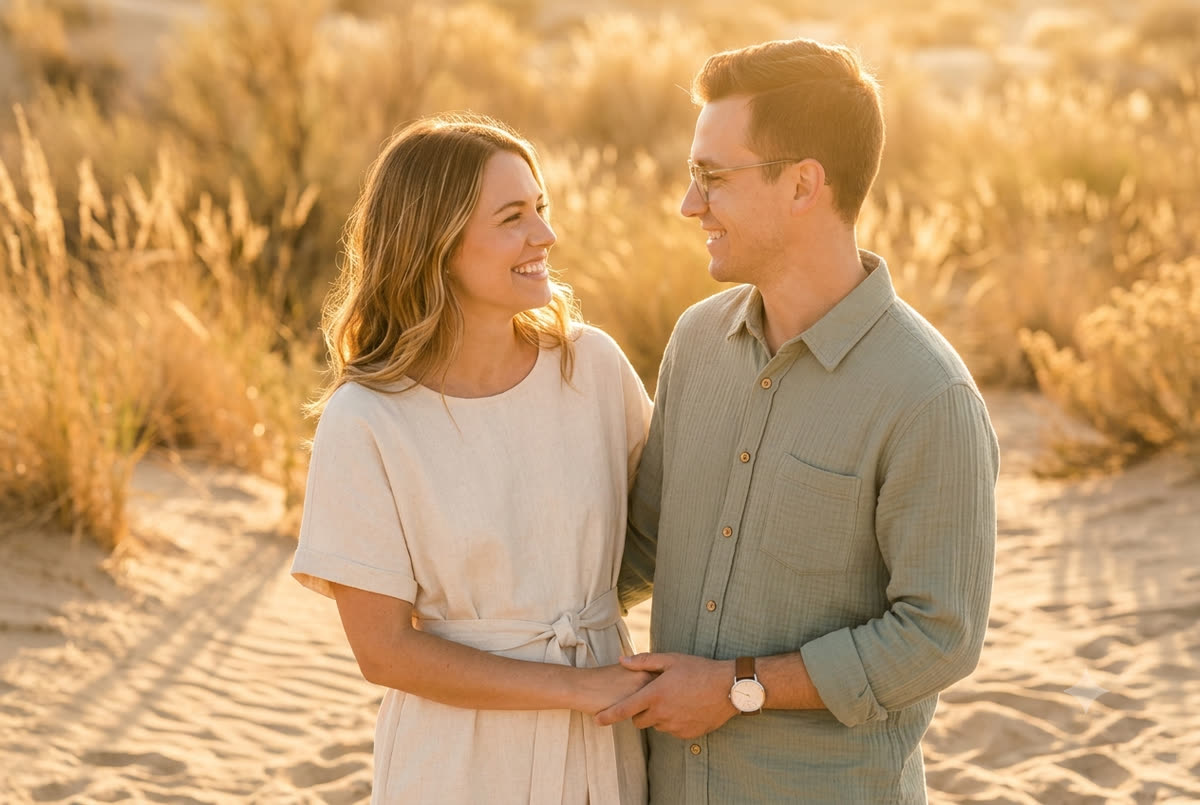
The mountains are giant natural reflectors. This is the part people never expect. The San Jacinto and Santa Rosa Mountains rise straight up out of the valley floor, and their pale rock catches the low sun and throws it back across everything below. At the end of the day, you are not just lit by the sun — you are lit by an entire mountain range glowing warm gold and rose. It's a soft, wrapping light that you cannot buy or fake. It's why "alpenglow" is a real word and why the light on the Palm Springs side of the valley at dusk looks the way it does.
The ground bounces light too. Sand, decomposed granite, light-colored desert soil, the pale stucco and patios of our neighborhoods — all of it acts like a fill card under your chin. In a green, shady forest, light falls from above and leaves eye sockets dark. Out here, the desert floor throws a gentle glow back up into faces, which is enormously flattering. It softens shadows under the eyes and gives skin a healthy warmth without a single piece of equipment.
The sun sits low for a long time. Because we're ringed by mountains, the practical "golden hour" can feel longer than the clock suggests — the sun tucks behind the Santa Rosas and the harsh overhead light gives way to that long, raking glow earlier than you'd think. More on timing below, because this is the single most useful thing to understand.
Golden hour in the desert is the headline act
If you take one thing away, take this: the quality of your photographs is decided more by when you shoot than by almost anything else. The same person, in the same spot, photographed at noon versus an hour before sunset, will look like two different sessions.
Golden hour — roughly the last hour before sunset and the first hour after sunrise — is when the sun is low and its light has to travel through more atmosphere to reach you. That long path filters out the harsh blue and leaves the warm, golden tones behind. The light comes in from the side instead of straight down, which sculpts faces beautifully, adds dimension, and creates those soft rim-lit edges around hair and shoulders that make portraits feel alive.
In the desert, golden hour has a few local quirks worth knowing:
- It shifts dramatically with the seasons. In December, the sun is setting around 4:30 in the afternoon, so golden hour is an early, cozy thing — a wonderful time for family sessions because it lines up with little ones who still nap and melt down by dinner. In June, the sun doesn't set until close to 8:00 PM, which means a late session and a long, lingering glow, but also a long, hot day to get through first.
- The mountains end golden hour early but gently. Because the San Jacintos are so tall and so close, the sun disappears behind them before the official sunset time, especially on the west and Palm Springs side of the valley. That's not a loss — the minutes after the sun drops behind the ridge give you soft, even, shadowless light that is gorgeous for portraits, with the sky and mountains still glowing.
- Sunrise is the desert's best-kept secret. I know, nobody wants to wake up at 5 AM. But a summer sunrise session in La Quinta or out toward Indio gives you that same magic light at a temperature that's actually bearable, with nobody else around. For families willing to do it, the results are worth the early alarm.
If you want to go deeper on planning around this, I've written more in The Best Time of Day for Desert Photos.
How the desert lights a room
Here's something people rarely consider: all of this — the dry air, the clean skies, the light bouncing off pale ground and walls — doesn't stop at your front door. It pours through your windows. A north-facing window in a desert home gives you the softest, most even portrait light imaginable, steady for hours and never harsh. An east- or west-facing window early or late in the day fills a room with a warm, gentle glow. This is the single biggest reason so much of my work is in-home: I can seat a family near a big window, let that soft light do the shaping, and let everyone stay exactly where they're most comfortable — on their own couch, in the baby's room, at the kitchen table. There's no golden-hour scramble against the clock, no heat to fight, no packing the car. Just a familiar room and beautiful natural light. If your house has good windows — and most homes out here do — we may not need to go anywhere at all.
The hours to be careful with
I'd be doing you a disservice if I only talked about the pretty parts. Desert light is spectacular, but it has a difficult middle.
Midday (roughly 11 AM to 3 PM) is the hardest light we get. The sun is directly overhead, which casts harsh shadows straight down — dark hollows under the eyes, a shadow under the nose, squinting because there's nowhere comfortable to look. The contrast is so strong that it's genuinely hard to expose for both bright skin and a bright sky at the same time. This is when most well-meaning phone snapshots go wrong out here, and people assume they did something incorrectly. They didn't. The light did.
The good news is that midday is workable if you understand it. Open shade is your friend — the north side of a building, under a covered patio, beneath one of our big desert trees, or in the shadow of a wall. Shade out here is not dull and gray the way it is in a humid climate, because all that bounced light from the ground and the walls fills it in. A shaded portico in Rancho Mirage at 1 PM can give you soft, even, beautiful light. The trick is staying out of the dappled, spotty light under sparse palm fronds, which throws messy hot spots across faces.
For an honest, full session, though, I will almost always steer you toward the edges of the day. It's simply where the desert shows off.
The seasons change everything
One of the real joys of living and working here is that the light has a yearly rhythm, and it's worth photographing with the calendar in mind.
Snowbird season (November through April)
This is the valley's golden window in every sense. The air is crisp, the heat is gone, the skies are clean, and the light is soft and long. It's no accident that this is when the valley fills up — the weather is close to perfect, and so is the photography. Late afternoons in January and February give you that warm, low, raking light against cool, comfortable air. If you're visiting for the season, or you live here and want family photos while the relatives are in town for the holidays, this is the time I book most heavily, so plan ahead.
Spring (March into May)
If the winter rains cooperated, the desert blooms. Wildflowers come up across the open desert and along the washes, the brittlebush goes yellow, and for a few short weeks the landscape has color it doesn't have the rest of the year. The light is still gentle, the days are getting longer, and the temperatures are lovely. Spring is a lovely time for engagement sessions at the valley's gardens and neighborhood parks, when everything is green and blooming and the evening light is soft.
Summer (June through September)
I won't pretend summer is easy — daytime temperatures regularly clear 110 degrees, and you cannot ask a family with small children to stand in that. But summer light has its own gifts if you respect the heat. Sunrise sessions are genuinely magical and comfortable. Monsoon season brings dramatic skies — towering clouds, distant lightning over the mountains, and the most extraordinary sunsets of the year as the leftover moisture lights up orange and violet. Some of my most striking images come from late-summer evenings right after a storm has cleared.
Fall (October into November)
The heat finally breaks, the season hasn't fully arrived yet, and you get clean air with comfortable evenings. October is quietly one of the best months to photograph here — all the benefits of winter light without the crowds.
Where the light is best in the valley
Light and location work together. Because most of my sessions are at home or close to it, here are the places I come back to, starting with the ones nearest your front door:
- Your own home and backyard patio — the setting I reach for first. Indoors, window light is soft and forgiving; outside, our bounced desert light makes even an ordinary patio glow at the end of the day. Best of all, children are comfortable because they are right where they live.
- Neighborhood parks and the valley's gardens — manicured lawns, palms, shade trees, and water, easy to reach for busy families, with open shade for midday and warm, low light at the edges of the day.
- Lush resort grounds in Rancho Mirage and Indian Wells — green against the warm light, plus plenty of open shade for midday or for families who can't do a sunset slot.
- Mid-century neighborhoods in Palm Springs — clean white walls, bright doors, and pools all act as reflectors and backdrops. The architecture and the light were practically made for each other.
- The higher ground toward the mountains — anywhere you can see the San Jacinto or Santa Rosa ranges catch the last light. The glowing mountain backdrop does half the work for me.
- Open desert and washes near La Quinta and Indio — for the occasional session when someone wants that wide, uncluttered, golden landscape with the Santa Rosas behind them and the desert itself as the story.
If you're weighing the desert against a studio, my honest take is that the natural light out here gives you a warmth and a sense of place that no studio backdrop can match.
Common mistakes I see — and how to avoid them
- Booking the middle of the day to suit a schedule. I understand it's convenient. But the light will not reward it. Give me the edges of the day and I'll give you images you'll treasure.
- Putting the bright sky behind you and the sun in your face. Squinting, harsh shadows, washed-out skin. Far better to put the low sun behind or to the side of you and let it rim your hair while soft bounced light fills your face.
- Underestimating the heat. In summer, even a "quick" session in the sun is risky for kids and grandparents. We work with the heat, not against it — early, late, or in the shade, always with water.
- Forgetting that white and light clothing glows beautifully here. The bounced desert light loves soft, warm, natural tones. Heavy black absorbs all that lovely fill and can feel flat against our landscape.
- Chasing a "perfect" cloudless sky. A few clouds at sunset are a gift — they catch and hold color long after the sun is down. Some of our best evenings are the partly cloudy ones.
What this means for your session
When you work with me, all of this is happening quietly in the background. If we're at your home, I'm reading which windows are doing the best work at that hour; if we're outside, I'm watching the calendar, the sunset time, the direction of the light, and the way the mountains will be glowing on the evening of your session — so that you don't have to think about any of it. My job is to keep the whole thing easy and low-key while the light, through a window or across a lawn at sunset, does what only desert light can do. You just get to be yourselves — your family, your partner, your children being exactly who they are — and I find the moments.
That's really the heart of it. The desert hands us this extraordinary light, free of charge, for an hour at each end of every day. All we have to do is show up at the right time and pay attention. After all these years out here, that still feels like a small miracle to me — whether I'm watching it pour through a living-room window or settle gold over a park at dusk.
If you've been thinking about portraits — for your family, an engagement, your children growing up so fast, or just because the light out here finally made you want to — tell me where you picture yourselves — your own living room, a favorite park down the street, or somewhere out under the open sky. Send me a note through my contact page with a little about what you have in mind, and we'll find the right room or the right hour. The light will take care of the rest.