Backlighting & Sun Flare in Portraits
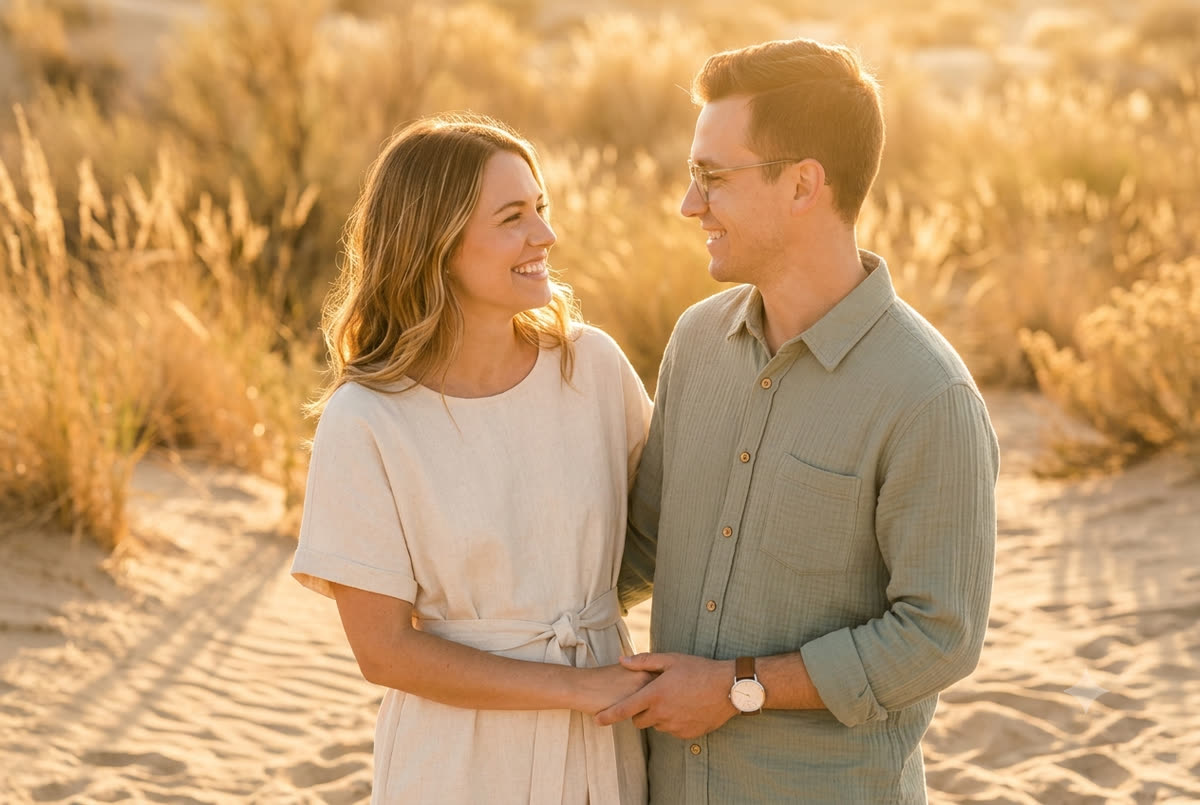
Light that comes from behind a person does something quiet and lovely: it traces the edges in gold and lifts them gently off the background. I see it two ways in the work I do most. Inside a family's home, it is soft window light glowing through a child's hair on the living-room floor. Outdoors at a nearby park or garden, it is the late-day sun rimming a couple in warm haze. Most of my sessions happen right where my clients already feel at ease — in their own homes, and at the gardens, patios, and shaded parks close to where they live across Palm Desert and the wider Coachella Valley. Backlighting is one of the things I love most in both settings, and when people ask how I get that warm, glowing, almost cinematic quality, the honest answer is that I am working with the light, not against it.
I want to walk you through how backlit portrait photography actually works, what it feels like to be on the other side of the camera while it happens, and why our particular corner of California — Palm Desert, Palm Springs, Rancho Mirage, Indian Wells, La Quinta, Indio — gives us such generous light to play with, whether we are beside a big window indoors or out under an evening sky. Whether you are a fellow photographer trying to understand the technique or a client wondering why I keep nudging you to turn a certain way, I hope this gives you a clear, grounded picture of what makes this light so special.
What backlighting actually is
Backlighting simply means the main source of light is behind your subject rather than in front of them. Instead of light shining onto a face — which tends to make people squint outdoors, or go flat and shadowless indoors — the light sits behind the person and the camera looks toward it. The source can be the low evening sun in a park, or a bright window in your living room; the principle is identical.
That single change does a few lovely things at once:
- It creates a rim of light around the hair, shoulders, and edges of the body. This is often called a "halo" or "rim light," and it separates your subject from the background so they almost glow off the frame.
- It softens the face. With the strong light coming from behind, the front of the face is lit by gentle, reflected light bouncing back off the ground, the walls, or the surroundings. No squinting outdoors, no hard shadows.
- It introduces atmosphere. When a little of that backlight spills into the lens, you get sun flare — those warm streaks, hazy washes, and soft golden glows that make an image feel dreamy and alive.
Sun flare is the artistic cousin of backlighting. It happens when light enters the lens at an angle and scatters, creating veils of warmth, gentle haze, and sometimes those little geometric "orbs." Used with intention, flare turns a nice portrait into one that feels like it was lifted out of a sun-soaked daydream. You can find a softer version of the same effect indoors when window light catches the edge of the frame.
Why the desert gives us such good light
I have photographed in a lot of places, but I keep noticing how generous the Coachella Valley is when it comes to light — both the window light pouring into homes here and the long evenings outdoors. A few reasons:
The light is abundant. Our homes tend to have big windows and bright rooms, and the valley's clear skies mean even an indoor session is rarely short on soft, directional light. Pull back a sheer curtain near a window and you have a beautiful backlight source without ever leaving the house.
The horizon is wide open. For outdoor sessions, much of the valley has long, low sightlines — park lawns, garden edges, mountain ridgelines — which means the sun stays usable as it gets low, instead of disappearing behind buildings and trees. That low, raking light is exactly what you want for rim lighting.
The air is clear and the sunsets are long. Our dry desert air gives golden hour a clean, saturated warmth. On the right evening, the light coming off the San Jacinto and Santa Rosa mountains turns everything the color of honey.
The surroundings reflect beautifully. A pale patio, a light-toned wall, a sandy path, garden gravel, the open sky — all of these act like giant natural reflectors, bouncing soft light back onto faces. That is the secret to why backlit portraits do not end up with dark, muddy faces, indoors or out: the environment fills in the front for me.
If you want to read more about timing the outdoor version of all this, I go deeper in my piece on the best time of day for desert photos, which pairs naturally with everything here.
Timing the light, indoors and out
The single biggest factor in beautiful backlit portraits is when we shoot. Outdoors, that means golden hour — the roughly 60 to 90 minutes after sunrise and before sunset — when the sun sits low enough to get behind your subject and stay soft. Indoors, the window matters less rigidly, but a room still has its own best hour, when daylight rakes across the space at an angle instead of glaring straight down.
For outdoor sessions here, timing shifts hard with the seasons, and it matters more than people expect:
- Summer (roughly May through September): Sunset can land close to 8 p.m., and the middle of the day is genuinely hot — often well over 100 degrees. For summer portraits outdoors I almost always book the last hour before sunset, sometimes starting around 6:45 or 7 p.m., so we get that gorgeous low light without anyone wilting. Sunrise sessions are wonderful too; the light is just as lovely and the air is blissfully cool. (This is also exactly when an in-home session shines — climate-controlled, comfortable, and no clock-watching the sun.)
- Cooler months (roughly November through April): The sun sets much earlier — sometimes by 4:30 or 5 p.m. in deep winter. Outdoor light is softer for more of the day and you can often start a little earlier in the afternoon, but the golden window is shorter and evenings cool off quickly, so a wrap or layer is smart.
For outdoor work I keep a close eye on the exact sunset time for our specific date and location, and I build the session around it. Backlight outdoors is a window, not an all-day option, and I would rather protect the most beautiful 45 minutes than rush through them. Indoors, we have far more flexibility, which is part of why in-home sessions are so easy to live around — naps, feeds, and all.
How I work the light during a session
When I turn you so the light is behind you — whether that is the setting sun or a tall living-room window — here is roughly what is happening on my end.
Finding the angle
I rarely put the source directly behind a person's head if I want a clean image — that can wash everything out. Instead I look for the angle where the light kisses one shoulder or skims through the hair, and I often tuck the sun (or the edge of the window) partly behind my subject's body or just outside the frame. By moving a few inches one way or another, I can dial the flare up into a hazy glow or tuck it away for a crisp rim of light. This is why you will see me shuffling around, crouching, and asking you to take one small step left or right. I am hunting for that exact sweet spot.
Exposing for the face, not the background
A backlit scene is tricky because the background is very bright and the front of your subject is comparatively dim. If I let the camera decide, it would expose for all that brightness and turn your face into a silhouette. So I expose for you — for skin — and let the background go bright and glowy. That intentional, slightly-overexposed wash behind you is a feature, not a mistake. It is what gives backlit portraits their airy, luminous feeling.
(Silhouettes, by the way, are the opposite choice — exposing for the bright background and letting the subject go dark on purpose. They are a beautiful tool too, especially against an evening sky, just a different mood.)
Controlling flare on purpose
Flare is wonderful until it is not — too much and the image goes flat and milky with no contrast left in the face. I manage it with a few quiet tricks:
- A lens hood or my own hand just out of frame to block stray light when I want a cleaner shot.
- Partially hiding the source behind my subject, a window frame, a hat brim, a doorway, or the edge of a wall, so only a sliver of light leaks through. That gives the prettiest, most controlled flare.
- Shooting a range — for any given pose I will take some frames with full hazy flare and some with it blocked, so we have both the dreamy version and the punchy version to choose from.
Adding gentle fill
Even with all that natural reflected light, sometimes a face needs a touch more. I will use a reflector, position you near a bright wall or pale patio that bounces light up, or simply turn you a few degrees so the open sky or the room's daylight fills in your eyes. The goal is always the same: keep the magic of the backlight while making sure your face is clear, warm, and well-lit.
What it feels like as the subject
I think this is the part that surprises people most. Backlit sessions are comfortable. Outdoors, because the sun is behind you, you are not squinting into a glare. Indoors, the room stays soft and even, with no overhead light flattening everyone out. You can relax, open your eyes, and actually look at the people you love. Parents stop fussing with the light, kids stop scrunching their faces, and everyone softens.
That ease is a big part of how I work, and good light does half the emotional work for me — when you are not straining against anything, you simply look more like yourself. The honest, warm expressions I am after come much more easily in backlight.
Common mistakes (and how I avoid them)
If you are a photographer learning this, or a curious client who likes to understand the craft, these are the pitfalls I see most often:
- Shooting too early outdoors. High, overhead sun cannot be turned into golden backlight; it is too steep. Wait for the sun to get low. Indoors, the same logic applies to the room — a window throws its best light at an angle, not at noon.
- Letting the face go dark. This comes from trusting the camera's meter. Expose for skin and embrace a bright background.
- Too much flare, every frame. A whole gallery of milky, washed-out images gets tiring. Vary it. Save the heavy flare for a few signature shots.
- Dirty or smudged lenses. A fingerprint or dust on the front of the lens turns lovely flare into ugly streaks and foggy patches. I am compulsive about wiping my glass when shooting toward any bright light.
- Forgetting the background. Because the background goes bright and soft, whatever is back there — a parked car, a cluttered counter, a bright sign — can become a distracting blob. I always check what is behind that glow.
- Fighting the room instead of using it. Indoors, the simplest fix is often just moving everyone closer to the best window rather than reaching for a flash.
Where this light looks especially beautiful around here
A few of the kinds of settings where backlit portraits really sing for the families I photograph:
- Inside your own home, beside a big window or a glass door, where soft daylight pours across the room. This is where I work most — kids on a sunlit bed, a baby in a parent's arms, light glowing through a curtain.
- Local parks and shaded lawns in Palm Desert, Rancho Mirage, Indian Wells, and La Quinta, where open greens and big skies give long, clean evening backlight.
- Gardens and patios, with low sun filtering through leaves, vines, or a trellis and throwing warm light down onto everyone.
- Palm groves and tall date palms, where the low sun rakes through the fronds — a lovely option when families want a more open, scenic feel.
- Mid-century architecture in Palm Springs, where a clean wall or breezeblock screen can catch a warm wash of flare behind you.
The specific spot we choose always depends on your story and the season, but between a bright room and the parks and gardens nearby, the valley will hand us beautiful light if we meet it at the right hour. If you are thinking about wardrobe for that glowy light, my notes on what to wear for a desert photo session walk through colors and fabrics that catch backlight especially well.
A few questions I hear often
Will my face be dark if the light is behind me?No — that is the whole craft of it. I expose for your skin and use the room's or the landscape's natural reflectors (and a reflector of my own when needed) to keep your face bright and warm while the background glows.
Can backlighting really work indoors?Yes, beautifully. A single large window is one of my favorite light sources of all. We simply place you so the daylight comes from behind or to the side, and the same rim-light glow appears, just gentler than full sun.
Isn't shooting into the light bad?Pointed at the sun carelessly, yes. Done with intention — angling, blocking, and exposing properly — shooting toward the light is exactly how we get that luminous, timeless look.
Can we still do this if it is overcast or hazy?Absolutely. We do not get many gray days here, but a thin haze or high clouds just soften the light further, which can be lovely. Backlighting still works; the flare is simply gentler.
The why behind all of it
For me, backlighting is not a trick or a trend. It is the closest I can get to photographing the feeling of a place — the hush of an evening park, or the calm of a Sunday morning at home with light spilling across the floor. What I am really after is the moment a face relaxes and someone looks unmistakably like themselves, and good backlight invites that moment more often than any other tool I have.
If you would love portraits with that warm, glowing, timeless quality — in the comfort of your own home, at a park or garden near you, or out among the palms at the end of the day — I would be glad to make them with you. We will build the session around your family and the best light available, wherever we are. When you have a date in mind, reach out and say hello, and we will plan it together.