Shooting in Harsh Desert Midday Light
Most photographers will tell you to avoid the middle of the day entirely. And I understand why. Out here in the Coachella Valley, noon sun is a force of nature — it sits straight overhead, it bleaches the sky to a pale, cloudless white, and it carves deep shadows under everyone's eyes. For years the conventional wisdom has been simple: shoot at golden hour, go home by ten, and never point a camera at a human face between eleven and four.
But I've been photographing families, couples, and children across Palm Desert and the desert cities for many years, and most of my work happens in two places: inside my clients' own homes, where soft window light does the gentle work for me, and out at the local parks, gardens, and shaded patios we're lucky to have here. Real life, though, doesn't always cooperate with golden hour. A newborn naps on her own schedule. Grandparents fly in for one weekend and want everyone together while the toddler is still smiling. A backyard get-together lands squarely in the middle of a bright afternoon. So I made peace with the desert sun a long time ago, and somewhere along the way I stopped seeing midday as the enemy. Handled with a little intention, that bright overhead light can give you clean, vivid, beautifully alive portraits — and I want to share exactly how I do it.
If you're a photographer working in the desert, or a client wondering whether a midday session can possibly look good, this is everything I know about making harsh light work for you instead of against you.
Why desert midday light is its own animal
Midday light anywhere is difficult, but the Coachella Valley adds a few wrinkles that make it genuinely unique — and worth understanding before you pick up a camera.
The first is the angle. We're far enough south that from late spring through early fall the sun climbs nearly to the top of the sky. At solar noon in June, it's almost directly overhead. That straight-down light is the source of every classic midday problem: raccoon eyes, shadows that pool under the nose and chin, and a top-of-the-head hot spot.
The second is the lack of atmosphere. We have famously clear skies and very low humidity. That's wonderful for stargazing and terrible for softening sunlight — there's no haze, no moisture, almost nothing to diffuse the beam before it hits your subject. The light arrives hard and contrasty in a way it simply doesn't in coastal Los Angeles, where the marine layer does half your diffusion work for free.
The third is reflectivity and heat. Pale sand, light decomposed-granite landscaping, white stucco, and bright pool decks bounce an enormous amount of light back upward. Sometimes that's a gift — natural fill from below. Other times it's just more raw light to manage. And the heat is real: from June through September, midday on the valley floor regularly runs past 110 degrees. That isn't a styling concern, it's a safety and comfort concern, and it shapes how I plan every summer session.
Put those together and you have a light that is bright, hard, directional from above, and unforgiving of mistakes. But it's also clean, saturated, and full of energy — and once you know how to shape it, that's a tremendous starting point.
Find shade, but find the right shade
If I could give a desert photographer a single piece of midday advice, it would be this: stop fighting the open sun and learn to read shade. Shade is where harsh light becomes soft light, and the desert offers more of it than people think — you just have to know what to look for.
Open shade is my workhorse. This is shade with open sky in front of it — the north side of a building, the shadow cast by a tall wall, the covered entry of a hotel. Your subject stands in the shadow, but they're facing out toward bright, open space, so soft, even light wraps onto their face. The key is to turn them toward the light source (the open sky or the bright scene in front of them), not toward the dark wall behind them. I'm constantly nudging people a few feet one way or another to find the edge where the shade is soft but the light still has direction.
Not all shade is equal, though. The shade I avoid is dappled shade — the broken, spotty light under a mesquite or a palo verde tree, or worse, under the fronds of a palm. Those little pinholes of sun scattered across a face are nearly impossible to fix and they look messy. A solid, unbroken shadow edge beats a pretty tree every time.
Some of my favorite midday shade across the valley:
- Covered hotel and resort architecture — the breezeways, loggias, and deep entry porticos at places like the desert's mid-century and Spanish-style resorts give gorgeous, directional open shade.
- Tall block walls and the north faces of buildings in residential neighborhoods, which throw a clean shadow most of the day.
- Palm groves with dense canopy, where the shade is genuinely solid rather than dappled — the historic groves and oasis areas can work beautifully if the cover is thick enough.
- Underpasses, covered patios, and ramadas at parks and venues — unglamorous on their own, but the light is reliably soft.
Once you train your eye to hunt for clean-edged shade, you'll start seeing it everywhere, and midday stops feeling like a countdown clock.
Use the sun as a backlight
When we're outside in open light — say, on a sunny park lawn or an uncovered patio — I almost always put the sun behind my subjects rather than in front. This is the single technique that transforms harsh light into flattering light without a single piece of gear.
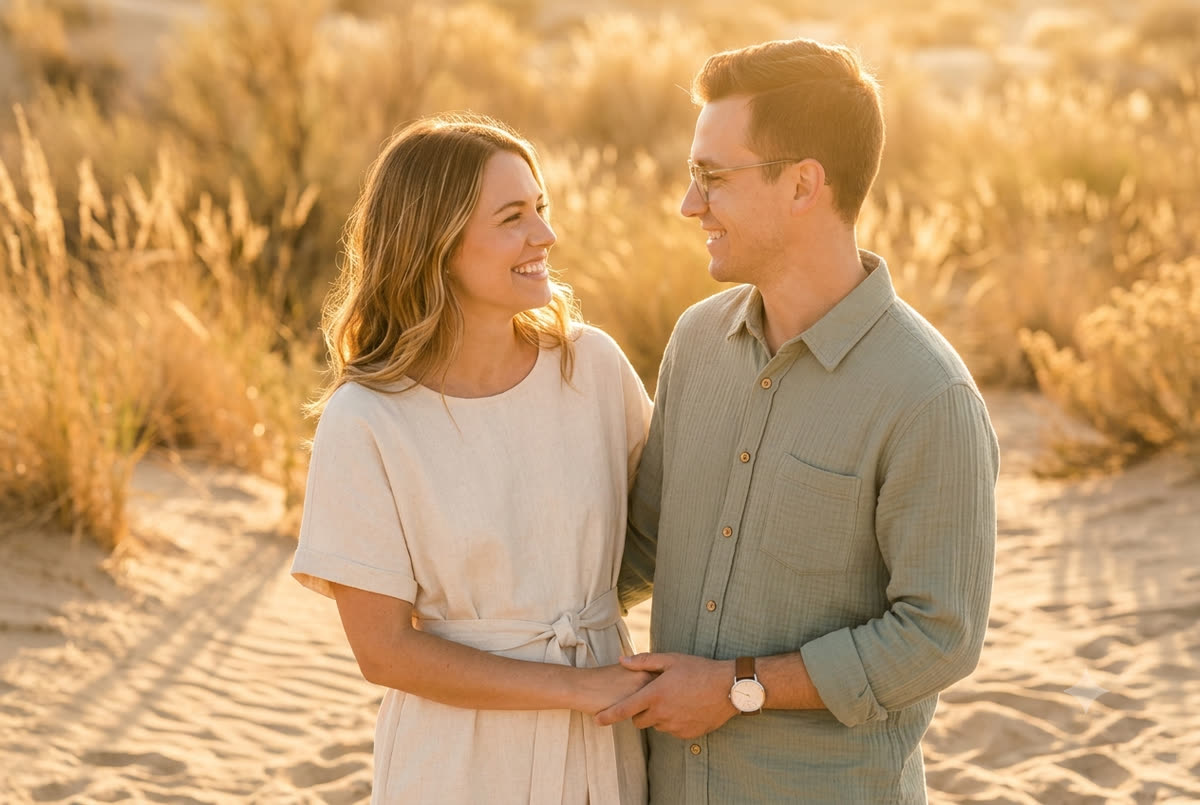
Backlighting means positioning your subject so the sun is at their back, lighting up the edges of their hair and shoulders and leaving their face in their own soft shadow. You lose the squinting, you lose the raccoon eyes, and you gain a luminous rim of light and often a dreamy, glowing background. Even at high noon, if I can get the sun behind a person and then meter for their face, I get a soft, open expression instead of a scrunched, uncomfortable one.
A few things I watch for when backlighting in bright sun:
- Protect the lens from flare unless you want it. A lens hood helps, and I'll often have my own hand or hat just out of frame to shade the front element. A little controlled flare can be lovely; an accidental wash of haze across the whole frame usually isn't.
- Add fill to the front. Backlighting leaves the face darker than the background, so I bring the shadow side back up — with a reflector, a touch of off-camera flash, or simply by placing my subject so a bright surface bounces light back onto them.
- Meter for the skin, not the sky. Expose for the face and let the background go bright. You can recover a surprising amount in editing as long as the skin is exposed correctly.
This approach works beautifully in the settings I use most: a couple backlit against a wall of pink bougainvillea in a garden, a family on a grassy park lawn with the light glowing through everyone's hair, or kids on a bright patio at noon.
Bring fill: reflectors, scrims, and a little flash
Working in harsh light is really a game of managing contrast — the gap between the brightest highlights and the darkest shadows. Three simple tools let me close that gap, and I rarely shoot a midday session without at least one of them.
A reflector is the cheapest, most useful thing you can carry. Held low and angled up, the silver or white side bounces sunlight back into those overhead-shadow eye sockets and instantly opens up a face. The desert gives you natural reflectors too — a white pool deck, a pale wall, a sandy wash — so sometimes I just position people to use what's already there.
A scrim or diffuser is my favorite for the worst of it. It's a translucent panel you hold between the sun and your subject, turning that hard, point-source light into soft, broad light right where you need it. For a tight family grouping or a newborn outdoors, a five-in-one diffuser overhead can take a brutal noon beam and make it look like an overcast afternoon. The catch is you need a second pair of hands to hold it, so I often bring an assistant for summer sessions.
A little off-camera flash or even a video light rounds things out. The goal isn't to blast people — it's to add just enough fill to balance the shadows against that bright desert background. Set thoughtfully, flash at midday is nearly invisible; it just makes everything look effortless.
If you want to go deeper on shaping light without a studio, I've written more in a desert photographer's guide to natural light.
Dress and styling that survive the sun
How my clients show up matters as much as where I put them. Harsh light is hard on certain choices, so I give a little gentle guidance before every bright-light session.
I steer people toward soft, mid-tone colors — warm neutrals, dusty rose, sage, terracotta, muted blues — that echo the desert and don't fight the light. Stark white tends to blow out and glow under noon sun, and pure black swallows detail and reads hot to wear. Mid-tones photograph forgivingly and keep skin tones true.
A few more things I mention:
- Matte over shiny. Glossy fabrics and lots of sheen catch hard highlights. Natural fibers like linen and cotton behave better.
- Hats are your friend — both for the photo and for comfort. A wide brim creates its own flattering shade, and it's a lifesaver in summer.
- Easy on the dewy makeup. A luminous finish that looks gorgeous indoors can read as shine under direct sun. A slightly more matte finish holds up better, and I always suggest blotting papers in a pocket.
- Sunglasses on hand for the walking-between-spots moments, so nobody arrives at the frame already squinting and tense.
Timing, heat, and planning a desert midday session
The most important midday skill in the Coachella Valley isn't a camera technique at all — it's planning around the calendar and the thermometer. The same noon hour is a completely different experience in January than it is in July.
The cooler months (roughly November through April) are when midday is genuinely pleasant here. A noon session in February might be a comfortable seventy-five degrees with bright, clean winter light, and the lower winter sun angle is naturally kinder to faces than the high summer sun. That's when I'm happiest to book a midday session without much hesitation.
Summer (June through September) is a different conversation. Midday on the valley floor can be dangerous, not just uncomfortable, and I won't ask a family with little ones or grandparents to stand in 112-degree sun for an hour. When we shoot in summer, I either chase the early morning and the last hour before sunset, or I move us somewhere the heat is survivable:
- Up the mountain. A short drive up to higher elevation, or a ride up the Palm Springs Aerial Tramway, can drop the temperature twenty or thirty degrees and put us in pine forest instead of desert floor. It's one of my favorite summer escapes.
- Covered and indoor-adjacent spaces. Shaded resort grounds, covered patios, and breezeways let us work in the heat of the day without baking.
- Water. Pool and splash sessions turn the heat into part of the story, especially for kids.
Whatever the season, for summer midday I keep sessions short, bring more water than I think we need, build in shade breaks, and watch everyone — especially children and older relatives — for signs of overheating. No photograph is worth anyone's wellbeing.
If you're weighing when to book, my honest take on scheduling is in the best time of day for desert portraits, and it pairs naturally with everything here.
A quick field checklist for harsh midday light
When I roll up to a bright noon session, this is the short version of what's running through my head:
- Put the sun behind them whenever they're in the open.
- Hunt for clean open shade, and turn faces toward the bright, open side of it.
- Skip the dappled tree light — solid shadow edges only.
- Fill the shadows with a reflector, scrim, or a whisper of flash.
- Expose for the skin and let the background go bright.
- Watch the styling — mid-tones, matte fabrics, hats.
- Mind the heat — short sessions, lots of water, shade breaks in summer.
None of it is complicated, but together it's the difference between a squinty, washed-out snapshot and a portrait that feels warm and alive.
The thing nobody tells you about midday
Here's what I've come to believe after years of doing this: harsh light isn't a flaw to be hidden, it's a character to be worked with. The desert is a place of big, bright, honest light, and there's something true about photographing people in it rather than only in the soft flattery of golden hour. Midday gives you clarity, saturation, and a kind of vivid energy that the gentle light at dusk simply can't. When I get it right, those noon frames don't look like compromises — they look like the desert, which is exactly the point.
So if you've been told to put the camera away between eleven and four, I'd gently push back. Learn the shade, learn the backlight, carry a reflector, respect the heat, and that intimidating overhead sun becomes just another tool in your hands.
If you're thinking about portraits here in the valley — whether it's an easy session in your own living room, an early-morning gathering at a favorite park, or a bright midday shoot done thoughtfully — tell me what you're picturing. You can reach out to me here, and we'll work out the light, the timing, and the place that suits your family. Send me a few details about who I'd be photographing and what you're hoping for, and we'll go from there.