What to Bring to a Bedside Portrait Session
When a family asks me to come photograph someone they love at the bedside — at home in Rancho Mirage, in a hospice room at Eisenhower, in a memory care suite in Palm Desert — what they usually want to know first is something practical: what do we need to do to get ready? And underneath that, almost always, sits a quieter worry: am I going to get this wrong?
You are not going to get this wrong. There is very little you actually have to do, and most of what helps is small. But because these sessions happen at a tender time, and often on short notice, it helps to know ahead of time what is worth gathering and what you can let go of. So this is the list I wish every family had in their hands before I arrive.
Think of it less as a checklist to perform and more as a way to bring a little of the person's real life into the room. The honest details are what make these photographs feel like them years from now.
First, the short version
If you only read one paragraph, read this. Bring whatever makes the room feel like the person, not like a facility. Bring the people who love them. Bring one or two objects that carry a story. Wear what you'd actually wear. Everything else is optional, and I will bring all the gear. You do not need to clean, dress up, or stage anything for me.
Now, the longer version — because the details genuinely help.
The most important thing to bring: the people
A bedside portrait is almost never just one face. The photographs families treasure most, when I look back over the years, are the ones with hands touching, foreheads leaning close, a grown daughter resting her head on her father's shoulder, three generations crowded onto one hospital bed and laughing about it.
So before you think about props or outfits, think about who should be in the room:
- Spouse or partner. Often the quietest, most powerful frames I make are the two of them together, the way they've sat side by side for fifty years.
- Children and grandchildren. Even very young ones. A toddler who doesn't fully understand the day still belongs in the picture, and that contrast — the very new and the very old — is one of the most tender things a family can keep.
- The person's closest friends, if they're nearby. Not everyone has family in the desert; many snowbirds and longtime residents have a chosen family of neighbors and friends who matter just as much.
- Caregivers, when the family feels it's right. The aide or nurse who has been present every day is sometimes part of the story too.
A practical note: you don't all have to be there at once. We can move through the session in small groups so no one feels crowded and so your loved one isn't overwhelmed. If energy is limited, we photograph the most important pairings first.
Objects that carry a story
This is where families sometimes overthink it, so let me make it simple. I am not looking for things that are valuable or pretty. I'm looking for things that are true — objects so tied to the person that, decades from now, a grandchild will point and say, "That was Grandpa's."
A few that have mattered in sessions I've photographed:
- A wedding ring, even if it no longer fits and now lives on a chain or in a small dish on the nightstand.
- A worn Bible, prayer book, rosary, or tallit — whatever the person's faith looks like in their own hands.
- A musical instrument, or even just the calloused fingertips of someone who played for sixty years.
- A quilt or afghan made by them or for them. These photograph beautifully and they make a hospital bed look like home immediately.
- A military cap, service medal, or unit photo for veterans — we have a large community of them here in the valley.
- A garden tool, a paintbrush, a deck of cards, a favorite mug. The ordinary objects are often the most evocative.
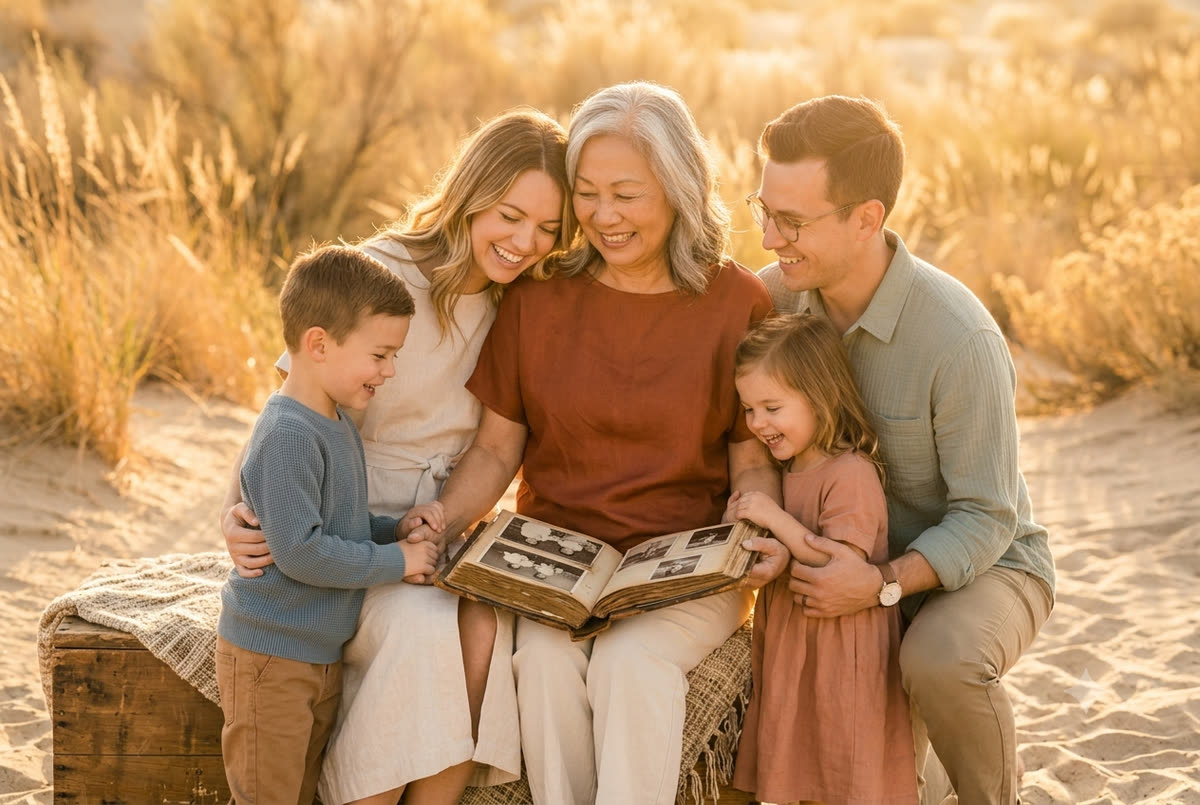
- Photographs of photographs — an old wedding portrait or a picture of them young and laughing, held in their hands now. The years between the two images say something words can't.
You don't need many. Two or three meaningful things are far better than a tableful. If you're not sure, set a few options on the nightstand and we'll choose together when I arrive.
Clothing — keep it honest, keep it comfortable
The single most common mistake I gently steer families away from is dressing the moment up into something it isn't. Please don't feel you need to get your loved one into "real clothes" or buy anything new.
For the person being photographed:
- A favorite robe, soft cardigan, or familiar sweater over a hospital gown reads as home and is easy to manage without moving them much.
- Solid, soft colors photograph more timelessly than busy patterns or large logos, but this is a preference, not a rule.
- If there's a beloved hat, scarf, or piece of jewelry they always wore, bring it. These details are recognizably them.
- Don't worry about hair and makeup being perfect. I'd far rather photograph someone as they truly are right now than a version that doesn't look like them.
For everyone else in the frame, wear what you'd genuinely wear to sit with family. If you'd like a little cohesion, choose a loose palette — soft neutrals, denim, muted tones — and skip the bright graphics and slogans. That's the whole formula.
The comfort items I'd never tell you to leave behind
Medical reality is part of these days, and I work around it without flinching. So bring whatever keeps your loved one comfortable, and don't try to hide any of it for the camera:
- Glasses, hearing aids, dentures — the things that make them most themselves and most present.
- Lip balm and water or ice chips. Rooms here run dry, especially with the air conditioning going for much of the year, and a comfortable, hydrated person photographs warmer.
- A favorite blanket or pillow from home. It softens the bed visually and physically.
- Tissues, for everyone. These sessions hold laughter and tears in the same hour, and that's exactly as it should be.
- Any medication or schedule notes, so we plan the session around their best window of the day rather than the other way around.
I will never ask you to remove oxygen, an IV, or anything that's keeping someone comfortable. If a particular detail bothers you, we can frame around it — but please don't let it stop you from doing this at all.
Things that set the room (you mostly already have these)
You don't need to redecorate. But a few small touches change how a clinical space feels and reads in a photograph:
- A lamp or warm light source. Overhead fluorescents are the least flattering light in any facility. If there's a bedside lamp, we'll use it. I bring my own soft lighting too, so this is a bonus, not a requirement.
- Fresh flowers or a familiar plant, if they're allowed where you are. Some immune-compromised settings restrict them, so check first.
- Cards and notes taped to the wall — leave them up. They're evidence of how loved this person is.
- A window with a view. If the room has one and we can position near it, desert daylight is gentle and kind in the morning hours, before the sun gets high and hard.
A word on timing, since it shapes everything: mornings are usually best. People tend to have more energy earlier in the day, and the light coming into most rooms in Palm Desert, La Quinta, and Indian Wells is at its softest before midday. We'll pick the hour around your loved one's rhythms, not the clock.
What you do NOT need to bring or do
Just as important as the list above. Please cross all of this off your worry list:
- You don't need to clean or tidy the room. The real environment is part of the story. I'll quietly move a tissue box or a water cup if it's in the frame; that's my job, not yours.
- You don't need professional clothes, props, or a "set."
- You don't need to keep everyone composed. Some of my favorite frames come from the moment between the posed ones, when someone cries or someone tells a joke that's been told a hundred times.
- You don't need to prepare your loved one to "perform." If they're sleeping, we can photograph the family around them, the held hands, the watchful tenderness. Those images are no less true.
- You don't need to make decisions while you're grieving. Bring your instincts and a few objects; we'll figure out the rest together in the room.
A few questions families ask me
What if my loved one isn't conscious or responsive?We still make beautiful, meaningful photographs. The story of a bedside session is the love in the room — the hands, the leaning-in, the people keeping watch. Presence matters more than a returned gaze.
What if I start crying, or I'm a mess?Then you're a person who loves someone. I work softly and slowly, I'm in no hurry, and there is no version of this where your emotion ruins the pictures. It's usually the opposite.
Can children be there?Yes, if you'd like them to be. Children often bring an unexpected lightness, and including them gives them a tangible connection to a grandparent or great-grandparent they'll carry for life. Follow their cues; they can come and go as they need.
How much time should we set aside?Plan loosely for an hour, but I let the person's energy lead. Some sessions are twenty focused minutes; some unfold gently over longer. We never push past what's comfortable.
Where do these sessions happen?Wherever your loved one is — a private home, an assisted living or memory care community, a hospice room, or a hospital. I've photographed across the valley, from Palm Springs to Indio, and I'm comfortable coordinating quietly with facility staff so the day is calm for everyone.
If you're reading this and it's urgent
Sometimes families find me with very little time. If that's you right now, don't worry about gathering a single thing on this list — bring yourselves and let me handle the rest. The list is here to help when there's time to plan, not to add one more burden when there isn't.
If it would help to understand the larger picture first, I've written about what a Legacy session looks like and who it's for and about how to talk with your family about portraits before a final goodbye. And if hands and small details are what you most want to remember, the quiet power of photographing a person's hands may be a gentle place to start.
When you're ready
There's no perfect moment to make this call, and most families tell me afterward they only wish they'd done it sooner. If someone you love is in hospice or memory care anywhere in the Coachella Valley, I'd be honored to come sit with your family and make photographs you'll hold onto. You can reach me through my contact page, and we'll talk it through at whatever pace feels right. I'll bring everything else.