The Long Goodbye: Loving Someone With Dementia
People call it the long goodbye, and the first time I heard that phrase I thought it sounded almost gentle. It isn't. It's a goodbye that doesn't end when you want it to and doesn't begin when you're ready. You say it a little at a time, over years — to the way your mother used to laugh at her own jokes, to your husband's habit of reaching for your hand in the car, to the father who knew exactly how you take your coffee. The person is still in the room. You can hold their hand. And you are already missing them.
I'm a portrait photographer here in Palm Desert, and over the years more and more of the families who sit down across from me are living inside this exact ache. They come to me because a diagnosis has made the calendar feel suddenly thin, and they want pictures while there's still time. But the conversations we have in my studio go far beyond which shirt to wear. So I want to write honestly about what it means to love someone whose mind is leaving before their body does — what I've seen, what helps, and how to hold on to a person while you still can.
I am not a clinician. I'm someone who has spent a career paying close attention to faces, and who has sat with a lot of families on the hardest days of their lives. Take what's useful here and leave the rest.
Why It Feels So Different From Other Grief
Most grief has a clear before and after. Someone is here, and then they are not, and the world divides cleanly along that line. Dementia refuses to do that. The losses come in pieces, out of order, and each one is small enough that other people don't always see it as a loss at all.
This is what makes it so lonely. When your wife forgets your anniversary, no one brings a casserole. When your father calls you by his brother's name, no one sends a card. You are mourning, but there's no funeral to mark it, no permission to fall apart, no socially agreed moment when people gather around you and say I'm so sorry. You grieve in the grocery store, in the car, at two in the morning.
Researchers have a name for this — anticipatory grief, the mourning that begins before the death. I've written more about that experience in a quieter kind of mourning that starts before the goodbye, because I think naming it helps. When you can say this is grief, even though they're still alive, you stop wondering what's wrong with you. Nothing is wrong with you. You are responding exactly the way a loving person responds to a slow, repeated loss.
There's a particular guilt that rides along with it, too. You may catch yourself wishing it were over, then hating yourself for the thought. You may feel relief on a good day and a strange resentment on a bad one. You may grieve the person while also feeling worn thin by the work of caring for them. All of this is normal. Love and exhaustion and sorrow can occupy the same heart at the same time. They do, in nearly every family I meet.
The Stages Don't Arrive on Schedule
You'll read about early, middle, and late stages of dementia, and that framework has its uses. But living it is messier than any chart. The disease moves at its own pace — fast some seasons, eerily still for others — and it rarely respects the tidy categories.
What I'd rather tell you is what tends to shift, so you know roughly what's coming:
- Early on, the person usually knows something is wrong. This is its own kind of heartbreak — they are grieving themselves, frightened, sometimes covering for the gaps with humor or irritation. This is the window when they can still tell you their stories, still consent to being photographed, still help decide how they want to be remembered. It is the most precious and the most overlooked window of all.
- In the middle, the ground gets unstable. Memory frays, but so does mood and reasoning. The person you knew flickers — present one hour, unreachable the next. This is often the hardest stretch for caregivers, because the demands are enormous and the rewards are unpredictable.
- Later, language often falls away, and recognition with it. People assume this is when the person is "gone." I don't believe that's the whole truth. The intellect dims, but something else — a response to warmth, to music, to a familiar voice, to touch — frequently remains long after names have vanished.
I say all this not to frighten you but to free you from the idea that you're doing it wrong because it doesn't match the diagram. You aren't. No two of these journeys look alike.
They Are Still in There
If I could press one belief into the hands of every family I meet, it would be this: the person is not their memory.
We are trained to think that who we are lives in our recollections — our history, our facts, our names. But feeling outlasts recall in ways that astonish the families I meet. A parent who can no longer place a daughter's face may still brighten at a hymn from girlhood. Someone who hasn't formed a sentence in months may still reach up to smooth a spouse's hair the way they must have a thousand times. The self runs deeper than the database of facts. Feeling outlasts memory. Tenderness outlasts language.
This changes how you visit. You stop quizzing them — Do you remember when? Do you know who I am? — because those questions only highlight the loss and frighten them. Instead you bring them into the present moment, where they still live:
- Sit close. Hold a hand. Touch is a language that doesn't require memory.
- Bring music from when they were young — for a lot of the snowbirds and longtime desert residents I photograph, that's big band, early rock and roll, Sinatra, the hymns of childhood. Music reaches places words can't.
- Don't correct. If your mother believes it's 1962 and she's waiting for her own mother, you don't have to drag her back to a present that only causes her pain. Step into her world. Ask her what her mother is making for dinner.
- Speak with warmth even when the words don't land. Tone carries when content can't.
This is hard, holy work, and you won't do it perfectly. No one does.
Photographs Become a Different Kind of Lifeline
Here is where my work and this grief intersect, and why I feel so strongly about it.
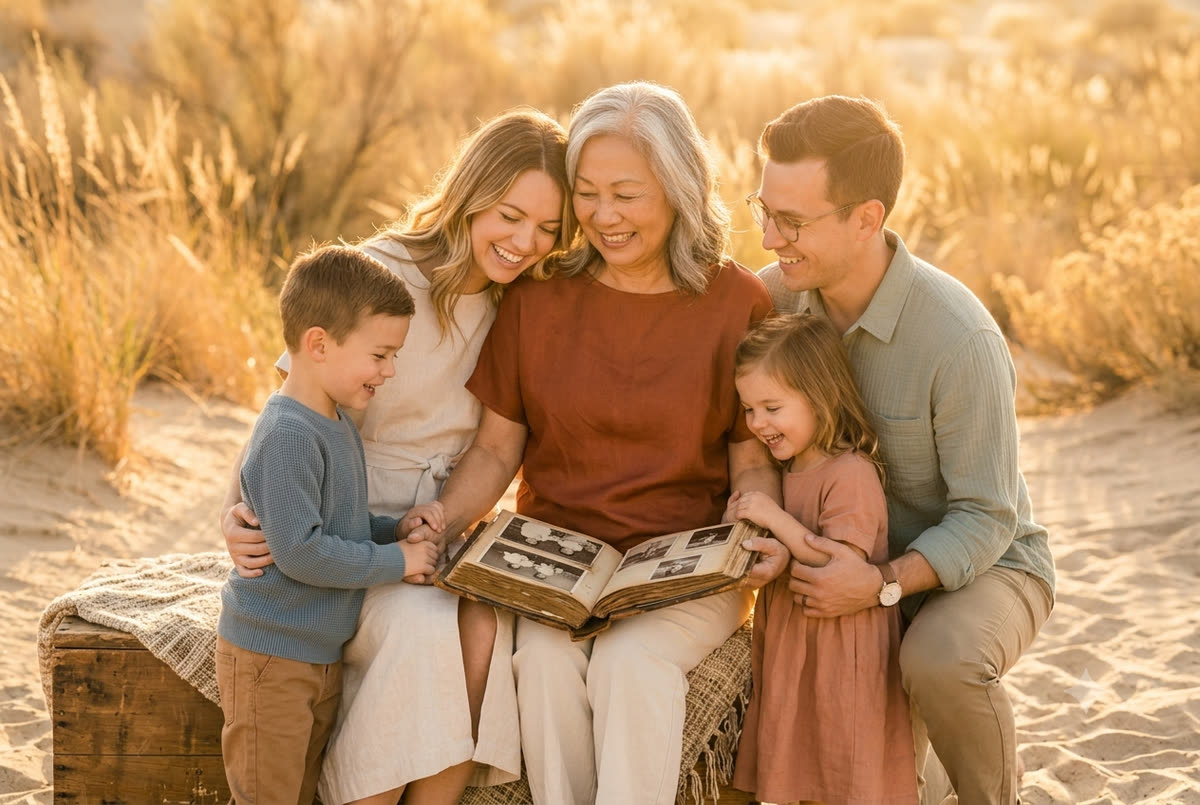
When someone's memory is failing, photographs stop being decoration and become something closer to scaffolding. For the person with dementia, a familiar face in a frame can be a steadying anchor on a frightening day. For the family, images made now — while connection is still possible — become irreplaceable in a way that's hard to grasp until much later.
I'll be honest about something families don't expect. After a loved one dies, the photographs people treasure most are almost never the careful, posed ones. They're the ones that caught a true gesture — the particular way he tilted his head, the exact warmth of her smile, two hands laced together. That's the thing I spend a whole session hunting for, and it matters enormously here, because dementia eventually takes the living version of those gestures away. A good photograph holds the gesture in place.
A few honest things about photographing someone with dementia:
- Sooner is better than perfect. Families wait for a "good week," for weight to come back, for the person to seem more like themselves. I understand the impulse, but the disease doesn't reward waiting. If you're thinking about it, that's the sign to do it now.
- We work on their clock, not mine. I keep these sessions short and flexible. Mornings are often best — many people with dementia experience more confusion and agitation as the day wears on, a pattern caregivers call sundowning. We pick the hour that's kindest to them.
- Comfort over formality. Their own living room in the soft wash of window light, a shaded back patio, a familiar garden — somewhere they feel safe usually produces something far truer than a studio. Most sessions like this happen right where the person lives, which is almost always the kindest option. If a short outing feels good on a given day, the gentle morning light at a place like the gardens at Sunnylands or a quiet corner of a favorite courtyard can work beautifully too.
- The family belongs in the frame. These are not solo portraits, most of the time. They're about the bond — your hand on their shoulder, a forehead resting against a forehead. That connection is what you'll reach for later.
If you'd like to think more about that specific decision, I've written separately about what to know before booking a portrait session when time is short. It walks through the practical side gently.
Caring for Yourself Is Not Optional
I want to talk to the caregiver for a moment, directly, because you are carrying something most people will never fully understand.
The Coachella Valley has a particular shape to this. We are a place people retire to, a place adult children fly into rather than live near, a place where the snowbird rhythm means support networks scatter for half the year. I meet a lot of people doing this alone — a wife caring for a husband in a quiet home in Sun City or Rancho Mirage, an adult daughter who relocated from somewhere colder to manage a parent's care and now feels stranded between two lives. If that's you, please hear this: you cannot pour from an empty cup, and martyrdom helps no one.
Practical footholds I've watched help real families here:
- Use the resources that exist. The Alzheimer's Association has a 24/7 helpline (1-800-272-3900) staffed by people who will simply talk to you at 3 a.m. Locally, organizations across the valley offer caregiver support groups, respite care, and adult day programs — places your loved one can spend a safe, engaged few hours while you breathe. Ask their doctor, or call the helpline, for current local options.
- Accept the help that's offered, and ask for the help that isn't. People want to bring a meal or sit with your mom for an afternoon; let them.
- Tend the relationships that remain. Grief shrinks the world. Keep one or two threads to the outside — a friend, a walk, a standing coffee.
- Find a way to mourn the losses as they come. Some people journal. Some talk to a counselor who understands dementia specifically. Some make something — and yes, sometimes that something is a set of photographs to hold onto.
You are allowed to have a life alongside this. Protecting it isn't a betrayal. It's how you last.
When You Don't Recognize the Person You Love
There may come a day — there often does — when the person looks at you with no recognition. A husband who asks his wife of fifty years who she is. A mother who is kind and curious toward her own son, the way you'd be toward a pleasant stranger.
I won't pretend this doesn't break something in you. It does. But I'll offer the thing that has helped the families I've sat with most: recognition is not the same as love. They may not know your name, but they can still feel safe with you. They can still soften when you walk in. The relationship hasn't ended — it has changed its language. You are still showing up. They are still being loved. On the days when none of it feels like enough, showing up is the whole of it.
And on the visits that go badly — the ones where they're agitated, or don't want you there, or it all just hurts — give yourself grace and come back another day. You are not failing them. You are loving someone through the hardest possible circumstances.
A Few Questions Families Ask Me
Should I tell them the truth about their diagnosis, or about other losses?Early on, honesty usually helps; they often already know and want to talk about it. Later, the calculus changes. Telling someone with advanced dementia that their spouse died years ago can make them relive the grief as if it's fresh, again and again. Compassion sometimes means meeting them where they are rather than insisting on facts. There's no universal rule — follow what reduces their suffering.
Is it worth photographing them if they won't remember the session?Yes — and I'd gently turn it around. The session isn't only for their memory. It's for yours, and for everyone who loves them, and for the children who will want to know this person someday. The experience of being treated with care and attention is also good for them in that moment, even if the moment doesn't stick.
How do I handle the holidays and family gatherings?Lower the bar and keep it short. Big, loud rooms overwhelm. A brief, calm visit at a good hour beats a long, chaotic day. And take the picture early, before everyone is tired.
When is it "too late" for portraits?Almost never, in the sense that connection of some kind usually remains. But it does get harder, and the window for the person to participate as themselves closes earlier than families expect. If the question is in your mind, the answer is now.
What I Want You to Carry
Loving someone through dementia is one of the most quietly heroic things a person can do. It asks you to keep loving someone who can no longer love you back in the old, familiar currency. It asks you to grieve in slow motion, in public, often alone. And it asks you to find the person inside the disease, again and again, on faith.
You will not do it flawlessly. Be as gentle with yourself as you are with them.
When the long goodbye finally ends, what you'll have left is what you gathered along the way — the moments you stayed present for, the visits you made when it was hard, and the handful of images that held a face you'll want to see again. I've also written about putting together a life's photographs into something that lasts, for when you reach the season of gathering it all together.
If you're somewhere in the middle of this and thinking about making portraits while your person is still here to be in them, I would be honored to help. We'd start with a conversation — what your family is carrying, what your loved one can manage on a given day, and whether home is the easiest place or a familiar garden close by. You can reach out to me here whenever the timing feels right, even if it's only to ask a question. Whatever you decide, I hope you find some peace in the days you have. They are worth holding onto.