Supporting a Spouse Through Terminal Illness
No one teaches you how to do this. One day you are two people building an ordinary life in the desert — Sunday breakfast at a place you've gone to for years, errands in Palm Desert, plans for next winter when the kids visit — and then a doctor says a word, and the floor of your life quietly drops a few inches. Everything looks the same. Nothing is.
I want to talk plainly here, because in my years photographing families across the Coachella Valley I have sat with a number of couples in exactly this season, and I have learned that the people living it are usually starved for honesty. Not pep talks. Not "everything happens for a reason." Just someone who will say: yes, this is as hard as it feels, and here is what other people have found helps.
If you are caring for a husband, wife, or partner who is dying, this is for you.
You are doing two impossible jobs at once
The first thing worth naming is that you are not just losing your spouse — you are also, right now, their caregiver, advocate, scheduler, and often their main source of courage. Those are two full-time roles, and they pull in opposite directions. The caregiver in you wants to manage, fix, research, and stay strong. The spouse in you wants to fall apart in their arms like you always have.
You cannot fully do both at the same time, and trying to is what burns people out. Giving yourself permission to be the spouse sometimes — to cry, to be scared, to not have a plan — is not a failure of caregiving. It is often the most honest gift you can offer the person you love. They do not need a flawless nurse. They need you.
The early weeks: getting your footing
The stretch right after a terminal diagnosis is its own kind of chaos. Appointments stack up. Everyone has an opinion. You are making decisions while in shock. A few things that genuinely steady people:
- Bring a second set of ears to appointments. Grief and fear shrink your hearing. Take a trusted friend or adult child to oncology visits at Eisenhower Health in Rancho Mirage, Desert Regional in Palm Springs, or wherever your care lives, and let them take notes while you simply be present with your spouse.
- Start one notebook. One place for medications, questions, doctors' names, passwords, insurance numbers. The mental load of holding all of it in your head is enormous and unnecessary.
- Ask "what does a good day look like for you?" early. Before the harder days come, understand what your spouse actually wants this time to be about. Some people want to keep working or driving as long as possible. Some want quiet. You cannot honor their wishes if you never asked.
- Don't make every big decision at once. You do not have to solve the whole road today. Decide what's in front of you this week.
Talking honestly when it's terrifying to talk at all
The cruelest thing about anticipatory grief — the grief that arrives before the loss — is how it can make two people who love each other go silent to protect one another. You don't want to scare them. They don't want to burden you. So you both perform okayness, and the loneliness of that performance can be worse than the truth.
You do not have to force big conversations. But you can leave doors open:
- Try, gently, "Is there anything you've been wanting to say to me that's hard to say?"
- Or, "What are you most afraid of?" — and then just listen, without rushing to fix it.
- It's also fine to say, "I don't know how to do this either. But I'm not going anywhere."
Many people find that the conversations they dreaded most became the ones they were later most grateful for. Saying the real things — gratitude, apologies, what someone meant to you — while both of you are present to hear it is one of the few things in this season that has no downside.
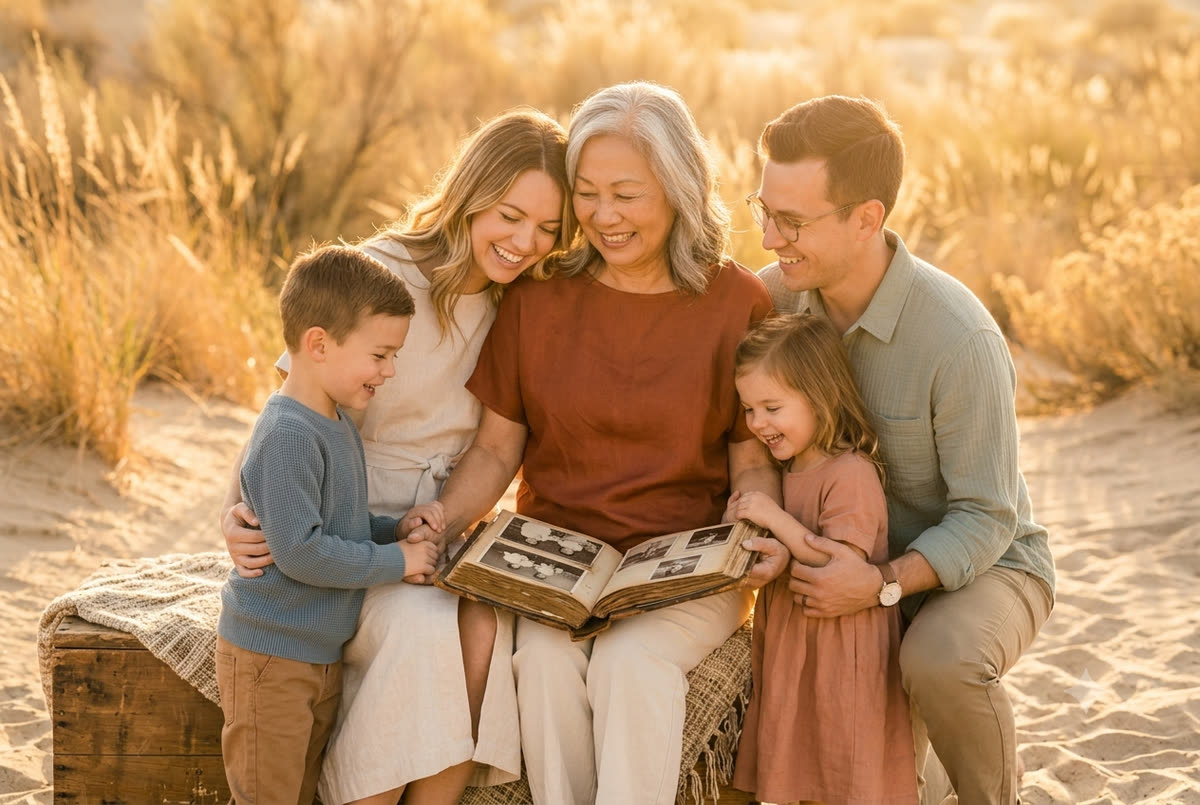
If words are too hard, there are other languages. Holding hands. A playlist of the songs from your wedding. Looking through old photographs together. I'll come back to that.
The practical scaffolding that takes weight off your shoulders
Love does not pay the pharmacy or fill out the forms. Some of the most loving work in this season is unglamorous logistics, and getting help with it frees you to be present for the things that matter.
Bring in palliative care sooner than you think
There is a persistent myth that hospice or palliative care means "giving up." It does not. Palliative care is simply expert help with comfort, pain, and quality of life, and it can run alongside treatment. In the valley, hospice and palliative services — including the longtime nonprofit hospices that serve Palm Desert, Palm Springs, La Quinta, Indio, and the surrounding communities — exist to make this road more bearable for both of you. Again and again, families come away wishing only that they had reached out sooner. The earlier they're involved, the more support you have and the fewer crises you face alone.
Let people help — and give them specifics
People genuinely want to help, but "let me know if you need anything" puts the work back on you. Keep a short list on the fridge and hand out real tasks: pick up a prescription in Palm Desert, sit with my husband Thursday so I can sleep, drop off dinner, walk the dog, take my wife to her hair appointment so she feels like herself.
A free shared calendar or a meal-sign-up site lets your circle organize themselves without funneling every text through you.
Handle the paperwork while you can do it together
I know it feels morbid, but couples who sort this early consistently say it gave them more peace, not less — because it cleared space to just be together later. Advance directives, a POLST form, wills and trusts, beneficiary designations, account access, passwords, and the contacts for the funeral home or cremation service. Doing it together also means your spouse's wishes are truly theirs and not a guess you'll have to make alone, exhausted, later.
Protect your own body
Caregiver health is not a luxury. In the desert specifically: in snowbird season, November through April, you may have far-flung family and friends nearby to lean on — use them. In the brutal summer heat, when much of your support network has left town and a sick body is more fragile, line up help in advance and keep cool, quiet routines. You cannot pour from an empty cup, and a caregiver who collapses helps no one.
What to actually say (and what to stop saying to yourself)
People will say clumsy things. You will too, to yourself. A few reframes that help:
- You do not have to "stay positive." Forced cheer is exhausting and it isolates your spouse, who can feel when you're performing. Honesty is kinder than optimism.
- You will lose your patience. You will snap over something small after a sleepless night. That does not erase your love. Apologize, forgive yourself, keep going.
- You are allowed to grieve while they're still here. Anticipatory grief is real grief. Mourning the future you won't have, even while you cherish the present, is not betrayal — it's love measuring what it stands to lose.
- You cannot do this perfectly, and "perfectly" was never the assignment.
Making meaning in the time you have
Once the practical scaffolding is in place, what's left is the part that actually matters: the time itself. You don't need a bucket list of grand gestures. Mostly it's ordinary days, made a little more deliberate.
Some couples find quiet meaning in returning to small places that hold their story — a slow morning at a favorite spot, a drive out toward the Indian Wells and La Quinta foothills when the light goes soft in the late afternoon, sitting on the patio in the cooler months just watching the mountains change color. The desert is good at this. It is patient, it is beautiful, and it asks nothing of you.
Other people want to put things into words and objects that will outlast the illness:
- Writing letters — to each other, to children and grandchildren, to be opened later.
- Recording your spouse's voice telling a story, sharing a recipe, or saying the things they want remembered.
- Gathering the family, even briefly, so the people who love them can say what they feel out loud.
On photographs — gently, and only if it's right for you
This is my work, so I'll speak to it honestly, and then I'll get out of the way.
When someone is dying, photographs change meaning. They stop being about looking good and become about being together — the proof that you were here, side by side, that this love was real and ordinary and yours. A picture of two hands. The way your spouse looks at you when they think no one's watching. A quiet hour on the patio. These are the images families hold onto for the rest of their lives, and I have never once heard someone say they regretted having them.
I approach this kind of session very differently from a normal portrait sitting. Most often it happens right where you live — in your own living room in the soft natural light from the windows, on a shaded patio, or in a nearby park or garden if your spouse is up for a short outing. It works around energy and good days, on your terms, quietly and without fuss. The goal is simply to capture the truth of you two while you are still you two. If you'd like to understand more about how that works and how to find the right window of time, I've written about planning a legacy session during a serious illness and about how anticipatory grief shapes these portraits. And if you are caring for an aging parent rather than a spouse, you may find documenting a parent's final chapter closer to your situation.
If photographs aren't part of what you want right now, that is completely okay. The right answer is whatever lets you breathe.
A few hard-won reminders
- Sleep is medicine. Trade nights with someone if you can.
- Keep one thing in your week that is only yours — a walk, a friend, a quiet coffee.
- Write down the funny and tender moments as they happen; you will not remember them as clearly as you think you will.
- Tell your spouse the specific things you love, not just "I love you" — the way they make coffee, how they've raised your kids, the sound of their laugh.
- Forgive the imperfect days. There will be many. They are still good days.
You will not regret being present
When this season ends, you will not wish you'd answered more emails or kept a tidier house. You will be glad for every hour you simply stayed. The world will tell you to be strong; I'd rather tell you to be present, which is harder and matters more. Strength is just love that decided to stay in the room.
You are doing one of the hardest, most loving things a person can do. Please be as gentle with yourself as you are being with them.
If quietly capturing this chapter of your life together is something you'd ever want to talk through, I'd be glad to. You can reach out whenever the moment feels right, and we'll figure out the rest from there. And if it isn't the right time, I hope this page itself was a small comfort. You are not doing this wrong.