Snowbird-Season Family Reunions in the Desert
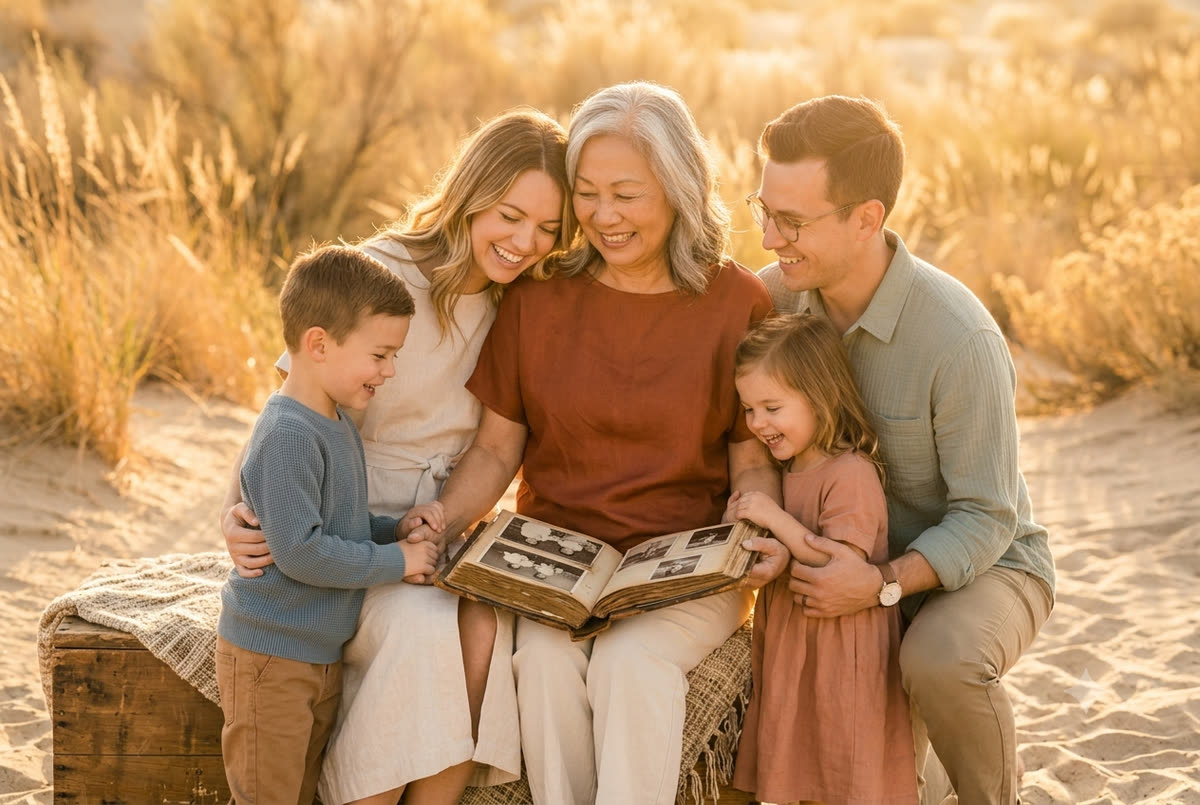
Most years, the desert quietly fills back up around the holidays. Flights land, casitas get aired out, and by January the grocery stores are busy again and the golf courses are full. For a lot of families, this stretch from late fall into spring is the one window of the whole year when everyone is actually in the same place — the parents who winter here, the adult kids flying in from Minnesota or Vancouver, the grandchildren on school break. That is exactly why so many of the family reunion sessions on my calendar happen between November and April. When the whole family is finally under one roof, or at least in one valley, a portrait stops being a someday idea and becomes something you can actually do this week.
I have photographed a lot of these gatherings over the years, and I want to give you the honest, practical version of how to make one happen well. Not the glossy version — the real one, with the travel schedules and the toddler naps and the uncle who arrives an hour late. If you are searching for a family reunion photographer in the Coachella Valley, this is the guide I wish I could hand you before we ever talk.
Why snowbird season is the right time to do this
There is a reason I gently push families toward the cooler months rather than fitting a session into a quick summer visit.
- Everyone is already here. Snowbird season is when the seasonal residents are settled in and the visiting relatives come to them. You are not asking people to make a special trip for photos — the photos simply join a gathering that was happening anyway. That alone removes the biggest obstacle to a multigenerational portrait.
- The light is kind from roughly mid-November through April. The low winter sun gives long, soft golden hours and comfortable temperatures, usually in the 70s by day. We are not racing a 110-degree afternoon or starting at 5:30 a.m. to beat the heat the way we would in July.
- The desert looks its best. Wildflowers come later in spring, the mountains often carry snow on the high peaks, and the whole valley feels alive rather than scorched. It is a beautiful backdrop and a comfortable one at the same time.
- It marks the occasion. Reunions during this season often line up with a milestone — a big anniversary, a significant birthday, a first holiday with a new baby, or sadly sometimes a last season with someone we love. A portrait gives that gathering a center of gravity.
The trade-off is simple: this is my busiest stretch of the year, and it is everyone else's too. The families who get the date and the light they want are the ones who reach out early — often weeks before they even arrive in town. More on that below.
Start with the date, before anything else
For a reunion, the calendar is the hardest puzzle, not the photography. When I work with a family, the very first thing we pin down is a single hour that the whole group can protect.
That sounds obvious, but with a large family it rarely is. Someone's flight lands midday Thursday. The teenagers have a tournament Saturday morning. Grandpa fades by late afternoon. The little ones nap from one to three. My job early on is to help you find the one hour that threads all of those needles — bright midday for the soft window light indoors, or the last hour before sunset if we are out on the patio or in a park — and to be honest if the dates you are floating are going to fight us.
A few things I have learned to ask for up front:
- The arrival and departure days of every household, so we schedule inside the window when everyone is genuinely in town and not exhausted or already packing.
- The youngest child's nap and meltdown windows. With babies and toddlers, we plan the session around them, not the other way around.
- Anyone with limited stamina or mobility. If an older relative tires easily, we keep things close to the car and short, and we photograph them first while they are fresh.
Once we have a date and an hour, everything else — location, wardrobe, the shot list in my head — falls into place around it.
Where to photograph a reunion in the Coachella Valley
For a reunion, location is partly about beauty and mostly about logistics. You are moving a lot of people, sometimes across three or four generations, and the right setting makes that effortless instead of stressful. Here is how I think about the main options.
The home, casita, or resort where everyone is staying
This is where most of my reunion work actually happens, and the choice families underestimate the most. If you have all rented a house in La Quinta or taken a block of rooms at a Rancho Mirage resort, that is where the real gathering is already living. The patio where you eat breakfast, the pool the cousins won't get out of, the kitchen island where the meal comes together — those places carry the memory of the trip in a way no scenic overlook can. Indoors, I work with the natural light coming through the windows and big glass doors, which the valley's homes have in abundance; it falls soft and flattering across a room and asks nothing of anyone. Outside on the patio or in the garden, we simply lean into the early-evening light when it turns warm and low.
Photographing where you stay also solves nearly every logistical problem at once: no caravan of cars, no parking, bathrooms and shade and a place for the baby to nap are all right there, and a relative who tires can step inside and come back out. If you are renting, a quick word with the property about photos on the grounds is all it takes. I wrote more about why these in-between, everyday settings matter in my piece on capturing everyday family moments.
A nearby park or garden
When a family would rather be out in the open, my next stop is almost always a local park or public garden — not the far-off backcountry. These spots give a big group room to spread across different levels, with firm footing, parking close by, shade, and restrooms a short walk away. For a group with young children and grandparents both, that easy access is what separates a beautiful idea from a beautiful evening. We time these for the last hour before sunset, when the golden-hour light wraps around everyone at once.
A few I return to again and again: Civic Center Park in Palm Desert, which is hard to beat for soft green instead of desert tones — big shade trees, open grass, a lake, easy parking, and room for the kids to run between frames. The manicured grounds at the larger resorts, too — mature palms, fountains, tiled courtyards, lawns — make a polished, classic backdrop with everything you need close at hand. Parks and gardens are forgiving for sessions with babies and toddlers because a snack break or a play break is never far away.
If you want the unmistakable desert look
Some families do want a frame that could only be here — warm light, the Santa Rosa and San Jacinto mountains, an open sky behind every face. You do not have to drive deep into the backcountry for it. The accessible desert-view edges and washes around Palm Desert, Indian Wells, and Bermuda Dunes can give you that horizon while still keeping the cars, the shade, and the grandparents close. I will tell you honestly whether a spot you have in mind will be comfortable for the whole group before we commit to it. If you are weighing settings for a large group specifically, I go deeper in my guide to the best locations for big family sessions.
Working with a big, multigenerational group
A reunion session is its own kind of choreography, and after many years of it I have a rhythm that keeps the whole thing relaxed.
I photograph in an order that respects people's energy. We usually start with the full group while everyone is fresh and dressed and before a single child has found the dirt. Then I break it down — each individual family unit, the grandparents with all the grandchildren, the siblings together, the four-generation line if you are lucky enough to have one. By the time we reach the loose, candid moments, everyone has loosened up and the formal pictures are already safely captured.
I keep the posing alive, not stiff. With twenty people I am not building a wax museum. I stagger heights and depths so it reads as intentional, then I get people talking and teasing each other so the real expressions surface. The frame I am always hunting for in a reunion is the one where the family forgets I am there — the grandmother laughing at something only her sister would say, the toddler reaching up for whoever is closest. That is the picture you will frame.
I plan for the unplanned. Someone arrives late. The wind kicks up. A baby has had enough. I build a buffer into every reunion session and I keep a calm head, because a relaxed photographer keeps a relaxed family, and a relaxed family always photographs better.
What to wear
I help every family with this, because coordinating wardrobe across a dozen people who packed in different cities is its own small project. The short version: think palette, not uniform. Soft, complementary tones — sand, cream, sage, warm neutrals, dusty blue — sit beautifully against both the desert and the green of the parks, and they let each person still look like themselves rather than like a matching set. I usually suggest starting with one or two anchor outfits and building everyone else around them. Avoid big logos and tight, busy patterns, which pull the eye away from faces. For more detail, see my notes on color palettes for desert family photos.
How far ahead to book
I will be direct, because it is the single most common reason families miss out. Snowbird-season golden-hour weekends fill up first, and they fill up early. If you know your family is gathering here in, say, February, the time to reach out is the moment you have a rough date — even if the flights aren't booked and the details are fuzzy. We can hold the window and sort the particulars later. Waiting until the relatives have already landed often means the prime evenings are gone, and a reunion is not the kind of thing you can easily reschedule for next month.
A few things families wonder about
How many people can you photograph at once? Comfortably, a lot — I have done groups of twenty-five and more. What grows with the group is the need for space and a setting that lets me stagger everyone, which is exactly why I steer larger reunions toward a roomy property, a resort lawn, or an open park.
We have a brand-new baby and a 92-year-old. Can this still work? Yes, and those are often my favorite sessions. We schedule around the baby, photograph the eldest first and seat them when they need it, and keep everything close to comfort. The picture of the newest and the oldest of you together is usually the one that means the most.
What if the weather turns? Even in winter, a windy or unusually warm day happens. I watch the forecast closely in the days before, I favor locations with shade and an easy retreat, and we adapt. The photographs are still wonderful — I promise you that.
Can we capture more than a portrait while everyone is together? Often, yes. A reunion is a rare chance to record more than faces — the stories, the recipes, the voices. If that resonates, you might like my thoughts on capturing family recipes and traditions.
When the family is finally all together
A reunion portrait is not really about the desert, or the light, or even the clothes. It is about the fact that everyone made it — that for one winter week the people who are scattered all year are standing in the same warm evening. Those gatherings get rarer and more precious as the years go, and a photograph is how you hold onto one.
If your family is heading to the Coachella Valley this season and you would like a portrait to remember it by, I would love to hear who is coming and when. Tell me your dates and a little about your crew, and we will build the session around them. You can start the conversation here whenever you are ready — even months ahead is not too early, and earlier is usually better.