Milestone Birthday Photography for Seniors
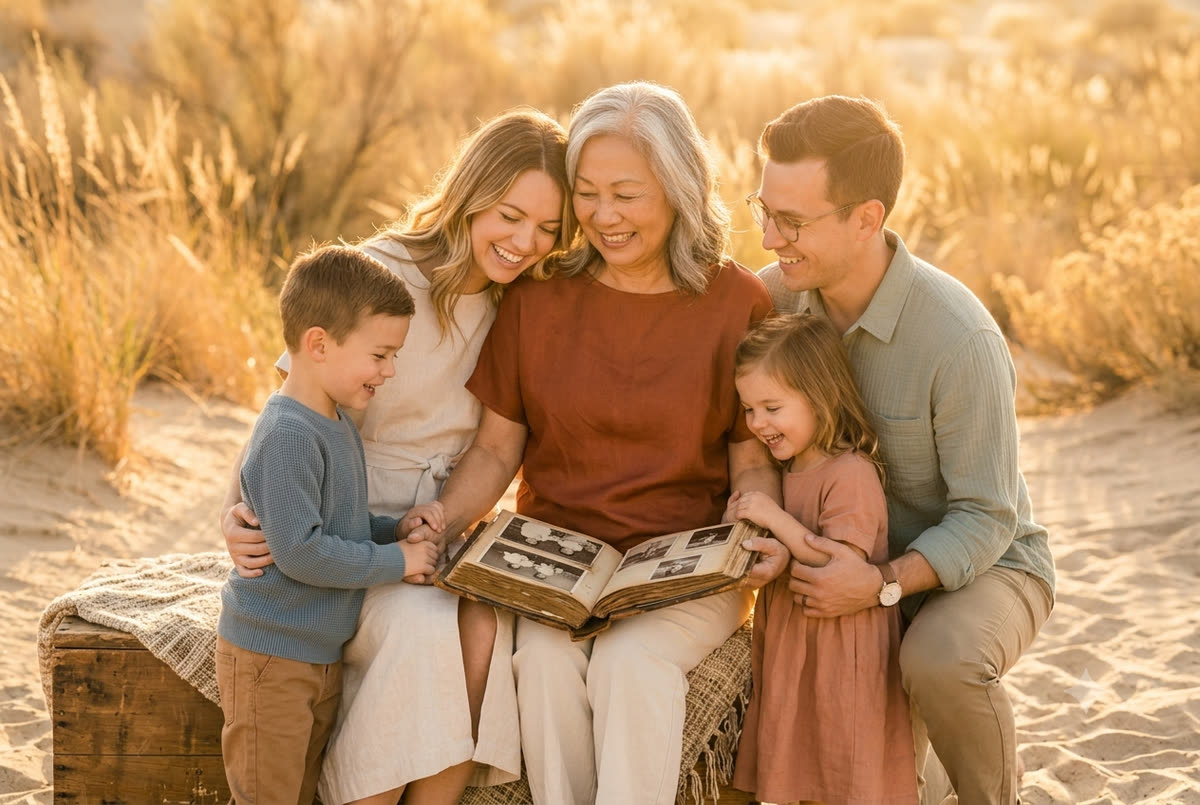
Some of the most meaningful calls I get start with an apology. A son or a daughter, planning a parent's eightieth, will hedge before they even ask — as if requesting a real portrait of an older man or woman were somehow an imposition. He doesn't think anyone wants pictures of him at this age, the reasoning usually goes. And then we do the session anyway, often right in the parent's own living room, and somewhere in the middle of it a grandchild wanders into the frame and says something that makes the guest of honor laugh for real. That is almost always the frame the family ends up hanging in the hallway — and very often it becomes the first picture the honoree has genuinely liked of themselves in years.
That is what a milestone birthday photoshoot is really for. Not vanity, not a forced smile in front of a backdrop, but a record — clear, kind, and unmistakably him — of a person at a particular age, surrounded by the people who love him. If you are planning a 70th, 80th, 90th, or any meaningful birthday for a parent or grandparent here in the desert, this is everything I have learned about doing it well.
Why a milestone birthday deserves real photographs
We are good, as a culture, at photographing the beginnings of life and not so good at honoring its long middle and its later chapters. There are thousands of pictures of most people before they turn five and a startling few after they turn sixty. A milestone birthday is one of the rare, natural occasions to correct that — a reason everyone already agrees on, a date on the calendar, a gathering that is probably happening anyway.
The honest truth I tell families is this: the photographs you make of someone at eighty become more precious every single year afterward, and you cannot make them retroactively. A phone snapshot at the restaurant table is wonderful and you should keep taking them. But a real portrait — where the light is considered, where your father is actually looking at you, where you can see the particular way your mother holds her hands — is a different kind of object. It is the picture that gets enlarged for the anniversary slideshow, the one the family reaches for later, the one that ends up framed.
This is part of what I think of as legacy work, and I write about it often. If you are thinking about the larger picture of preserving a generation, you may also find planning a multi-generation family portrait session and photographing grandparents with grandchildren useful companions to this one.
Deciding what kind of session you want
"Senior birthday photoshoot" can mean several quite different things, and the first conversation I have with a family is usually about which one they actually want. There is no wrong answer — but knowing the goal shapes everything else.
- A solo portrait of the birthday person. Quiet, dignified, focused entirely on them. This is the one I most gently encourage, because it is the picture that rarely gets made otherwise. Twenty unhurried minutes of someone simply being themselves.
- The birthday person with their spouse or partner. Especially moving for couples who have been married fifty or sixty years. The way long-married people stand near each other is its own language.
- A full multi-generation gathering. The honoree at the center, children and grandchildren around them. More logistics, more joy, more herding — but the group frame is often the one everyone wants on the wall.
- A documentary approach at the actual party. I move quietly through the celebration and photograph it as it unfolds — the toast, the candles, the great-grandchild on a lap. No posing at all.
Many families choose a blend: a short, calm portrait session first, then I stay to document the party. That sequence works beautifully because the formal frames are made while everyone is fresh, and the candid coverage happens once people relax.
The conversation worth having before the day
The single most valuable thing you can do is talk to the birthday person honestly about it beforehand — and to listen to what they say. Some people are delighted to be photographed and some are deeply reluctant, and the reluctance almost always comes from the same place: they do not believe they look good anymore.
I take that feeling seriously rather than waving it away. When someone tells me they hate having their picture taken, I do not argue. I tell them that my job is to photograph them the way the people who love them actually see them, which is not the way they see themselves in a harsh bathroom mirror. I work slowly, I show them frames on the back of the camera as we go so they can see it is going well, and I never make anyone hold a smile until it curdles. By the time we are twenty minutes in, the shoulders have usually come down.
A few things worth settling in that early conversation:
- Mobility and stamina. Can they walk on uneven ground? Stand for a while, or do we need seated setups and frequent breaks? How long can they comfortably be "on" — thirty minutes, an hour? I plan the whole session around the real answer, not an optimistic one.
- Time of day they feel best. Many older adults are sharpest and most energetic in the morning. We will talk about why that matters for desert light in a moment, but their personal rhythm comes first.
- What they are proud of. A garden they tend, a vintage car, an instrument, a wall of their own paintings, a beloved dog. Including the thing a person loves relaxes them instantly and makes the portrait specifically theirs.
- Hearing and vision. If someone wears hearing aids or has trouble with eye contact at distance, I adjust how I direct — coming in close, speaking clearly, never shouting instructions across a lawn.
Timing it to the desert: season and light
Living here, the calendar and the clock matter more than people expect, and they matter even more for an older subject.
Season. Our most comfortable outdoor weather runs roughly November through April, when an afternoon in the garden is a pleasure rather than an endurance test. From late May into September, the heat is serious, and I will not ask an eighty-five-year-old to stand outdoors at 108 degrees. If the birthday falls in high summer, we simply adapt — and this is one more reason I love working inside the home: a cool, familiar room with good window light is the most comfortable studio there is. When we do want to be outside in summer, we keep it to a very early start just after sunrise, or a shaded courtyard or patio. The picture is always worth more than proving we can tough out the temperature.
Light. Most of my sessions are built around two kinds of light, matched to where we are. Indoors, I work with soft natural window light — north-facing windows and sheer-curtained rooms are wonderfully kind to an older face, even and gentle, with none of the harshness that overhead light brings. Outdoors, in a park or garden or backyard, I aim for the golden hour, the stretch shortly after sunrise or before sunset, when the light turns warm and flattering and does lovely things for every face. In cooler months that late-afternoon light is glorious and the temperature is pleasant; in summer the early-morning version is the comfortable one. Open shade — under a patio cover, beneath a tree, on a covered porch — is my other reliable friend outdoors, soft and even and easy on the eyes. What I steer away from is bright overhead sun, which deepens shadows under the eyes and is unkind to everyone, older subjects most of all.
Where to photograph a senior birthday in the Coachella Valley
The best location is almost always the one that means something. For milestone birthdays, that turns out to be close to home far more often than not — so that is where I begin, and where most of my sessions happen.
Their own home, patio, and garden
This is my signature setting for milestone sessions, and the one I suggest first: simply home. It is where someone is most themselves, most physically comfortable, and surrounded by the objects of a life — the reading chair, the kitchen table where decades of dinners happened, the backyard they planted. There is no travel, no parking, no walking on gravel. We photograph in a favorite room by the window light, then drift out to the patio or garden if the hour and the weather are kind. For someone with limited mobility, an at-home session removes nearly every obstacle — and even for the spriest eighty-year-old, the comfort of familiar surroundings shows in the pictures.
Local parks and gardens
The other setting I lean on most is a nearby park or public garden — somewhere green, shaded, level, and close by. The Living Desert in Palm Desert has gentle, shaded paths and lovely plantings. Sunnylands Center & Gardens in Rancho Mirage is calm, manicured, and easy to walk. A neighborhood park with mature trees and a bench works just as beautifully. These spots give us a soft natural backdrop and golden-hour light without anyone having to venture far from a parking spot or a place to sit. I always scout for flat, even footing and nearby seating.
Resort grounds and courtyards
When a family wants a slightly grander backdrop for a gathering, the valley's resorts — in Indian Wells, La Quinta, and Palm Springs — have beautiful, level grounds with mature landscaping and plenty of shade. A private courtyard at a resort can be a graceful, contained setting for a birthday party, with the celebration and the portraits in one comfortable place. If a family especially loves the desert's mountain-and-palm horizon, we can often find it as a backdrop from these accessible, easy-to-walk spots — no rugged trek into open desert required.
A meaningful restaurant or club
If the celebration is centered on a long-standing favorite restaurant or a country club in Palm Desert or Indian Wells, I am happy to photograph there — a few considered portraits before guests arrive, then documentary coverage of the meal and the toasts.
What to wear
I send every family a wardrobe note before the session, and the guidance is simple.
- Comfortable and like themselves. A milestone portrait is not the moment to put your father in a stiff new outfit he has never worn. Choose something he already feels good in. Comfort reads as ease in the final picture.
- Solid, slightly muted colors photograph more timelessly than busy patterns or large logos, and they keep the attention on the face. Soft blues, warm neutrals, deep jewel tones all sit beautifully against desert backdrops.
- A shared palette for groups, not a uniform. If the whole family is in the frame, pick two or three colors and let everyone choose their own pieces within that range. It looks intentional and current; matching outfits look dated.
- Layers and texture — a nice cardigan, a textured jacket, a scarf — add depth and also let someone adjust if they get warm or cool.
- Bring the glasses they actually wear. I would rather photograph someone in their real spectacles than in an unfamiliar bare-faced version of themselves. We can manage reflections with positioning.
How I run the session itself
My pace with older subjects is unhurried by necessity and by preference. I build in time. A session I would do in forty minutes with a young couple I will plan for ninety with an elderly honoree, not because it takes longer to make the picture but because the breaks, the conversation, and the settling-in are part of how the good frames arrive.
I start with the easiest, most comfortable setup — usually seated, often the solo portrait — while energy is highest. I keep a chair nearby always, even for standing shots, so anyone can rest between frames. I talk the whole time, ask about the grandchildren, the old neighborhood, the year they moved to the desert; the best expressions come in the half-second after a real memory crosses someone's face, not when I say "smile." When the family is present, I let them interact rather than freezing them — I will ask the grandchildren to tell Grandpa a joke, and then I simply photograph what happens.
If the day is also the party, I shift into documentary mode and become nearly invisible: the candles, the cake, the quiet hand-squeeze between old friends, the great-granddaughter asleep on someone's shoulder by the end of the night.
Gentle, honest retouching
Families sometimes ask, a little nervously, whether I will "fix" things. My approach to retouching an older face is conservative and respectful. I will even out a distracting hot spot, soften a stray reflection in the glasses, tidy flyaway hair, brighten the eyes a touch. I will not erase the lines that a long life has earned, because those lines are the person — smooth them away and you have a stranger. The goal is for the family to look at the print and say "that is exactly him," not "that looks airbrushed." Dignity, not de-aging.
Common mistakes to avoid
- Waiting for a "better" year. This is the one that aches. The portrait you keep postponing is the portrait that may not get made. Eighty is a wonderful age to be photographed; so is ninety-five.
- Scheduling around midday convenience instead of light and comfort. A 1 p.m. session in June is a hard ask for anyone, let alone an older subject. Morning or late-day, almost always.
- Overpacking the day. Trying to do a full session, a big lunch, and a party all in one afternoon exhausts the guest of honor. Spread it out or keep the portrait portion short.
- Forgetting the solo frame. In the rush to gather everyone, the simple, beautiful portrait of just the birthday person often gets skipped. It is the one I would protect above all others.
- Not printing. Files on a phone are not a legacy. Order the prints, make the album, frame the wall piece. A photograph you can hold is the whole point.
A few questions I'm often asked
How long should we plan for? For a focused portrait session, plan an hour, with the understanding that we will use it gently. For portraits plus party coverage, a few hours. I always build in more time than I think we need.
My mother says she will hate it. Should we still do it? Yes — and tell me ahead of time. Reluctant subjects are a large part of who I photograph, and working gently, in a place where they already feel at ease, changes most minds by the end. The photographs they expect to hate are very often the ones they end up loving.
Can you come to the house? Absolutely. At-home sessions are one of my favorites for milestone birthdays, especially when mobility or stamina is a consideration.
What if the birthday is in the summer heat? We work with it — sunrise light, deep shade, or a comfortable indoor session. No one stands out in 110 degrees on my account.
Let's make this one count
If someone you love has a milestone birthday on the horizon — a 70th, an 80th, a 90th, or simply a year that feels important — I would be honored to help you mark it with photographs your family will hold onto for generations. Tell me about the person, the date, and what you are imagining, and we will shape a session around their comfort and their character. You can reach me here, and we will start with a conversation.
The years keep moving. The pictures are how we keep them.