Multigenerational Family Photo Poses & Shot List
The first time grandma, the grown kids, and a wobbly toddler are all standing in front of my camera at once, somebody usually laughs and says, "Good luck getting all of us to look at the same time." I love that moment. Because the truth is, getting everyone to look at the camera simultaneously is the easy part — and it's also the least important part. What I'm really there to capture is the way your father rests his hand on your shoulder without thinking about it, or how the baby reaches for great-grandma's necklace, or the particular way your whole family folds in toward each other when they stop posing and just are a family.
A multigenerational session is one of the most meaningful things you can give the people you love, and often the rarest. Three or four generations are seldom in the same place at the same time — a milestone birthday, a 90th, a reunion, the one week a year everyone's actually in town. Most of mine happen right where the family already gathers: in a living room, on a shaded patio, around the kitchen table, or at a favorite local park. So when you have everyone together, I want you walking in with a plan. This is the shot list and posing guide I actually use, organized so you can hand it to a busy family and have it just work.
Start with the goal, not the poses
Before any arms-around-shoulders, decide what this session is really for. It changes everything about how I shoot it.
- The full clan portrait — the one that gets framed and hung, printed for everyone, sent in the holiday card. This is the anchor image, and we build the whole session to guarantee we get it.
- The generational story — separate, deliberate groupings that show the line of descent: the great-grandparents, then their children, then the grandchildren.
- The legacy of one person — sometimes a session quietly centers on the eldest member. We're documenting them surrounded by everyone they made possible. I treat these tenderly, and I'll talk more about that in planning photos with aging grandparents.
When I know the goal, I know which shots are non-negotiable and which are bonus. We get the must-haves early, while everyone is fresh and the little ones haven't melted down.
The complete multigenerational shot list
Here's the running order I work through. You don't need every frame on this list, but if you capture even two-thirds of it, you'll have a gallery that tells the entire family story. I shoot roughly in this sequence because it moves from "everyone hold still" energy to relaxed and warm — and because it banks the hardest shots first.
The anchor shots (get these first)
- Everyone, together, looking at the camera. The classic. Posed, organized, all faces visible. This is the one we cannot leave without.
- Everyone, together, not looking — interacting. Same group, but I'll prompt a little chaos: "Tell the person next to you something embarrassing about the year you were born." The genuine version is almost always the keeper.
- The eldest generation seated, everyone gathered around. Grandparents or great-grandparents in chairs, family arranged behind and beside. This composition reads as "this is where it all started" and it photographs beautifully.
The generational ladder
- Each generation as its own group. The grandparents alone. Their adult children alone. The grandchildren alone. Side by side later, these tell the story without a single word.
- Three (or four) generations of one gender. Great-grandmother, grandmother, mother, daughter. Or the men of the family in a line. These are the images people gasp at.
- The "hands" shot. Four generations of hands stacked or linked — newborn fingers inside a 90-year-old's palm. Quiet, abstract, and devastating in the best way. Always worth thirty seconds.
The family units
- Each immediate family unit on its own. Every set of parents-and-kids gets a clean portrait. Practically, this is also why families book a multigenerational session — everyone leaves with their own photo too.
- The original couple. If the grandparents are still together, a portrait of just the two of them. This is often the photo their kids didn't know they desperately wanted until it existed.
- Each grandparent with all the grandchildren. No parents in frame — just the generation gap, which is where the magic lives.
The relationships
- Eldest member with the youngest member. Great-grandma and the baby. The bookends of the family.
- Siblings, all grown. The adult children together, as the kids they still are to each other.
- One-on-ones that matter. A grandfather and the grandchild named after him. A mother and the daughter who became a mother herself this year. Tell me these in advance and I'll make sure they happen.
The candids and the in-betweens
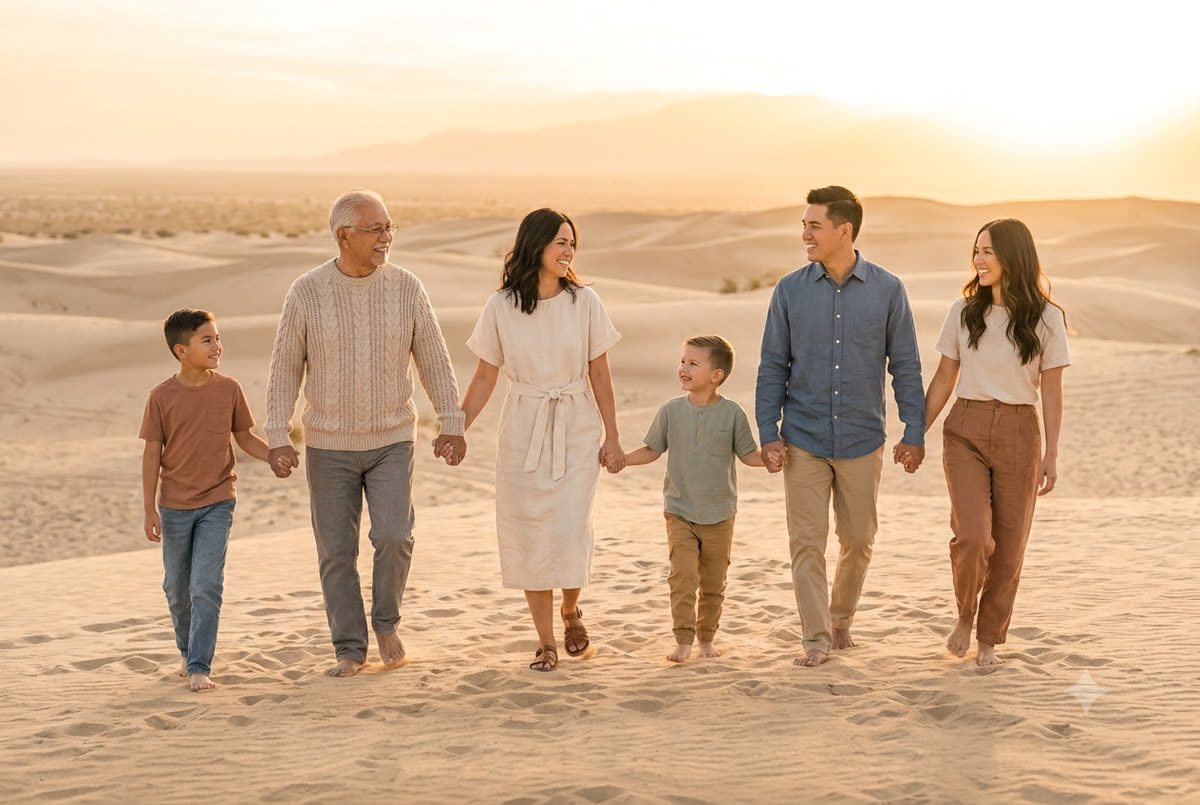
- Walking together. I'll have the group stroll toward me, talking. Loose, natural, full of life.
- A shared activity. Whatever this family actually does — a card game, a meal, the grandkids climbing on grandpa. Real beats posed every time.
- The blooper. Somebody's eyes closed, the toddler bolting, everyone cracking up. Keep it. In ten years it'll be the photo you love most.
How to actually pose three or four generations
Posing a large, mixed-age group is mostly about avoiding the two things that wreck these photos: the "lineup at the firing squad" look, and the "I can only see half of you" problem. Here's how I prevent both.
Build in levels, not a straight line
A row of people all standing at the same height is static and, frankly, unflattering. I create vertical variation instead. Seat the grandparents. Have some people kneel, some stand, a child sit on a lap. When eye-lines fall at different heights, the composition feels like a family and not a class photo. It also gracefully handles the reality that your family ranges from 36 inches to six-foot-two.
Triangles, always triangles
I arrange faces into overlapping triangle shapes rather than even rows. It's the oldest trick in portraiture and it works because the eye glides through the group instead of scanning a fence line. You won't notice me doing it; you'll just notice the photo looks right.
Close the gaps
The single most common mistake families make is standing too far apart — a polite arm's length that the camera reads as emotional distance. I'll gently pack everyone in closer than feels natural. Shoulders touching, bodies angled inward. Tight grouping looks like love. Spacious grouping looks like a corporate org chart.
Give hands and arms a job
People don't know what to do with their hands, and idle hands look awkward. So I assign them: a hand on a shoulder, an arm around a waist, fingers laced with the person beside you, hands resting on the back of grandma's chair. Connection points also visually bind the group together, which is exactly what we want a family portrait to do.
Angle bodies toward the center
Rather than everyone squared off flat to the lens, I turn shoulders slightly toward the heart of the group — toward whoever the photo is "about," often the eldest. It's slimming, it's natural, and it subtly tells the viewer where the center of gravity is.
Making it work with the very young and the very old
This is where experience earns its keep, because the toddler and the great-grandmother have opposite needs and we're serving both at once.
For the littlest ones: I shoot their cooperation first, fast, before naps and patience run out. I never expect a two-year-old to "look and smile" for a big group shot; instead I capture the group around them and let the child be a child. If they're having a meltdown during the formal shot, we let it go and circle back — a forced toddler smile fools no one.
For the eldest: comfort and dignity lead every decision. A real chair with back support, not a posing stool. Soft, even light — a window indoors, open shade outside — so the face stays relaxed. I keep their portion of the session short and front-loaded, get their must-have images locked in early, and then let them rest and watch while we photograph the younger groups. If mobility is limited, we bring the family to them rather than asking them to move around the location. This is one more reason I love working in a family's own home: the most comfortable chair in the house is already there.
A gentle, practical note I share with every family: if you've been meaning to gather everyone, don't wait for the "perfect" year. The most precious multigenerational portraits I've ever made were taken because someone sensed the window was open now. I write more about this in why family reunion photos are worth planning ahead.
Where to shoot a multigenerational session in the Coachella Valley
Location matters more with a big group, because you need space, shade, and footing that works for both a stroller and a cane.
- A family home, patio, or vacation rental. This is where I do most of my multigenerational work, and for good reason. It's where everyone is relaxed, there's seating and shade and a bathroom, and the photos carry the meaning of the place the family gathered. If grandma and grandpa have a home or rental in Palm Desert or Rancho Mirage, their living room, patio, and garden are usually all we need.
- A local park or garden. When a family wants a little more greenery, neighborhood parks and gardens around Palm Desert, Rancho Mirage, and Indian Wells give us soft lawns, mature trees, and flat, easy paths — kind to older knees and toddler legs alike, with shade close at hand.
- Desert resort grounds. The lawns and palm-lined walkways at the valley's resorts make a manicured backdrop with plenty of shade and gentle footing, if you'd like something a touch more formal.
- A favorite restaurant or a backyard table. If your family's tradition is a long Sunday lunch, let's photograph that. Some of my best candids happen around food.
If you're set on a wide-open desert vista — dunes, open scrub, the dramatic vistas toward La Quinta and Indio — I'm glad to scout one with you. Just know it asks more of everyone physically, so I usually save those for a fit, mobile family or a single generation rather than the whole multigenerational group.
Timing the light
The right hour depends on where we shoot. Indoors, we work with the natural window light, which means we have flexibility on time of day — a late-morning living room with the curtains open is wonderfully soft, and a big group can settle in without anyone watching the clock. Outdoors, in a park or garden, we aim for golden hour: the soft stretch shortly after sunrise or in the last hour before sunset, when the light is warm and faces relax. In the hottest months I won't ask your grandmother to sit through 108-degree midday heat, and the light is unflattering then anyway. Whatever the season, an early call gets us the gentlest light and the freshest little ones — so the earlier we can put a date on the calendar, the better.
A few things families ask me
How long does a multigenerational session take?Plan on about 60 to 90 minutes for a group of eight to twenty. Longer than that and the youngest and oldest both fade. I'd rather work efficiently through a focused shot list than drag everyone through a marathon.
What should everyone wear?Think of it as one shared palette, not one shared outfit. Pick two or three colors and a general level of dressiness, then let each person dress like themselves inside those guardrails. Identical white-shirt-and-jeans uniforms can look dated and a bit stiff; a few harmonized tones look timeless and let grandpa, the teenagers, and the toddler each keep their own character. Soft, muted shades tend to photograph beautifully in our desert light.
We've never managed to get everyone in one place. Is it worth the trouble?Yes. Unreservedly. The logistics of corralling a family are real, but I have never once had a family regret making the time. I've had many wish they'd done it a year sooner.
When you're ready
If you have a window coming up — a visit, a birthday, a holiday when the whole family will finally be under one roof — let's put a plan together so all you have to do is show up and be together. I'll handle the rest, from the must-have anchor portrait to the quiet little moments you'll treasure later. You can tell me about your family and what you're hoping for, and we'll find the right time and place to make something your family keeps for generations.