How to Photograph a Large Family Group: Posing & Logistics
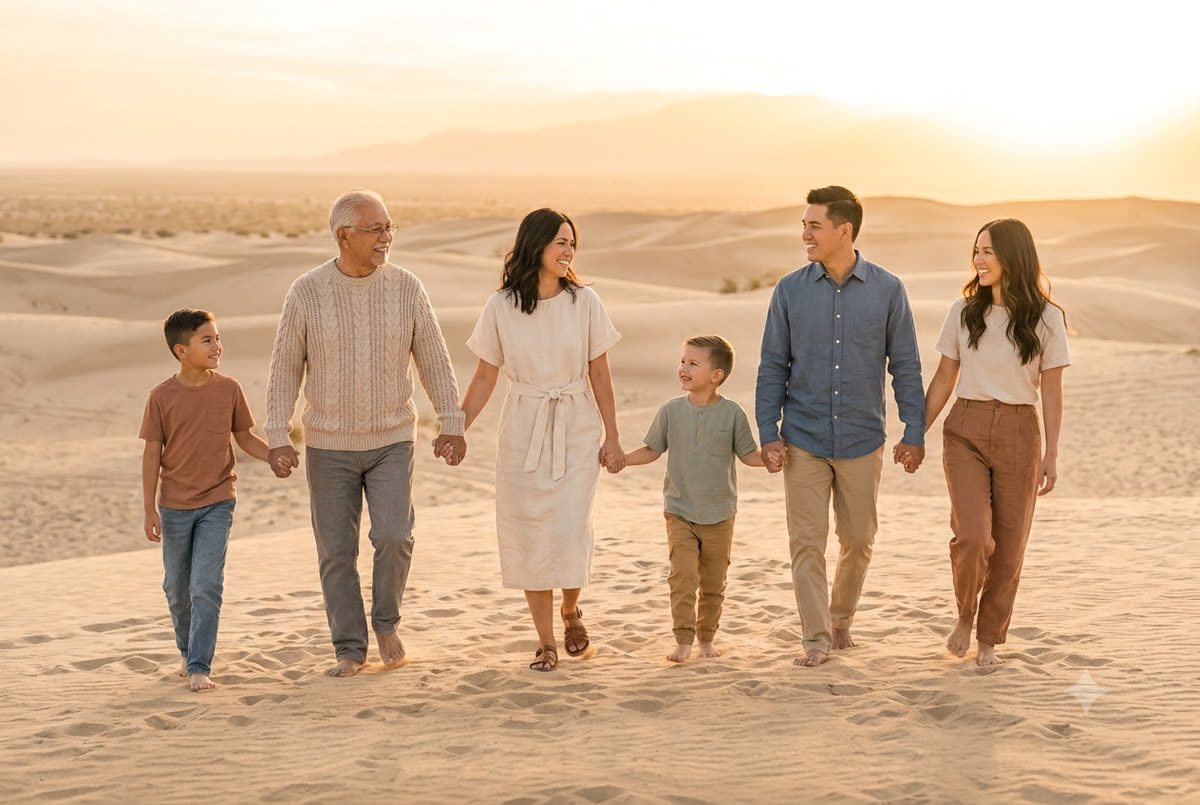
Picture a backyard in Rancho Mirage: twenty-some people spread across the patio and lawn, a few of them under the age of six, and a grandfather who can stand for maybe ten minutes before he needs to sit down. That's a fairly ordinary large family group for me — and most of my big sessions happen exactly there, in a family's own home and yard, or at a familiar local park. The ones that send everyone home thrilled are almost never the sessions where everybody behaved perfectly. They're the ones where we had a plan, and the plan left room for the day to be human.
A large family group is its own kind of photography. It is part portraiture and part air-traffic control, and the families who walk away thrilled are almost always the ones who understood, going in, how the hour was actually going to flow. So let me pull back the curtain. Whether you're a relative who has been handed the camera, or you're hiring me and want to know what you're signing up for, here is how I think about a large family photo session here in the desert — the posing, yes, but just as much the logistics that make the posing possible.
What counts as "large," and why it changes everything
For me, the dynamics shift somewhere around ten people. Up to eight or nine, you can still arrange folks almost individually, like a small still life. Past that, you're composing groups within the group — this couple, that branch of the family, the cousins — and then knitting those groups into one frame. By the time you're at fifteen, twenty, twenty-five people, you are managing sightlines, height, the width of your lens, and a dozen attention spans at once.
The single biggest mistake I see is treating a thirty-person extended-family shoot like a slightly bigger version of a four-person session. It isn't. The posing logic is different, the timeline is different, and the failure modes are different. With four people, if someone blinks, you reshoot in five seconds. With twenty-six, the odds that all eyes are open and all expressions are good in a single frame are genuinely low — which is the first thing worth understanding.
The hard truth about big groups: you're going to compositing-blend, and that's fine
Here is something most families don't know until they hire a professional: in a large group, I'm almost never relying on one perfect click. I shoot the same arrangement in a quick burst — six, eight, ten frames in a row, holding the pose steady — precisely so that I can later swap a closed-eyed face from one frame for the open-eyed version a half-second later. It's a clean, invisible edit, and it's how every honest pro delivers a twenty-person portrait where everyone looks their best.
Why tell you this? Because it changes how you should behave in front of the camera. You do not need to achieve a miraculous synchronized moment. You need to hold still and hold your expression for a few seconds while I work the burst. The families who relax into that — who stop straining for the one perfect instant — give me the most to work with. If you're the relative behind the camera, this is your most important technique: lock the focus, hold the frame, and fire a run of shots. Pick the keepers later.
Before the day: the logistics that decide everything
The session is mostly won or lost before anyone shows up. A few things I sort out in advance, and you should too.
Pick the season and the hour with intention
This is the desert, and light is not negotiable here the way it is in gentler climates. From roughly November through April — our snowbird stretch, when the extended family is most likely to actually be in town together — the weather is glorious and the golden hour is kind. That's prime time, and it's also why my calendar fills early for those months. If you have a goal of "the whole family, all the generations, in one place," it almost always means a holiday or a winter visit, so book well ahead.
In summer, a large outdoor group at midday is genuinely unsafe — I've watched elderly relatives wilt fast, and the little ones unravel even faster. If we shoot June through September outdoors, we're meeting close to sunrise or in the last hour before sunset, full stop, and we're keeping it short. I'll often steer summer big-group sessions toward early morning specifically because the kids and the grandparents both have more patience before the heat arrives. Summer is also when an in-home session really earns its keep — indoors we're free of the clock entirely, working with soft daylight through the windows while it's a hundred and ten outside.
For an outdoor session, the best window almost any time of year is the desert golden hour — that last hour to ninety minutes before sunset, when the light goes warm and low and forgiving, and the mountains turn rose and gold. It flatters every age and hides a multitude of sins, so I plan an outdoor timeline backward from it. Indoors, the equivalent is simply a room with good windows and the light turned off — clean, gentle window light that's kind to every face, no matter the hour.
Choose a location that can physically hold the group
Not every pretty spot works for twenty people. I look for:
- Room to back up. Big groups need a wide arrangement, which means I need distance to fit everyone without a distorting ultra-wide lens. A roomy backyard or patio, an open park lawn, a wide garden path.
- Built-in levels. Porch or staircase steps, a low garden wall, a gentle slope. Anything that lets me stack rows so the back faces aren't hidden behind the front ones. A home's own front steps, the low walls and tiered lawns around Palm Desert's El Paseo area, and the terraced grounds at many of the Indian Wells and La Quinta resorts all give me natural tiers.
- Shade and a place to sit. For multigenerational groups especially, I want somewhere the great-grandparents can rest between setups and somewhere out of the sun to regroup — one more reason a family's own home, with its couches and bathrooms, is so often the easiest setting of all.
- Parking and a short walk. Sounds trivial. It is not, when you're moving two dozen people, three strollers, and a walker. I avoid locations with a long hike from the car.
My first choice for big families is almost always the family's own home — the living room, the backyard, a shaded patio. Everyone's relaxed on their own turf, the little ones treat it as home base, and the bathroom-and-rest-stop problem solves itself. Indoors I work with soft light from the windows; out on the patio or lawn we lean on the golden hour. After home, I love the local parks and gardens — the green civic spaces and desert-garden plantings around Palm Desert, and the manicured resort grounds in Indian Wells and Rancho Mirage for families staying there. And if a family does want a more dramatic, unmistakably-desert backdrop, the mountain-and-boulder views you can reach easily in La Quinta photograph beautifully — just know that's a scenic flourish, not how a big group session normally has to go. I write more about matching place to family in choosing the right Coachella Valley location for big family photos.
Coordinate clothing — loosely, not as a uniform
Matching outfits in a big group tend to read as a flat wall of sameness, and they make it harder to see each individual face. Instead, I ask families to pick a palette of two or three soft, coordinating colors and let everyone dress within it. In the desert that means warm neutrals, soft denims, sage and dusty blues, creams and warm whites — tones that sit naturally against sand, stone, and golden light. Steer away from tiny patterns and loud logos, which buzz at a distance and date the photo. One trick: lay all the outfits out together on a bed beforehand and photograph them with your phone. If something jumps out as wrong, it'll jump out in the portrait too.
Build a shot list and assign a "family wrangler"
For any group over a dozen, I ask the family to think in advance about which sub-groupings matter to them, because we will not have time to improvise twenty combinations. A typical priority list:
- The full group (we shoot this first, while energy and outfits are fresh and before a toddler loses a shoe).
- The grandparents with all the grandchildren.
- Each individual family unit (each set of parents with their own kids).
- The grandparents alone — quietly important, and often the photograph the family treasures most later.
- Just the "kids" (the adult siblings together), and just the grandchildren together.
- Any wildcards: the four sisters, the whole group being silly, a candid walking shot.
Then I ask for one person — usually not a grandparent, ideally someone organized and a little bossy in the kindest way — to be my wrangler. Their job is to know the names, to physically fetch the next grouping while I'm finishing the current one, and to corral stragglers. A good wrangler can cut a chaotic ninety-minute shoot down to a calm forty-five.
On the day: how I actually pose a big group
Now the part everyone asks about. Posing a large family is less about individual poses and more about architecture — building a shape that holds together and lets every face breathe.
Start with structure, not people
Before I place anyone, I look at the space and decide on the shape: a gentle triangle, a soft curve, two tiers on a low wall. Then I anchor it.
- Anchor with the eldest and the seated. I usually seat the grandparents (or great-grandparents) in the center, often on a chair or bench I've brought or borrowed. They become the heart of the composition, and everyone builds around them. This is both a posing choice and a kindness — it spares them standing for twenty minutes.
- Build outward and upward. Standing adults frame in behind and beside the seated center. Older kids tuck into gaps. Little ones go on laps, on the ground in front (sitting or kneeling), or on a parent's hip.
- Stagger the heights. The cardinal rule of group posing: avoid a flat row of heads at one level and avoid faces stacked directly above each other. I want a loose, varied "heightscape" — some seated, some standing, some leaning. It reads as natural and keeps every face visible.
Close the gaps
The most common amateur error in big groups is leaving air between people — a row of individuals standing a polite foot apart. It looks disconnected and it sprawls too wide for the frame. I bring everyone in close enough to touch: hands on shoulders, arms around waists, bodies turned slightly toward the center rather than squared flat at the camera. Turning shoulders inward does two things at once — it slims everyone a touch, and it physically pulls the group into a tighter, warmer cluster.
Watch the feet and the front line
I check the bottom of the frame as carefully as the top. Front-row feet, knees on the ground, a toddler sprawled in front — these set the base of the composition. I like the front row low (seated or kneeling) so the structure rises behind them. And I keep the front edge clean: no one's arm cut awkwardly, no stray bag in the grass.
Give them something to do
Strangely, "everyone look at me and smile" produces the stiffest results in a big group, because two dozen people performing a smile on command looks like two dozen people performing a smile on command. So I mix in interaction. I'll have the group talk to each other, share the worst family joke they know, have the grandparents look at the youngest baby instead of at me, ask the cousins to lean in and whisper. The genuine laughter that follows is where the real picture lives. I'll always get the formal "everyone looking" version — families want it and they should have it — but the frame that ends up framed on the wall is usually the one a half-second after I said something they didn't expect.
Lens and distance
A quick technical note for the relative-with-a-camera. Resist the wide-angle lens for the group portrait. Wide lenses distort the people at the edges — and in a big group, that's a lot of relatives with subtly stretched faces. I shoot groups from farther back with a moderate focal length, which is exactly why I need that room-to-retreat I mentioned. Stand back, zoom in a little, fill the frame by stepping back rather than going wider.
Managing the people problem: kids, elders, and energy
The logistics that trip up big sessions are almost never about cameras. They're about people.
The little ones set the clock
Small children have a finite cooperation budget, and it drains fast. So I spend it wisely:
- Shoot the all-important full group first, before the youngest melts down.
- Don't fight a tired toddler. A child on a parent's hip looking away can be a beautiful, true photograph. Forced eye contact rarely is.
- Have a parent or wrangler stand right behind me to draw little eyes toward the lens — and skip the squeaky toys, which produce a manic, unnatural look. A calm voice and a real moment beat a gadget.
- Build in a release valve. Snacks, water, a five-minute run-around. A short break can resurrect a session that's sliding sideways.
The eldest set the priorities
In a multigenerational shoot, the grandparents — sometimes great-grandparents — are usually the reason the photo exists. So I protect their comfort and shoot their key frames early, while they're freshest. Seated center, supported, never left standing while I fuss with a row of cousins. If mobility is a concern, I'll quietly arrange the whole composition around a chair so it never reads as anyone being "sat out." These portraits — four generations in one frame, or the grandparents alone in the golden light — are exactly the images that become irreplaceable later, and they're at the center of why I think of extended-family sessions as legacy work. I've written more about that in why multigenerational portraits matter more than you think.
Keep the energy up, keep the session short
Counterintuitively, the best big-group sessions are not long. Energy is the real currency, and it doesn't refill. I'd rather shoot a focused 45 to 60 minutes with a sharp shot list than drag a fading group through two hours. We get the priorities locked early, work the fun combinations while spirits are high, and finish before anyone is asking how much longer.
A realistic timeline for a one-hour session
Here's roughly how I pace an extended-family hour, golden-hour start:
- Minutes 0–10: Everyone arrives, I greet, the wrangler does a headcount, we walk to the first spot. (Tell everyone to arrive 15 minutes early. Someone always runs late.)
- Minutes 10–25: The full group portrait, while everyone's fresh. Several arrangements, several bursts.
- Minutes 25–45: Grandparents-with-grandkids, the generations, each family unit. We move efficiently down the shot list, wrangler feeding me the next group.
- Minutes 45–55: The fun stuff — the silly frame, a walking shot, the cousins, the candids. Light's at its best now.
- Minutes 55–60: Grandparents alone, then any final wildcard requests. Wrap while everyone still likes each other.
Mistakes to avoid (a quick checklist)
- Booking midday in warm months. Heat, glare, and wilting relatives. Go early or late — or move it indoors.
- Skipping the shot list. You will forget the one grouping someone secretly wanted most, and they'll be quietly disappointed for years.
- Matching outfits too rigidly. Coordinate a palette; don't uniform.
- Standing too far apart. Close the gaps. Always.
- Leaving heads in a flat line. Stagger the heights.
- Going ultra-wide. Distorted edge faces. Step back instead.
- Front-loading nothing. Shoot the full group and the elders first.
- No wrangler. One organized relative is worth an extra half hour of daylight.
- Chasing the single perfect frame. Hold the pose, let the burst do the work.
A few questions families ask me
How many people is too many? There's really no ceiling — I've photographed forty in a single frame. Past about twenty-five, you simply need more structure (levels, a wider spot) and a tighter plan. The number doesn't scare me; a lack of a plan does.
What if a baby is fussing or a toddler won't cooperate? We work with it, not against it. Genuine, slightly-imperfect family life photographs beautifully, and I'd much rather capture a real moment than a forced one. There's always a frame in there.
Can you really fix the one person who blinked? In a held burst, almost always — I swap in their open-eyed face from a neighboring frame, seamlessly. It's standard practice for group work and part of why hiring a pro for the big family portrait pays off.
When should we book? For November-through-April dates — the popular ones, when the family's all in town — reach out early; those weekends go first. For summer, plan on sunrise or the last light of the day.
Let's make the one your family will keep
The portrait that ends up over someone's mantel, or tucked into a grandparent's wallet, almost never happens by accident with a group this size. It happens because someone cared enough to plan the light, the place, and the people — and then stayed loose enough to let the real moment arrive. That's the part I love most: the unguarded laugh in the middle of all that organizing, the one frame that could only be your family.
If you're hoping to gather everyone — all the generations, while they're all in town — let's get it on the calendar before the moment slips past. Send me a note about your family: who's coming, roughly how many, and where you picture it (your own backyard absolutely counts). We'll build the shot list and the plan together from there — reach out here.