Documenting a Multigenerational Holiday Gathering
The phone call almost always sounds the same. Someone is hosting the whole family in the desert this year — the parents who winter in Palm Desert, the adult kids flying in from Denver and Seattle, the grandchildren who have grown a full head taller since anyone last looked, and, if everyone is lucky, a great-grandmother who still insists on making the cranberry sauce herself. They want pictures. But they don't quite want a "photo shoot." What they want, when we really talk it through, is for this particular Christmas or Hanukkah or Thanksgiving — the one where everyone is finally in the same house at the same time — to leave behind something they can hold.
That is the most honest reason to photograph a holiday gathering, and it is a very different job than a posed portrait at a studio. When all of your generations are together, often only for a handful of days, the photographs are not really about looking nice. They are about proof. Proof that Grandpa held the baby. Proof that the cousins were thick as thieves at that age. Proof of the house, the table, the light through that particular window, the people who were still here.
I have photographed these gatherings across the Coachella Valley for many years, and I want to walk you through how I think about them — when to schedule, how to handle a houseful of people of wildly different ages, the one formal portrait worth fighting for, and how to keep the day feeling like a holiday rather than a production.
Why the holidays are the rare window — and why the desert makes it easier
A multigenerational photograph requires a thing that is genuinely hard to manufacture: everyone in one place. Most years, that simply doesn't happen. Then the holidays arrive, the snowbirds are settled into their season here, the working children take their time off, and suddenly the impossible logistics solve themselves. The family is already assembled. You are not asking anyone to fly in for a portrait — they are already at the table.
That is why I gently push families to capture it now, in the years when the full set is present. The composition of a family changes. The toddler this year is the only year he will be exactly that small. The great-grandmother at the head of the table may or may not travel next winter. I am not trying to be grim about it — I am trying to be truthful, because the families who wait for a "better" year are the ones who later wish they hadn't.
Our valley has a real advantage here. From November through April, the weather cooperates almost rudely well. While the rest of the country is bundled indoors against the cold and dark, we have warm afternoons, long soft evenings, and golden hour light that lasts and lasts. A December portrait in Palm Springs or La Quinta can happen outdoors in shirtsleeves at four in the afternoon, with the Santa Rosa Mountains going pink behind everyone. Most of the country cannot say that about their holiday photos.
What "documenting" actually means here
I want to draw a line between two things people lump together, because choosing wrongly is the most common mistake I see.
There is the posed family portrait — everyone arranged, looking at the camera, polished. It is wonderful, and I will get to it.
And there is documentary coverage of the gathering itself — the cooking, the arrivals at the front door, the kids underfoot, the toast, the dishes, the card game that gets too loud. Nobody arranges themselves. I move through the day quietly and photograph what is genuinely happening.
A multigenerational holiday deserves both, and the documentary half is the one families forget to ask for and treasure the most. Ten years on, a sharp posed portrait is lovely, but the frame that stops you cold is your father laughing with his head tipped back while he carves, or your daughter asleep on her uncle's chest by the fire. Those moments are the real record of who this family was. If I had to keep only one kind, I would keep that one.
So when we plan, I usually suggest a hybrid: a stretch of natural, unobtrusive coverage during the gathering, plus one deliberate window — fifteen or twenty minutes — for the formal portrait while everyone is dressed and present.
The one portrait worth interrupting the party for
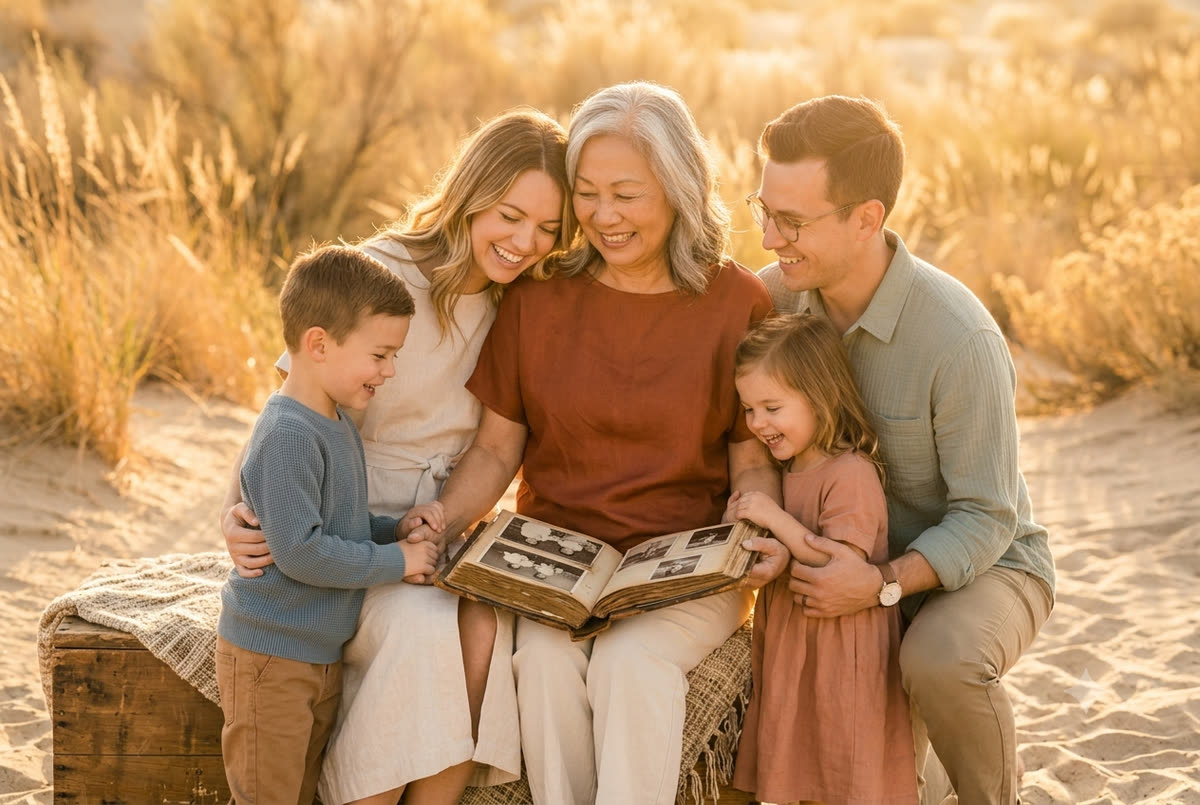
Here is the photograph I will quietly insist on: the whole family, all generations, together in one frame. It is the single hardest image to ever recreate, and the one most likely to hang on a wall for decades.
The trick is to make it cost the family almost nothing. A common error is saving it for "later" — and later never comes, because by evening someone has changed into sweatpants, the baby is melting down, and Uncle Ray has had a second glass of wine and wandered off. So I plan the group portrait for early, while everyone is still assembled and presentable, usually right before or right after the meal when nobody has scattered yet.
A few things I have learned about wrangling four generations into one good frame:
- Anchor the portrait on the eldest. Seat the great-grandparents or grandparents and build the family around and behind them. It is more comfortable for them, it reads beautifully, and it quietly says who this gathering is honoring.
- Babies and toddlers go in laps or arms, never standing free where they will bolt. Hand the youngest to the oldest when you can — that pairing is often the photograph of the whole day.
- Keep it short and keep it warm. I work fast, I talk the whole time, and I get what I need before the little ones run out of patience. Twenty minutes, not an hour.
- Then break into the smaller groupings — just the grandparents with the grandchildren, each set of parents with their own kids, the siblings on their own, the cousins as a pack. These combinations are the ones people request prints of later.
Where and when in the Coachella Valley
If you want to fold a portrait session into the holiday, the desert gives you good options. A few I return to:
At the house. Honestly, my favorite. So many of these gatherings happen in a family's winter home in Palm Desert, Rancho Mirage, or Indian Wells, and the house is the story — the table set for fourteen, the patio, the pool the grandkids won't get out of. Photographing where the day is actually happening means nobody has to load into cars, and the great-grandmother never has to leave her chair.
The patio or backyard at golden hour. If the group is mobile, the hour before sunset in winter is extraordinary here, and you rarely have to go further than your own patio for it. We step outside, use that low, warm light, and keep the great-grandmother a few feet from her chair. In December and January the sun sets early — closer to 4:30 — so we plan the outdoor portrait for mid-to-late afternoon, not after dinner when it is already dark.
A local park or garden. For families who want something unmistakably of this place but still easy on everyone, the valley's parks and public gardens are where I most often head — palms, lawns, and those mountain backdrops without anyone wading into the scrub. Civic Center Park in Palm Desert, the gardens and greens around La Quinta and Rancho Mirage, a shaded community lawn — all of them photograph beautifully in the soft, low winter light. We keep to the kinder hours of the day; even late morning sits gentler here than people expect once the sun is low.
A practical note on timing: I ask families to tell me the meal time first, then we build everything backward from it. Photographs should orbit the holiday, not the other way around. For more on planning around little ones specifically, I wrote separately about keeping young children happy during a family session, and about what to wear so a big group looks pulled together without looking matchy.
Helping the day feel like a holiday, not a photo op
The fear I hear most is that bringing in a photographer will make everyone stiff and self-conscious and ruin the easy feeling of the day. It is a fair fear. My whole approach is built to prevent exactly that.
For the documentary stretch, I am as close to invisible as I can be. No big lights, no constant direction, no "everybody look here." I am in the kitchen while the pies happen, near the door as people arrive, low to the ground where the kids are playing. After a little while people genuinely forget I am there, which is the entire point — that is when the true expressions come back.
A few things that help the day stay relaxed:
- Let the kids be kids. I would much rather photograph a child mid-laugh and slightly blurry than a row of children ordered to sit still. The honest frame always wins.
- Don't over-clean for me. A few families panic and strip every personal trace out of the house. Don't. The handwritten place cards, the grandchildren's drawings on the fridge, the worn recipe box — those details are the texture of your family. I want them in.
- Feed people first when you can. Hungry relatives are impatient relatives. A group that has just eaten is loose, warm, and far easier to photograph.
- Tell me who matters. If this is likely the last winter your mother makes the trip, I want to know, gently, so I can make sure I have her — with each grandchild, at the head of the table, doing the thing only she does.
The questions families ask me most
How long should you be there?For a gathering, two to three hours covers it well — enough to catch the arrivals, the cooking, the meal, the group portrait, and the easy aftermath, without overstaying into the part of the evening where everyone is tired. For a simpler portrait-only session, thirty to forty-five minutes is plenty.
What about the relatives who hate being photographed?There is one in every family, and I am used to them. I never force it. Documentary coverage is forgiving — I will catch them naturally, laughing at something, off guard, and those are often the images they end up liking best precisely because they didn't have to perform.
Can you do this in the evening, after dark?Yes, indoors, and it has a wonderful warm-lamplight feeling — but I plan any outdoor or full-family portrait for daylight. If a formal group shot matters to you, we do it in the afternoon and let the evening be loose and candid.
We are only all together for three days. Is that enough notice?It can be, but the winter holidays are my busiest stretch because every snowbird family is in town at once. The earlier you reach out, the better the odds I can hold your date. If you know your family is converging this December, I would say something sooner rather than later.
What you are really leaving behind
Years from now, the people in these photographs will look at them for reasons that have nothing to do with whether everyone's shirt was tucked in. A grandchild who is now grown will look for the grandparent who is no longer at the table. A mother will look at how small her children once were. The pictures become a kind of inheritance — quiet, honest, and irreplaceable.
That is the work I care about most. Not a perfect, glossy image, but the true and telling one — the gesture, the glance, the particular way your family is together when nobody is performing. A holiday gathering with every generation in the room is one of the few times that whole truth is gathered in a single place. My job is simply to be there, paying attention, when it happens.
If your family is coming together in the valley this season and you would like to keep a real record of it, I would love to hear about your gathering and help you figure out the right shape for it. You can reach out to me here, tell me who is coming and when, and we will plan something that fits your holiday instead of interrupting it.