Best Quiet Outdoor Spots for Gentle Senior Portraits
When a daughter calls me about photographing her mother, the first question is almost never about light or wardrobe. It is, "Where can we do this where she won't have to walk far, and where it will be quiet?" That question matters more than people realize. For an elder — someone using a walker, tiring easily, or simply happiest away from crowds — the right location is half the photograph. Choose a place that is flat, shaded, close to parking, and free of noise, and the person in front of my camera relaxes. The shoulders drop. The face softens. And softness is exactly what we are after.
I should say up front that a good share of my elder portraits never leave the house. A favorite armchair by a south-facing window, a back patio with a potted lemon tree, the garden a husband planted forty years ago — those are where some of my most honest Legacy work happens, and I'll come to you. But when a family does want to be outside, they almost always want the same things: somewhere close, flat, and quiet. So this guide is the one I wish I'd had years ago: the gentle, accessible parks and gardens across the Coachella Valley I turn to when the subject is an older parent or grandparent, and why each one works. I have scouted every one of these with a wheelchair, a bench, or an afternoon nap in mind.
What "accessible" really means for a portrait session
Before I name places, let me tell you what I'm actually looking for when I scout a location for an elder. It is not the same checklist as a senior-in-high-school session or a family with toddlers.
- Parking within sight of where we'll shoot. Not "a short walk." Within sight. Many of the loveliest desert spots fail this test, and I won't ask an 88-year-old to cross a hot lot.
- Paved or hard-packed, level paths. Grass and gravel are exhausting for walkers and impossible for many wheelchairs. A smooth path changes everything.
- Shade and a place to sit, close together. I want a bench or low wall within a few steps, so we can work in short bursts and rest in between. The best portraits of older people often happen during the rest, not the posing.
- A restroom nearby. Unglamorous, but it determines how long we can comfortably stay.
- Quiet. Crowds and noise make people self-conscious and tired. A calm setting lets someone be themselves.
Keep those five things in mind and you'll understand why I send people to these particular parks and gardens rather than the dramatic, photogenic spots you might expect.
Accessible parks in Palm Desert I return to again and again
Palm Desert is, honestly, the easiest city in the valley for this kind of work. The civic spaces here are well-maintained, flat, and generously shaded.
Civic Center Park
If you ask me for one place, this is it. Palm Desert Civic Center Park (off San Pablo and Fred Waring) is the gentlest, most accessible green space I know in the valley for portraits of an older adult. The paths are wide, smooth, and level. There is abundant parking that wraps close to the lawns and the rose garden. Mature trees throw real shade by mid-afternoon, and benches are everywhere — so we can move ten feet, sit, photograph, and move again.
The rose garden and the desert-planting beds give me color without anyone having to walk into rough terrain. And because it's a community park rather than a tourist destination, mornings on a weekday are peaceful and low-key. More than once an older guest has mentioned driving past this park for years without ever stopping in — and then not wanting to leave.
The Living Desert (paved sections only)
The Living Desert Zoo and Gardens in Palm Desert is mostly paved and quite manageable along its front gardens, and it rents wheelchairs at the entrance. I use it selectively — we stay near the entrance gardens rather than touring the whole grounds — but the desert botanicals make a warm, distinctly local backdrop. Bring a membership or budget for admission, and go early before the day warms. This one rewards a slow morning.
University Park and the smaller neighborhood parks
For families who want something even quieter than Civic Center, Palm Desert's smaller parks — like University Dog Park's surrounding green and the pocket parks up in the northern neighborhoods — offer flat paths and almost no foot traffic on a weekday morning. They lack the rose garden, but for a tender, plain-background portrait of someone in a wheelchair, plain is often perfect.
Beyond Palm Desert: gentle spots across the valley
Sometimes the family lives elsewhere in the valley, or there's a sentimental reason to be in a particular city. Here's where I go.
Rancho Mirage: The Observatory and Community Park
Rancho Mirage Community Park, beside the public library, is beautifully kept and very flat, with shaded ramadas and close parking. It's one of my favorite quiet alternatives. The grounds feel cared-for and serene, and on a cool weekday morning it is close to empty.
Palm Springs: Ruth Hardy Park and the Wellness Park
In Palm Springs, Ruth Hardy Park is leafy, level, and residential — quiet in a way the downtown gardens never are. The mature trees mean we can work later into a winter morning without harsh light. If you want something with a little more desert character, the Palm Springs Downtown Park is newer, fully accessible, and has smooth paths, though it carries more street noise.
La Quinta: Civic Center Campus
La Quinta's Civic Center Campus has a gentle, paved lakeside loop with benches and public art. The full loop is longer than an elder may want, but you don't need the whole thing — the first stretch by the water gives us everything we need, with parking right there.
Indian Wells and Indio
Indian Wells is largely private and resort-based, so for public, accessible green space I usually steer those families a few minutes over to Palm Desert. In Indio, the grounds around the Indio Senior Center and the shaded paths at Miles Avenue Park work for a simple session close to home, which matters when the drive itself is tiring.
The light, the season, and the timing
The desert gives us one enormous gift for this kind of photography and one real challenge.
The gift is the long, soft light of late afternoon in the cooler months. From November into April, an hour or so before sunset, the whole valley glows and the temperature is kind. That window is my favorite for portraits of elders — warm, flattering, and gentle on someone who chills or tires easily.
The challenge is heat. From roughly May through September, midday and afternoon outdoors are simply too much to ask of an older body. In those months I do one of two things: we meet shortly after sunrise, when it's quiet and bearable, or we stay indoors entirely — and honestly, the home is one of my favorite places to photograph anyone, any month of the year. Soft daylight through a large window, the chair they always sit in, the things on the walls that say who they are: that is its own kind of gentle, and the natural light indoors is as flattering as anything the desert offers. There is no portrait worth a heat-stressed afternoon. If you're planning a summer session, read my thoughts on photographing elders comfortably in the desert heat before you pick a time.
A note on overcast and "bad" weather: don't cancel for clouds. A soft, gray sky is the most forgiving light there is for a lined, beloved face. Some of my most tender Legacy portraits were made on flat-light mornings.
How I actually run a gentle session
The location sets the tone, but how we spend the time matters just as much. A few things I always do when the subject is an elder:
- We keep it short. Forty-five minutes is plenty. I'd rather have twenty good minutes than wear someone out chasing more.
- We sit for most of it. Standing poses are the exception, not the rule. A favorite bench, a wheelchair I simply photograph as part of the picture rather than hiding, a chair we bring from home — all of these are fine.
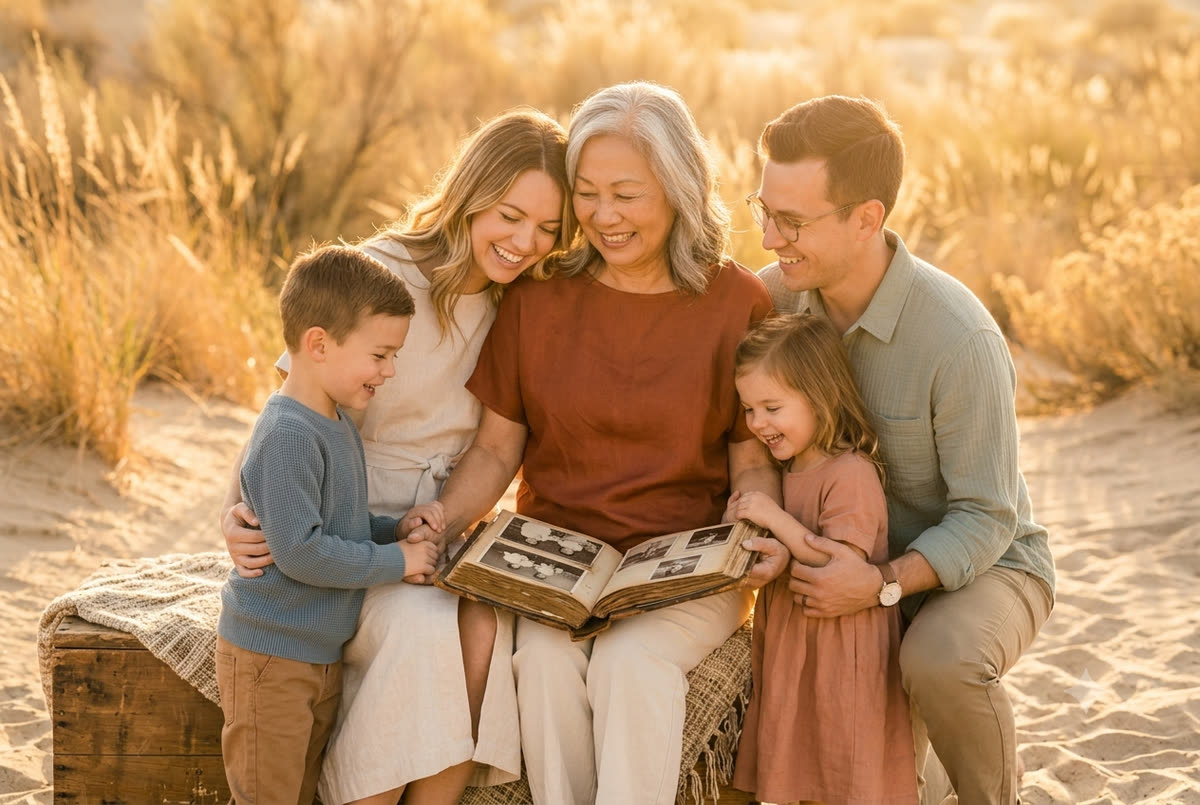
- We bring the people who matter. Some of the truest frames are an adult child's hand resting on a parent's shoulder, or two old friends laughing at something I'll never be told. I leave room for those.
- We don't over-direct. I ask a question — about a wedding, a job, a garden they used to keep — and photograph the answer. The face doing the remembering is what I'm there for.
- Home is always an option, not just a backup. Many of my Legacy sessions happen entirely in someone's living room or back garden, and I'm glad when they do. Even for an outdoor plan, I confirm we can move inside if the day turns too hot, too cold, or simply tiring.
If you're gathering several generations, you might also look at my guide to unhurried multi-generation family portraits, which covers wrangling everyone without exhausting the eldest among them.
Common questions families ask me
Can we photograph someone who uses a wheelchair or walker? Absolutely, and we don't hide it. A walker someone has relied on for years is part of their story. I frame thoughtfully so the picture is about the person, but I never pretend the mobility aid isn't there.
What if my mother gets confused or anxious in new places? Then we go to her, or somewhere deeply familiar. For someone living with dementia, a calm, known setting — a backyard, a care community's garden, a regular bench — almost always produces a better, happier portrait than an unfamiliar park. Tell me ahead of time and I'll plan entirely around it.
What should they wear? Soft, solid colors they already love and feel like themselves in. Comfort first. Nothing new or stiff.
How far in advance should we book? In the cooler months the best morning light gets spoken for, so a few weeks ahead is wise. But I always keep room for the calls that can't wait — when someone's health is changing, we make it happen quickly.
Why I think this work matters
I have come to believe these are the most important portraits I make. A wedding can be photographed again in an anniversary session; a baby will be photographed a hundred more times. But the chance to make a calm, honest, loving photograph of an elder — while the light in their eyes is still theirs — comes once. The quiet park, the close parking, the nearby bench: those small logistics exist so that the person can forget the camera entirely and simply be loved in front of it.
That is the whole point of choosing the gentle spot over the dramatic one.
If you've been meaning to capture a parent or grandparent and weren't sure where to even begin, tell me a little about them — how far they can walk, what kind of morning is a good one, the spot or the room where they're most themselves — and I'll handle the rest. You can reach me here, and we'll find the right quiet corner of the valley, or the right sunlit chair at home, together.