Legacy Photography Guide for La Quinta Families
There is a particular kind of phone call I have learned to recognize within the first few sentences. A daughter, usually, sometimes a son, calling from a kitchen in PGA West or a casita off Washington Street, voice a little tight. Mom is still sharp but slowing down. Dad turns ninety in the fall. The whole family is coming out for the holidays and someone finally said out loud what everyone had been thinking — we should get real pictures while we still can. That is the call that starts almost every legacy session I photograph in La Quinta, and if you are reading this, you may be about to make it yourself.
I want to give you the guide I wish those families had before they picked up the phone. Not a sales pitch — a genuine, practical walk through what legacy photography actually is, why it matters more than people expect, and exactly how it works here in our corner of the desert, from booking around snowbird season to the specific spots in and around La Quinta that photograph beautifully. My hope is that by the end you will feel less rushed and more sure of what you want.
What "legacy photography" actually means
The phrase gets used loosely, so let me be plain about how I use it. A legacy portrait is a photograph made deliberately to outlast the moment — and often to outlast the person in it. It is the picture a granddaughter will frame on her own mantel forty years from now and point to when her children ask who that was. The whole point is permanence, honesty, and the unmistakable feeling of this is exactly who they were.
That is a different thing from a casual family snapshot, and it is also different from the stiff department-store portrait many of us grew up with. Legacy work sits in between: relaxed enough that the real person shows up, but made with enough care — light, composition, expression — that it carries weight. When it is done right, you get the warmth of a candid and the staying power of a formal portrait in the same frame.
In practice, legacy photography for La Quinta families tends to take one of a few shapes:
- An elder's portrait — a single, beautiful, dignified picture of one person at a meaningful age or stage.
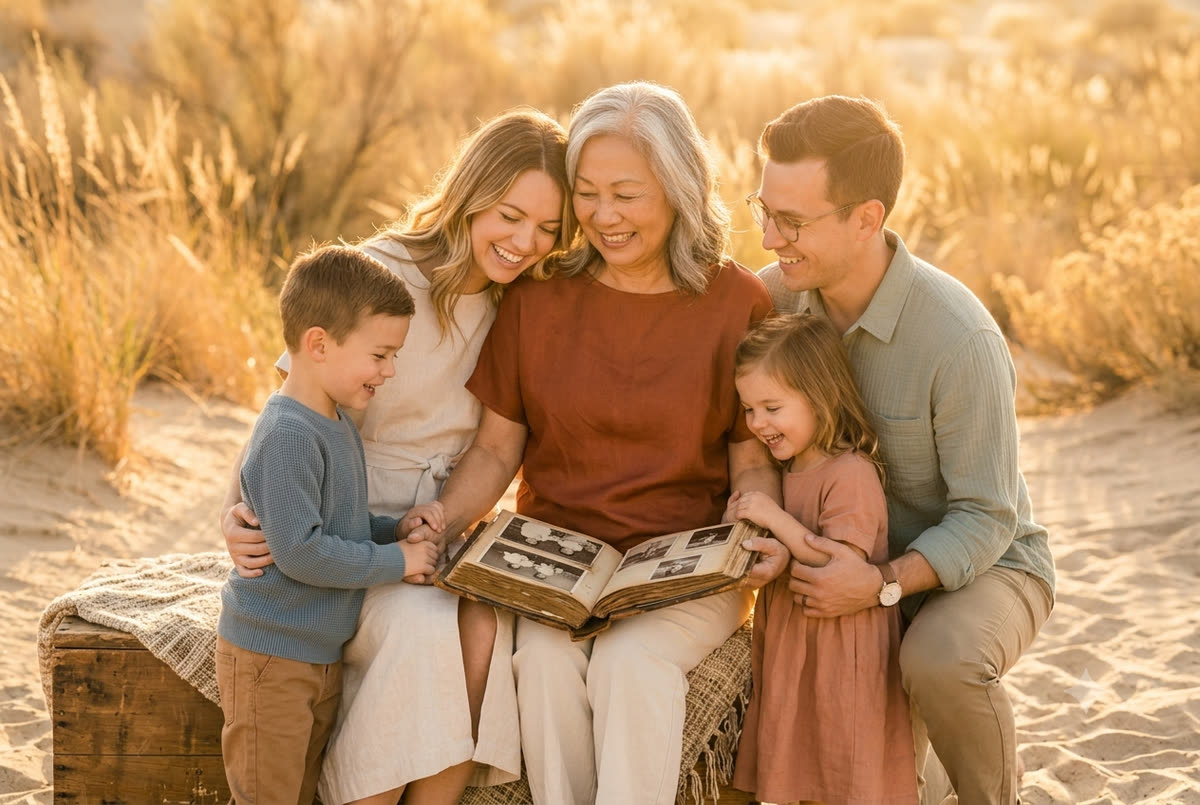
- A multi-generation gathering — grandparents through grandchildren, made when the family is physically together, which out here usually means the winter visit.
- A story session — portraits combined with recorded voice or written memories, so you keep not just the face but the way they told their stories.
Most families come to me wanting the first or second, and discover partway through that they also want the third. I will come back to that.
Why La Quinta families, specifically, should not wait
I am careful not to be dramatic about this, because the goal is reassurance, not pressure. But there is an honest reason these sessions carry urgency here that they might not in a town where everyone lives year-round.
La Quinta is full of families who are visiting their elders, not living beside them. Parents retired to a community off Jefferson or down in the Cove; the kids are in Seattle, Denver, Chicago, the Bay Area. You are all in the same place for maybe a week or two around the holidays, and then the desert empties out again come April. That narrow window is the whole challenge of legacy work here — the people you want in the picture are rarely in the same zip code, and "we'll do it next visit" quietly becomes years.
The other honest factor is time itself. The families who book these sessions are almost never sorry they did. The ones who carry regret are the ones who waited for a better year, a thinner waistline, a moment when Dad's memory was a little sharper — and the better year did not come. I have photographed people in the last season of their lives, and I have also been called too late. The difference between those two outcomes is usually a single decision made a few months earlier than felt necessary.
If you are weighing the timing because of a recent diagnosis or a decline, you may find it steadying to read how I think about photographing a parent who is seriously ill. The short version: it is almost always worth doing, and it can be done gently.
When to book: the La Quinta calendar
Timing here is shaped by two things — when your family is actually in town, and the desert's light and weather. Let me take them in order.
Snowbird season (November through April) is the natural window, and it is also my busiest. This is when the part-time residents are here, when adult children fly out for Thanksgiving and Christmas and spring break, and when the weather is genuinely perfect — daytime in the seventies, soft evenings, the mountains crisp against the sky. If you want a multi-generation session built around a holiday visit, tell me as early as you can. December dates around the holidays go first, often weeks ahead, because every family has the same idea at the same time.
Late spring and summer (May through September) are quieter, and not at all off-limits — they just change the playbook. Midday in July can climb past 110, which rules out long outdoor sessions in the heat of the day. But our summer light at dawn and at the last hour before sunset is some of the most beautiful of the year, and for an elder it is far gentler to photograph at 6:30 in the morning or in the cool of evening than to stand in November wind. If your family lives here year-round, or someone's health makes waiting unwise, summer works beautifully with the right scheduling.
A simple rule I give people: if the session is tied to a visit, book the moment plane tickets are confirmed. If it is tied to a milestone — a ninetieth, a sixty-fifth anniversary, a move into assisted living — book as soon as the milestone has a date. Everything else we can figure out together.
Where we photograph in and around La Quinta
People often assume a legacy portrait means a studio backdrop. It can, but most of my work happens in the places where a family actually lives their life — at home, on the patio, in a familiar garden or neighborhood park a few minutes from the front door. Those everyday settings are my signature, and they are where elders relax fastest. Here are the settings I return to.
At home
For an elder, home is frequently the best studio there is. A favorite armchair by the window, the kitchen where she has made the same recipe for fifty years, the patio where he has his morning coffee looking at the Santa Rosas — these places hold the person. There is no travel, no fatigue, no unfamiliar room to navigate. I work with the natural light coming through your own windows, and I bring what I need to fill in the rest. For someone using a wheelchair, oxygen, or a walker, home removes nearly every obstacle, and the pictures are warmer for it. This is very often my first recommendation for anyone frail or easily tired.
Nearby parks, gardens, and scenic spots
When mobility allows and a family wants the outdoors in the frame, La Quinta has lovely, easy settings a short drive from home — not a wilderness expedition, just a pretty green corner or a familiar view:
- Lake Cahuilla Regional Park — water, palms, lawns, and shade on the southern edge of town, lovely and uncrowded on a weekday morning.
- The garden grounds of the historic La Quinta Resort — bougainvillea, white walls, and old desert architecture that has photographed elegantly for nearly a century.
- The La Quinta Cove neighborhood and the foothills behind it — that dramatic rock face rising right behind the homes makes a stunning, very local backdrop, with the mountains close enough to walk to.
- The date groves and civic gardens out toward Indio — quieter, golden, unmistakably ours, and gentle on tired feet.
For any of these, I build the session around the "golden hour" — the roughly sixty to ninety minutes after sunrise and before sunset — when the light turns warm and directional and faces look their best. We skip the middle of the day, when the overhead light goes flat and the heat makes standing around a chore.
A place that tells the story
Sometimes the right location is none of the above — it is the golf course where he played four times a week, the church on Avenue 50, the restaurant in Old Town La Quinta where the family always celebrates. If a place is part of who someone is, it belongs in the picture. Tell me about it and we will see what is possible.
What to expect in a legacy session
Families are often nervous about this part, especially when the subject is an elder who "hates having their picture taken." Let me demystify it.
Pace. These sessions are slow by design. We are not racing a shot list. If your father needs to sit and rest, we sit. If your mother is at her best in the late morning and fades by afternoon, we shoot in the late morning. I would rather get one true frame in an easy hour than fifty tense ones in a hurry.
Length. A single-elder portrait might take forty-five minutes to an hour. A full multi-generation gathering with several groupings runs closer to ninety minutes to two hours, with breaks built in. Children and very elderly subjects both have a window of patience, and I plan the whole session to use it well — the big four-generation shot happens early, while everyone is fresh, not at the tired end.
Getting a real expression. This is the part I care about most. Anyone can make a person say cheese. My job is to get the look that the people who love this person will recognize instantly — the particular way she tilts her head when she is amused, the hand he rests on his wife's shoulder without thinking. I get there by talking, by asking about their life, by being patient enough that they forget the camera is there. That is the difference between a nice photo and one your family will weep over in twenty years.
Adapting to health and ability. I have photographed people from hospital beds, in memory care, on oxygen, mid-treatment. None of it is a barrier. We adjust seating, timing, and setting around whatever is true that day. If you are unsure whether your loved one is "up to it," that is a conversation to have with me, not a reason to cancel — there is almost always a gentle way.
What to wear
You do not need new outfits, and you should not buy matching shirts. A few simple guidelines go a long way:
- Aim for one gentle palette, not identical outfits. Pick a small range — soft neutrals, denim, warm earth tones, the muted blues and creams that sit beautifully against the desert — and let everyone choose their own pieces within it.
- Avoid bold logos, bright neon, and busy patterns. They date a photograph and pull the eye away from faces.
- Dress the elder in something they feel like themselves in. If your grandmother always wears a particular cardigan and her good earrings, that is the right outfit. Comfort and recognizability matter more than formality.
- Plan for the weather. For outdoor sessions, light layers breathe better, and a hat that comes off easily between frames keeps everyone comfortable. Indoors, none of this matters much — wear what feels like home.
I send every family a short wardrobe note before the session, tailored to the location and season, so you are not guessing.
Beyond the portrait: keeping their voice and stories
Here is the part families rarely ask for and almost always treasure most. A photograph keeps a face. It does not keep the sound of his laugh, or the way she always started the story about crossing the country in 1961 with the same three words.
For many legacy sessions, especially with an elder, I encourage adding a recording — even just audio captured on a phone while we talk during the shoot. We get the portraits, and we also get twenty minutes of them telling you where they grew up, how they met, what they were proudest of. Years later, the grandchildren who never met him can hear his voice. I have watched families listen to those recordings and it undoes them, in the best way.
If that idea resonates, I have written more fully about recording an elder's voice and stories, including simple questions that get people talking. You can do it yourself, or we can build it into the session.
Common questions La Quinta families ask
"Is it strange to do this when nothing is wrong?" Not at all — it is the best time. The easiest, happiest sessions I photograph are the ones booked simply because the family was together and well. You do not need a crisis as a reason.
"What if a parent refuses?" It is more common than you would think, and usually softens. Often the resistance is about feeling old or self-conscious, not about the pictures. Framing it as a gift to the grandchildren — something for them, not vanity — tends to open the door. And once we are talking and laughing in the session, the reluctance usually melts.
"Can you come to assisted living or memory care?" Yes, regularly. I photograph in communities throughout La Quinta, Palm Desert, and Indian Wells, and I am comfortable working around staff schedules, mobility needs, and good days versus hard days.
"How quickly can you do it?" When there is real urgency — a hospice timeline, a parent declining fast — I will move things to make it happen, often within days. Please just say so when you call.
"What do we get afterward?" Carefully edited, high-resolution images you fully own, and printed pieces if you want them. I am a believer in prints — a file on a phone is not the heirloom; the framed portrait on the wall is.
A gentle place to start
If any of this is sitting close to home right now, the most useful first step is usually the smallest one: send me a few sentences about your person. We can figure out the rest together — whether the session belongs in their living room, on the patio, or at a park near the house; whether to fold in a recording of their voice; and how to fit it around a winter visit or a health situation. What I most want to know early is who they are and what would mean the most to keep.
Reach out through my contact page whenever the timing feels right — whether that is this coming winter's gathering or this Saturday. I would be honored to help your family hold onto them.