In-Home Senior Photography Across the Valley
There is a chair in almost every home I visit. The one by the window that gets the morning light, worn soft at the arms, angled just slightly toward the door so whoever sits there can see who is coming. When I photograph an elder in their own home, that chair tells me where to begin. It already knows them better than any studio backdrop ever could.
A good portion of my Legacy work happens this way now — not in a rented space or out under the desert sun, but at a kitchen table in Sun City, in a living room in Rancho Mirage with the patio doors open, in a casita off a courtyard in La Quinta. When a parent or grandparent is in their eighties or nineties, or simply tired in a way that a morning out can't undo, bringing the camera to them changes everything. The portrait stops being an event they have to rise to meet, and becomes an afternoon I get to share.
This is a guide to how in-home senior photography actually works across the Valley — what to expect, how I keep it gentle, and how to plan it so the day feels like a visit rather than a production.
Why photograph an elder at home
Home is where a person is most themselves. Put someone in an unfamiliar room with lights and a stranger holding a camera, and you can almost watch them brace. Photograph them in the room where they read their mail and water the orchids, and within twenty minutes the bracing is gone. They forget I'm working. That is when the real pictures arrive.
There are practical reasons too, and for many families they are the deciding ones:
- Mobility and energy. No transfer from wheelchair to car to wheelchair again, no parking, no long walk across a hot lot. For someone who tires quickly or uses oxygen, that saved energy is the difference between a relaxed sitting and a depleted one.
- Dignity and control. At home, your mother decides which sweater, which chair, whether we pause for coffee. She is the host, not the subject being managed.
- The setting is the story. The bookshelf, the piano, the framed photos of grandchildren on the wall, the kitchen where she has made the same recipe for sixty years — these belong in the portrait. They say who this person is without a single word.
- Comfort for everyone. Family members relax too. Grandkids wander in and out. The dog flops down in the sun. Some of my favorite frames come from these unguarded in-between moments.
If you are weighing this against a sitting somewhere else, I've written more about the gentler approach in photographing elderly parents with patience and care. The short version: meet people where they are, literally.
What an in-home session looks like
I want to take the mystery out of this, because the unknown is what makes people nervous. Here is how a typical visit unfolds.
Before I arrive
We talk first — usually a phone call, sometimes with the adult child who arranged everything and sometimes with the elder directly. I ask about energy and time of day. Many of the people I photograph are sharpest and most cheerful mid-morning, so I tend to favor a 9:30 or 10:00 arrival over the afternoon, when fatigue and "sundowning" can settle in. We talk about what matters to them: a wedding ring they never take off, a quilt someone made, a uniform, a garden they tend. Those details become anchors for the session.
I also ask, plainly, about anything I should know — hearing, vision, memory, whether there are good days and harder days, whether a caregiver or hospice schedule shapes the week. None of it surprises me. All of it helps me show up prepared and unhurried.
When I get there
I come with very little. A camera, a couple of lenses, and usually one small light I may or may not use. No racks of equipment, no crew tramping through the house. I want the footprint to feel like a friend stopping by, not a film set arriving.
The first thing I do is sit down and not photograph anything. We talk. I let them get used to my voice and my face. I look around the room — not for "good angles" so much as for where they're already comfortable and where the light is kind. In most Valley homes that means the big windows. Our light here is generous; even in the shoulder months a north- or east-facing window throws the softest, most flattering glow you could ask for, no equipment required.
The pace
Slow. We work in short stretches — ten or fifteen minutes, then a rest, a sip of water, a story. If someone needs to lie down partway through, we stop and pick up later or another day entirely. I would always rather come back twice than tire someone out once. The whole sitting might run an hour and a half, but the actual photographing inside that is gentle and broken up.
I talk the entire time, and most of it has nothing to do with posing. I ask about how they met their husband, what the Valley looked like when they moved here, what they made for Sunday dinners. The looks I'm after — the soft amusement, the faraway tenderness, the sudden clear-eyed directness — come out of those questions, not out of "chin down, look here."
Making the most of the home itself
A home gives me far more to work with than any blank wall. A few things I look for, and a few you can set up before I arrive if you'd like:
- A window with indirect light. We rarely lack for sun here, so I'm usually managing it down, not chasing it. Sheer curtains are a gift. Direct afternoon sun pouring through a bare west window is the one light I steer around, so a morning window or a softly shaded room tends to win.
- Meaningful objects in reach. The reading glasses, the well-thumbed Bible, the deck of cards for the bridge game, the locket. Set out two or three things that matter. Held objects give restless hands something to do and give the portrait its truth.
- One tidy zone, not a whole-house clean. Please don't exhaust yourself cleaning. I only need one good corner. Often the most honest backdrop is the slightly lived-in one anyway.
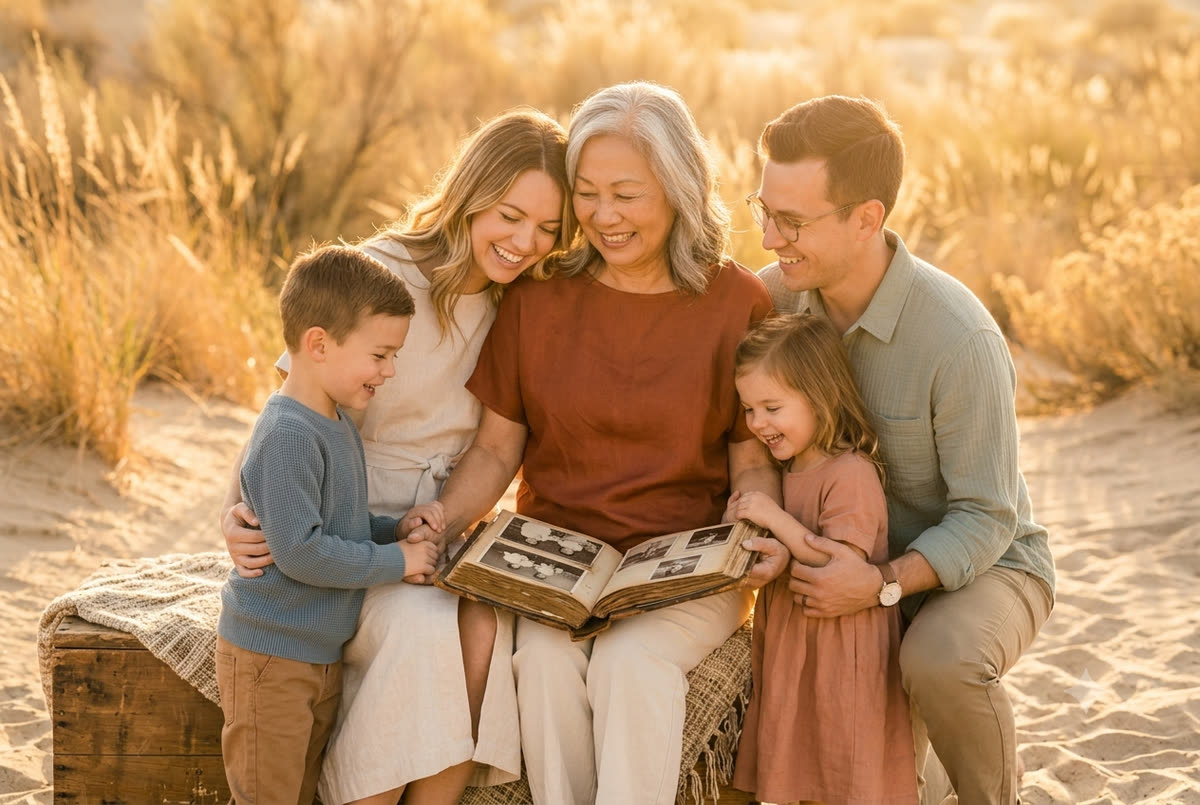
- Photos of the past. If there are old portraits on the walls or in an album, I love working a few into the session — your mother at thirty beside your mother now. Those pairings become some of the most treasured prints families order.
For families thinking about how to weave generations together, I get into that more in planning a multi-generation family portrait.
Across the Valley: a few local notes
I photograph in homes from Palm Springs down through Palm Desert, Indian Wells, La Quinta, and out to Indio, and across the gated communities and 55-plus enclaves in between — Sun City Palm Desert, Trilogy, Del Webb, the country clubs in Rancho Mirage and Indian Wells.
A handful of things worth knowing locally:
- Gate and guard logistics. Most of the communities here have a gate. Just add me to your guest list for the day and let me know the gate name and any code. It saves a phone call at the worst possible moment.
- Season matters for scheduling, not for whether we can shoot. The cooler months draw more of the family back to the Valley, so if you're hoping to gather several generations into the frame, that's a natural window to aim for. But because we work indoors in the cool, an in-home sitting comes out just as beautifully in the quiet of summer, when the calendar is wide open.
- Indoor light is reliable year-round. Unlike an outdoor session that lives or dies by golden hour, an in-home portrait isn't at the mercy of a 110-degree afternoon. We work around your loved one's best hours, not the sun's.
- Care communities welcome. I also photograph residents in assisted living and memory care across the Valley — Atria, Brookdale, Vista Cove, and the smaller board-and-care homes. The same gentleness applies; I simply coordinate with staff on timing and quiet space.
Common questions
Will it tire my mother out?Not the way you might fear. Because we rest often and I follow her energy rather than a shot list, most people end the visit more lifted than drained — they've been listened to for an hour, which is its own kind of medicine.
What if she "doesn't photograph well" or doesn't want to?I hear this constantly, almost always from the very people who later love their portraits most. Reluctance usually isn't about vanity; it's about feeling exposed. Working at home, slowly, with conversation instead of commands, dissolves most of it. And I never force a smile. A calm, true expression outlasts a posed grin every time.
What should she wear?Whatever feels like her. Solid, soft colors photograph kindly; I'd gently steer away from brand-new clothes she doesn't feel at home in. The cardigan she actually wears beats the outfit bought for the occasion.
Can the family be in some pictures?Please. Some of the most meaningful frames I make are a daughter's hand over her father's, three generations crowded onto one couch, a grandchild leaning in. We can do solo portraits of your elder and family groupings in the same visit.
How soon should we do this?Sooner than feels urgent. I say this as kindly as I know how: the families who reach out "before there's a reason to" are never the ones with regrets. If you've been thinking about it, that thought is the reason.
What do we end up with?Beautifully finished portraits — and I steer families toward printed work, not just files on a phone. An album or a framed wall piece is what gets passed down. The thumb drive gets lost in a drawer; the print on the wall gets pointed to by grandchildren for decades.
A few honest cautions
- Don't wait for the "right time." Health rarely cooperates with our calendars. The right time is when everyone is well enough to enjoy the afternoon.
- Don't over-orchestrate the day. The instinct to script everything — the outfits, the poses, the schedule down to the minute — works against the very ease that makes home portraits special. Let it breathe.
- Don't skip the in-between moments. Tell me ahead about the small rituals — the afternoon tea, the crossword, the way he always whistles while he waters the plants. Those are gold, and I'll want to catch them.
Let's plan a gentle morning together
If there is an elder in your life — a parent, a grandparent, a neighbor who has become family — and you've felt that quiet tug to have them photographed while they're here to be photographed, I would be honored to help. We can do it entirely on their terms, in their own home, at their own pace, anywhere across the Valley.
When you're ready, reach out and tell me about them. Tell me their name, where they live, and what makes them them — and we'll find a morning that feels easy for everyone.