How to Get Kids to Cooperate for Photos
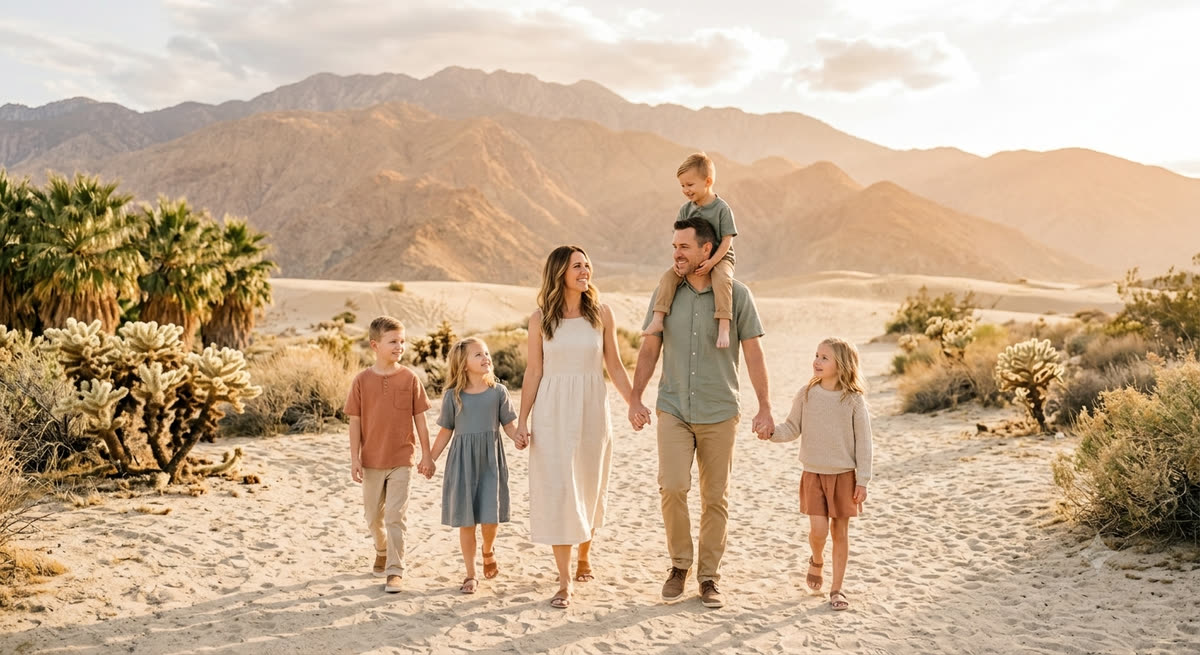
Let me tell you a small secret I've learned over many years of photographing families in the Coachella Valley: the children who "won't cooperate" are almost never the problem. The setup is. The wrong time of day, an empty stomach, a stiff pose held a beat too long, a desert afternoon that's just too hot — those are the things that turn a happy toddler into a puddle on the ground. Fix the setup, and cooperation tends to take care of itself.
I say this gently, because I know the worry. So many parents arrive at a session apologizing in advance. "He's been in a mood all week." "She's shy with new people." "They never sit still." I always smile, because I've heard it a hundred times, and the photos almost always turn out beautifully anyway. The way I keep a session loose and low-key is not just a nice-to-have — it's the actual technique. Children read the room. When the adults relax, they relax.
It also helps that most of my sessions happen on a child's own turf. My bread and butter is in-home photography — your living room, the morning light through the kitchen window, the backyard patio — and a short list of local parks and gardens around the valley. Familiar ground is where small children are bravest, and a brave child is a cooperative one.
This is the most complete guide I can give you on how to get kids to cooperate for photos, written specifically for families here in Palm Desert, Palm Springs, Rancho Mirage, Indian Wells, La Quinta, and across the desert. Some of it is universal. A good deal of it is local — because the light, the heat, and the rhythm of life out here change what works.
Start with timing — it's 80 percent of the battle
If you remember nothing else from this article, remember this: a well-timed session beats every trick in the book. A child who is rested and fed will cooperate. A child who is hungry, overtired, or melting in the sun will not, no matter how charming the photographer is.
Work around naps and bedtimes, not against them
For babies and toddlers, I always ask one question first: when is your child genuinely at their best? For most little ones that's mid-morning, after breakfast and before the first nap, or in that sweet window in the late afternoon after a nap and before dinner starts to feel far away. I'd much rather schedule around your child's real rhythm than fight a tired two-year-old at the "perfect" hour.
Older kids — five and up — are more flexible, but even they have a wall they hit. School-day evenings can be rough. Weekend mornings tend to be golden.
Match the light to where we're shooting
How I time a session depends on where it happens. For an in-home session, I work with natural window light — usually the soft, even glow of mid-to-late morning, when a kitchen or living room fills with gentle daylight and there's no need to chase the clock against a sunset. That flexibility is one of the quiet advantages of shooting at home: we can pick the hour that suits your child, not the one that suits the sky.
For anything outdoors — a park, a garden, the backyard — I lean on golden hour, the hour after sunrise or, more often, the hour before sunset. The Coachella Valley's daytime sun is bright and, for much of the year, genuinely hot, so that softer window of light does double duty: it flatters the photos and it lands at a comfortable temperature. A cool, easy child is a cooperative child.
Let the seasons guide you
- The cooler months (November through April): This is our prime time for outdoor sessions. Mild mornings, comfortable evenings, that postcard desert light. If you have any flexibility, this is when to book a park or garden shoot. Golden hour can be a leisurely, pleasant experience for even the youngest kids.
- Summer (roughly June through September): It's hot — often well over 100 degrees. I still photograph beautiful summer sessions, but this is when in-home work really earns its keep — air-conditioned comfort, soft window light, no heat to fight. If we do go outside, we shoot at the very edges of the day: right at sunrise, or the last 40 minutes before sunset, somewhere shaded and close to home rather than out in open desert at midday. We keep things short and keep water close.
- Spring and fall shoulders: Wonderful, with wildflower color in spring and warm tones in fall. Watch the afternoon wind, which the desert serves up generously — it can undo a toddler's good mood (and hair) in seconds.
If you'd like more on this, I go deeper in my guide to the best time of year for family photos in the desert.
Prepare your child before the day — without overdoing it
A little preparation goes a long way. Too much, and you build pressure that backfires.
Talk it up, lightly. In the few days before, mention it the way you'd mention a fun outing: "We're going to meet Margot and play at the park, and she's going to take some pictures of us being silly." Frame it as play, not performance. Avoid "you have to behave" or "smile nicely for the camera" — that turns a fun thing into a test.
Don't over-rehearse smiles. Please, please don't drill the "cheese" face. Practiced smiles are the squinty, toothy grimaces that make parents sigh at the gallery. I'd far rather capture a real laugh. We'll get those by playing, not posing.
Show them a picture of me, or my website. For shy children, knowing the new person's face in advance takes the edge off. By the time we meet, I'm a little bit familiar instead of a stranger with a big camera.
Let them weigh in on something small. Picking their own shoes, or which stuffed animal comes along, gives a child a sense of control. Cooperation flows much more easily when a child feels like a participant rather than a prop.
What to bring — the family photographer's kit
This is the part parents most often underestimate. A small, well-packed bag has rescued more sessions than I can count.
- Snacks — but the right kind. Bring things that won't stain or smear: dry cereal, crackers, a banana, plain puffs for babies. Avoid anything red, sticky, or chocolatey right before we start. A snack break mid-session is a powerful reset button.
- Water for everyone. Non-negotiable in the desert, even in winter. Our air is dry; dehydrated kids get cranky fast.
- A favorite small toy or lovey. It can live just out of frame and come out when a little one needs comfort. Sometimes it makes it into the photos, and honestly those become some of the most treasured images — that worn bunny is part of this chapter of their life.
- A change of clothes for toddlers, in case of spills or a sudden encounter with desert dirt.
- Wipes and a hairbrush for quick touch-ups. The desert wind will hand you plenty of reasons.
- Layers in the cooler months. Golden-hour winter evenings cool off quickly once the sun drops behind the mountains. A cold child is a done child.
- Bug spray or sunscreen depending on season and location — applied well before, so it's not a fresh battle at go-time.
Dress for cooperation, not just for the photo
Beautiful outfits matter, but comfort matters more for the youngest crowd. A scratchy collar, stiff new shoes, or tights that itch will derail a toddler faster than anything I can do with a camera.
Choose clothes your child can actually move and play in. Soft fabrics, familiar shoes, nothing brand-new and unbroken-in. I love soft neutrals, warm earth tones, and gentle creams and sages — at home they sit beautifully against natural wood and light walls, and outdoors they echo the palms and the mountains, and they tend to be the comfiest options anyway. Pull the family's outfits from the same gentle palette and let each child keep a bit of their own personality; it reads more honestly than dressing everyone in an identical uniform.
During the session — how I actually get the smiles
Here's what happens when we're together, and how you can help it along.
I let kids warm up at their own pace
I never start by aiming the camera at a child and asking them to perform. I say hello, I get down to their level, I talk about something they care about — a superhero on their shirt, a loose tooth, the lizard we just spotted in the yard. Those first few minutes aren't wasted time; they're the foundation. Catching the small, unguarded flash of who a child really is — that's the part I love most, and it only happens once they trust me.
We play instead of pose
With young children, I rarely say "smile." Instead we run, we chase, we play peekaboo, we tell terrible jokes, we ask about the smelliest thing they can think of (the answer is always wonderful). Parents tickle, swing, and whisper secrets. I'm photographing the whole time. The genuine laughter that comes from real play is the thing you'll treasure — far more than any posed grin.
Give the wiggles somewhere to go
Movement is a child's natural state. So I build it in. We walk the path together, we count steps, we do "the biggest jump ever," we spin and flop into the grass. A toddler who's allowed to move is a toddler who's having fun. The stillness — the quiet, tender frames parents love — comes in the small pauses between, and those are easy to catch once a child is happy.
Bribery? I prefer "incentives," used wisely
I won't pretend treats never help. A promised trip for ice cream after, or a few puffs as a between-shots reward, can absolutely smooth a tricky stretch. The trick is to keep them small and to keep them genuinely cheerful — a reward offered warmly, never a treat dangled as a threat. And avoid promising the snack for smiling, which produces those strained faces. Promise it for "helping me" or simply for the fun of the day.
Follow the child, don't force the shot
If a two-year-old decides the most fascinating thing in the world is a pinecone, we photograph the pinecone moment. Some of my favorite images come from exactly these detours — the absorbed concentration, the little discovery. When you stop fighting a child's focus and join it instead, the resistance disappears.
Parents: relax your own shoulders
Children are mirrors. If you're tense about whether they'll "behave," they feel it and tense up too. The single most helpful thing you can do is enjoy yourself. Laugh at the chaos. Don't correct every little thing in the moment. Let me do the gentle steering. The sessions where parents trust the process and simply play with their kids are, without exception, the ones with the most magical photos.
Tailoring your approach by age
Different ages need different handling. Here's roughly what I plan around.
Babies (0–12 months)
Full bellies and dry diapers rule everything. We work in short bursts around feeds, and we keep them warm and supported. Newborns sleep through much of it, which is lovely. For older babies, a peekaboo game and a parent making silly sounds just over my shoulder works wonders. Patience is the whole game.
Toddlers (1–3 years)
The famous "won't sit still" age, and honestly my favorite kind of challenge. We don't ask them to sit still. We let them roam within a pretty spot and we photograph the joy. Snacks, a lovey, and a sense of humor are essential. Expect a meltdown or two; they pass quickly, and the session recovers. I promise.
Preschool and early school age (4–7 years)
These kids love to be helpers and love silliness. Give them a "job" — "can you help me find the best jumping spot?" — and they light up. Knock-knock jokes, made-up words, and pretending I can't tell which one is the real them all earn real laughter.
Older kids and tweens (8+)
The trick here is dignity. They don't want to be treated like babies, and they can feel self-conscious. I talk to them like the interesting people they are, ask about their world, and give them a bit of input on locations and poses. A little respect buys a lot of cooperation.
The settings that work best for happy kids
Location matters more than people think, because a place a child enjoys is a place a child cooperates. Here is where I most often work around the Coachella Valley, roughly in the order I reach for them:
- Your own home and backyard. This is my signature, and for good reason. For babies, shy children, and anyone who melts down in unfamiliar places, home is the comfort zone — the familiar couch, the patio, the toys within reach. The window light is soft and forgiving, there's a snack and a nap close by, and the photos carry an intimacy that no location can match. It's where children are most themselves.
- Grassy parks and shaded green spaces in Palm Desert and Rancho Mirage — room to run, soft ground for flops, and shade when it's warm. A nearby park is the natural extension of a backyard session.
- Gardens and leafy courtyards with greenery, texture, and gentle pools of shade — pretty, contained, and easy for a small child to feel safe in.
- Palm groves and date-tree settings that are uniquely ours, offering shade, texture, and a real sense of place when a family wants something distinctly desert.
If your family is up for an adventure, the open desert washes near La Quinta and Indio can be lovely at golden hour for older, bolder kids — but it's the exception, not my everyday. I'm always happy to suggest a spot based on your child's temperament and the season — a wide-open desert vista is wonderful for an adventurous five-year-old and overwhelming for an anxious toddler. For more, see my notes on the best family photo locations in the Coachella Valley.
Common mistakes to avoid
A few patterns I see again and again — and how to sidestep them:
- Scheduling over a nap or right at a meltdown hour. The most common one, and the most fixable. Protect the rest and the food.
- Booking high-noon in summer. Harsh light and desert heat are a tough combination for small kids. Edges of the day, always.
- Threatening or bribing under pressure. "Smile or no treat" produces exactly the strained face you don't want. Keep it light.
- Apologizing constantly during the shoot. It signals to your child that something is going wrong. Trust me; we're fine.
- Over-managing in the moment. Constant "sit up, stop that, look here" wears everyone down. Let me handle the direction so you can just be Mom or Dad.
- Giving up too soon after a wobble. A two-minute meltdown is normal and almost always followed by some of the best frames of the day. We just wait it out with a snack and a giggle.
What to expect, and a gentle reassurance
A family session with little ones is not a quiet, orderly affair, and it isn't supposed to be. There will be running, some silliness, perhaps a tear, and a great deal of laughter. My job is to find the honest, warm, timeless images inside all of that — and after many years, I can tell you the children who arrive "impossible" leave with a gallery their parents adore.
Here's the thing I wish every nervous parent knew before they booked: I'm not hoping for perfectly behaved children. I'm hoping for real ones — the wiggly, curious, occasionally grumpy children who actually live in your house — because real is what makes a photograph something you'll treasure for years to come.
If you're planning a session, you might also like my guide to what to wear for desert family photos, which pairs naturally with everything here.
Let's make something your family will keep
If worry about how the kids will do has been the thing holding you back, let it go. Bring them exactly as they are, on a Saturday morning in your own living room or at a park down the street. You handle the giggling; I'll handle the patience and the playing-along, and between us we'll catch this fast-disappearing chapter of your family's life while it's still here.
Tell me a little about your kids — their ages, their quirks, what makes them laugh — and we'll shape a session around them. Send me a note through my contact page whenever you're ready, and we'll find a date that fits your family's rhythm.