Retirement Legacy Sessions
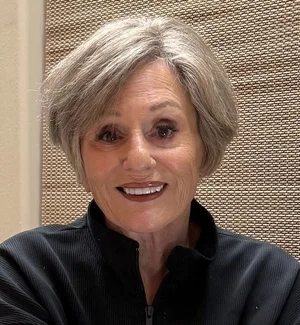
There is a particular week in someone's life when the alarm clock loses its grip. The badge gets handed back, the work email goes quiet, and a person who spent forty or fifty years being defined by what they did for a living wakes up one morning as simply themselves. That threshold deserves a photograph. Not a stiff corporate headshot and not a hurried phone snap at the farewell lunch, but a real portrait of who this person is at the moment a whole career closes behind them and the rest of their life opens up ahead.
I photograph a lot of these here in the desert, and I want to walk you through what a retirement portrait session actually involves, why it matters more than people expect, and how we make one that you'll be glad to have on the wall for the next thirty years.
Why retirement is one of the most photographable milestones we have
We are quick to book photographers for weddings, newborns, and graduations. Retirement tends to slip by unmarked, which has always struck me as strange. It is arguably the biggest identity shift an adult goes through. A wedding adds a person to your life; retirement hands you back your own time. The teacher who shaped three decades of kids, the nurse who worked night shifts through two recessions, the contractor whose hands built half a neighborhood — that body of work doesn't get a ceremony with a photographer the way a wedding does. The party at the office is lovely, but it's loud and fluorescent-lit and over in an hour.
The Coachella Valley makes this milestone especially worth marking. So many people here didn't just retire — they retired to Palm Desert, Rancho Mirage, Indian Wells, La Quinta. They closed a career in Seattle or Chicago or Toronto and chose this place as the reward. A retirement portrait session here is often two stories at once: the close of the working chapter and the start of the desert chapter. I love photographing that double meaning.
What a retirement portrait session actually is
When people first hear "retirement portrait," they picture something formal and a little dated — a person in a blazer, hands folded, against a gray studio backdrop. That's one version, and if the career was the kind that wore a uniform or a suit with pride, we can absolutely honor that. But most of the sessions I shoot are warmer and more personal than that.
A retirement portrait session is, at its heart, a portrait of a person at a hinge point. We build it around three questions:
- Who were you in the work? The doctor's white coat, the chef's knives, the pilot's epaulets, the teacher's classroom, the rancher's boots. The tools and uniforms of a life's work carry enormous weight.
- Who are you outside of it? The golfer, the grandmother, the painter, the gardener, the road-trip couple with the new Airstream. Retirement is the permission slip for all of this.
- Who's coming with you into this next part? A spouse, the kids and grandkids, a circle of friends, the dog who's about to get a lot more walks.
We don't have to answer all three in one sitting. Some clients want a single, distilled portrait. Others want a small story — a few frames of the work, a few of the new freedom, and a family grouping to anchor it. We decide that together before the camera ever comes out.
The conversation comes first
Before I ever pick up a camera, I want to hear the story. I'll ask what you did, how long you did it, what you were proud of, and what you're most looking forward to now. This isn't small talk — it's how I find the one true image of you. Someone might tell me, almost as an aside, that they kept the same pair of work boots for twenty-two years, or that they always wanted to photograph the desert in bloom and never had a free spring to do it. That detail becomes the photograph. The picture that ends up meaning the most is almost never the one we planned on the call; it's the one that surfaces because we took the time to talk.
This is also where we sort out the practical questions. Do you want this to be just you, or you and your spouse? Should the grandkids be in some of the frames? Is there a meaningful object or place we should build around? There are no wrong answers, but the more I know going in, the more the session feels like yours and not a template.
Where we shoot, and how the light works for you
Location is half the portrait. Here are the directions a retirement session tends to go, and how each plays out specifically here in the valley.
In your own home
Most of my retirement portraits happen right where people live, and that's my favorite place to make them. A sunlit living room, the patio of a home in Sun City Palm Desert or Trilogy, a garden you've tended for years, the pool in a Rancho Mirage backyard. Indoors I work entirely with natural window light — it's soft, forgiving, and kind to every age, and it falls across a face far more gently than anything I could haul in and switch on. These rooms and patios tell the truth about this chapter of life in a way a rented studio can't fake. If your patio garden is your pride, that's the set. If the kitchen is where the family always ends up, we make a frame there.
A favorite park, garden, or club
When people want to step outside, we usually don't go far — a nearby park, one of the valley's botanical gardens, a quiet patio at the country club where you'll be spending your Tuesdays now. For anything outdoors I build the session around golden hour, the last hour before sunset or the first after sunrise, when the light turns warm and flattering and everyone looks easy in it. If you're drawn to a more scenic backdrop, the gardens and palm groves around the base of the Santa Rosa Mountains and the greener edges of La Quinta and Indio photograph beautifully at that hour. In the deep summer we either shoot early in the morning or move indoors, because a 110-degree afternoon is no place to ask anyone to stand and smile.
At the place of the work
Sometimes the most powerful version is to go back to where the career happened — the clinic, the workshop, the school, the firehouse. If that's available to us and it's safe to arrange, a portrait in that environment, on one of the last days, carries a charge nothing else does. We have to plan these carefully around access and permissions, so tell me early if this is the direction you're drawn to.
A formal studio-style portrait
And yes, the classic dignified studio portrait still has its place, especially when someone wants the uniform-and-medals formality. We can do that cleanly and beautifully, with light I shape to be soft and kind.
What to wear and what to bring
A few honest, practical notes, because this is where people most often ask for help.
- Wear what feels like you, not a costume. Solid, muted colors photograph beautifully and never date. The desert palette — warm neutrals, soft blues, sage, cream — sits naturally against our landscape. I'd steer you away from tight patterns and big logos, which pull the eye away from your face.
- Bring the work, if it has weight. The uniform, the stethoscope, the tools, the name tag, the hard hat. Even if we only use them in a frame or two, they're worth having on hand. These objects are the visual shorthand of a whole career.
- Bring the future, too. New golf clubs, the watercolor kit, the hiking boots, the passport. Props from the chapter ahead make wonderful, hopeful counterpoints to the ones from the chapter behind.
- Layers help. Desert evenings cool off quickly once the sun drops, even after a warm day. A jacket or shawl can both keep you comfortable and add a nice layer to the look.
- Don't over-rehearse. The best frames come when you stop performing for the camera. I'll handle that part — your only job is to show up as yourself.
Bringing family into it
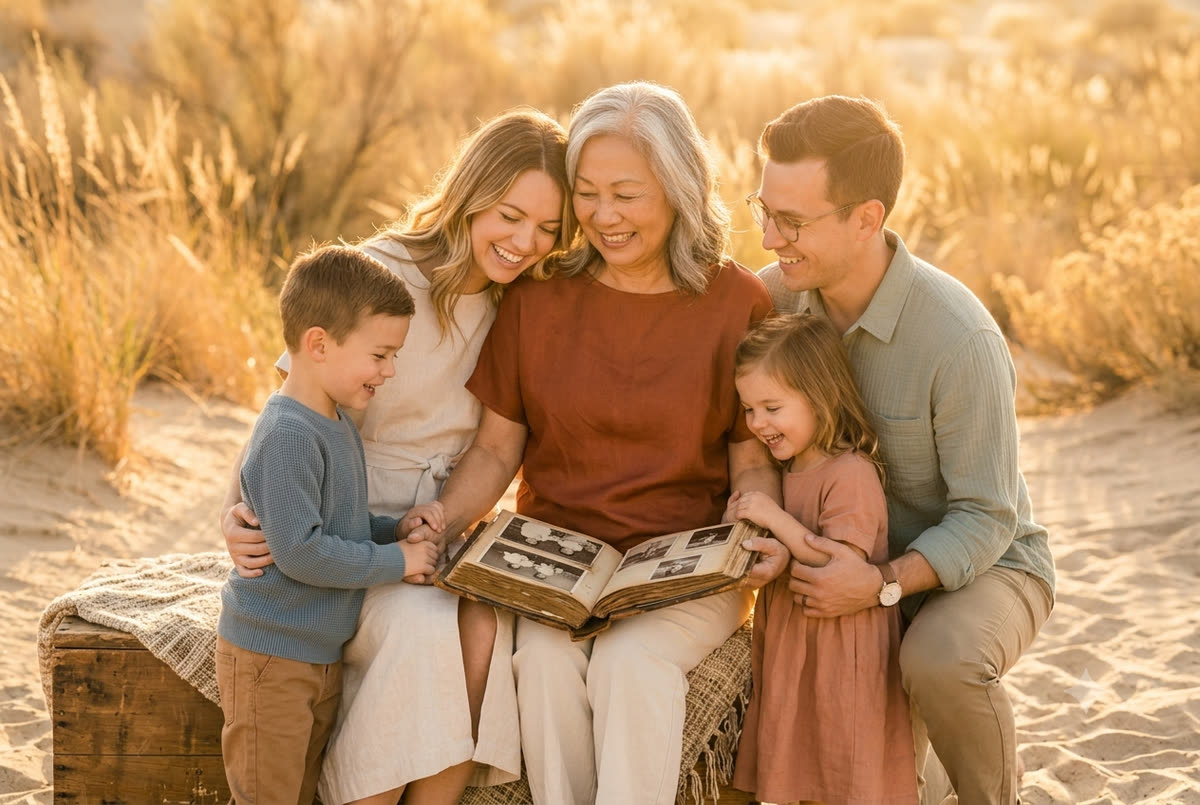
Retirement portraits very naturally widen into family ones, and I encourage it when it fits. For so many people here, the whole point of retiring to the desert is proximity — to grandchildren who visit on school breaks, to adult kids who fly in for the holidays. If the family is going to be gathered anyway, a retirement session is a beautiful excuse to make a real generational portrait while everyone is together. A session can begin as a solo portrait of one newly-retired grandparent and, by the end, grow into three or four generations gathered on the same patio.
If that interests you, it pairs well with what I do in multigenerational family portrait sessions, where the whole point is getting three or four generations into one honest frame. And if there's a specific person being celebrated, a milestone birthday portrait session follows the same gentle, story-first approach.
How I think about these as legacy work
I've started folding retirement portraits into what I call my Legacy work — sessions built specifically around generational and milestone moments, the ones meant to be passed down rather than posted and forgotten. A retirement portrait is legacy by its very nature. It's the image the grandkids will point to and say, that's the year Grandpa stopped working and we got him back. It's the frame that ends up beside the wedding photos and the baby photos as part of the family record.
That framing changes how I shoot it. I'm not chasing a trendy edit that'll look dated in five years. I want a portrait that's honest, warm, and timeless — one that holds up as long as the people in it want it to. The whole spirit of legacy and heritage photography is making images for the long haul, and retirement sits squarely inside that.
Common questions
Should I do this before or after my last day?Either works, and it depends on what you're honoring. If the work environment or uniform is central, sometimes we shoot in the final week while you still have access. If the session is really about the freedom ahead, the weeks just after retiring are lovely — there's a visible lightness in people once the last day has passed.
I'm not very comfortable in front of a camera. Is this for me?Especially for you. Most of my retirement clients have spent decades being the one doing the work, not the one being photographed, so feeling awkward is the norm, not the exception. My whole job is to make that fall away. We talk, we go slowly, and the camera becomes background noise faster than you'd think.
Can it just be me? It feels a little self-indulgent.It is not self-indulgent in the slightest. A lifetime of work earns a portrait. Plenty of my sessions are one person, full stop, and they're some of the most meaningful ones I shoot.
What do we end up with?That's a conversation we have based on what you want — wall pieces, an album, prints for the kids. Because these are legacy images, I lean toward printed, archival pieces rather than files that get lost in a phone. We'll figure out the right form for your home and your family.
A few mistakes I'd help you avoid
- Waiting too long. People mean to do this and then a year slips by. The clarity and feeling of the moment are strongest right around the transition. Catch it then.
- Defaulting to the office headshot. If your company took a flat corporate photo on your way out, that's a record, not a portrait. It rarely looks like the actual person.
- Booking a flat midday slot to "get it over with." I'll always steer us toward window light indoors or golden hour outside. The quality of the light is too important to compromise for the sake of convenience.
- Leaving out the things that tell the story. The boots, the tools, the spouse of forty years. The specifics are what make it yours.
Let's mark the moment
If you or someone you love is closing out a career — whether you spent it here in the valley or you're just now arriving to start the next chapter under these mountains — this is a moment worth keeping. I'd be glad to hear the story behind your work and help shape a portrait that does it justice: in the light of your own living room, out in a garden at golden hour, or wherever this chapter of your life truly lives.
Tell me a little about the career you're closing and the years ahead, and let's make a portrait of it — start the conversation here. We'll build something you'll be proud to pass down.