90th Birthday Legacy Portraits
A ninetieth birthday is not the same kind of party as a fortieth. By the time someone reaches ninety, the people gathered around them have usually traveled a long way to be there — grown children flying in from other states, great-grandchildren meeting cousins for the first time, old friends who have known the guest of honor since before the desert had half its streets. What everyone in that room quietly wants is the same thing: to hold onto this. To have a real picture of all of them together while they still can.
That is what I mean by a legacy portrait. Not a stiff studio pose, and not the blurry phone shot someone grabs while the cake is being cut. A photograph made on purpose — calm, well-lit, and honest — that becomes the family's anchor image for the next thirty years. If you are searching for 90th birthday photo ideas because you are planning a celebration here in the Coachella Valley, this is the guide I wish every family had before the day arrived.
Why a milestone like this is worth photographing properly
I have been photographing families across Palm Desert, Rancho Mirage, and La Quinta for a long time, and I can tell you the pattern without exaggeration. The pictures that families come back to me for, years later, are almost never the candids from the party. They are the deliberate ones. The one frame where Grandma is seated and every face around her is turned the same direction, lit evenly, eyes open, nobody mid-blink.
The reason is simple and a little tender: a ninetieth often turns out to be one of the last times the whole family is physically in one place. People mean to do the big group photo "next time," and next time has a way of not arriving. So when a family asks me what they should do for the milestone, my honest answer is to treat the portrait as the main event, not an afterthought squeezed between dinner and dessert.
If you are weighing this against a more casual approach, it may help to read how I think about family reunion photography in the desert — much of the same logic applies, just at a smaller, more intimate scale.
The one picture you cannot skip: four generations
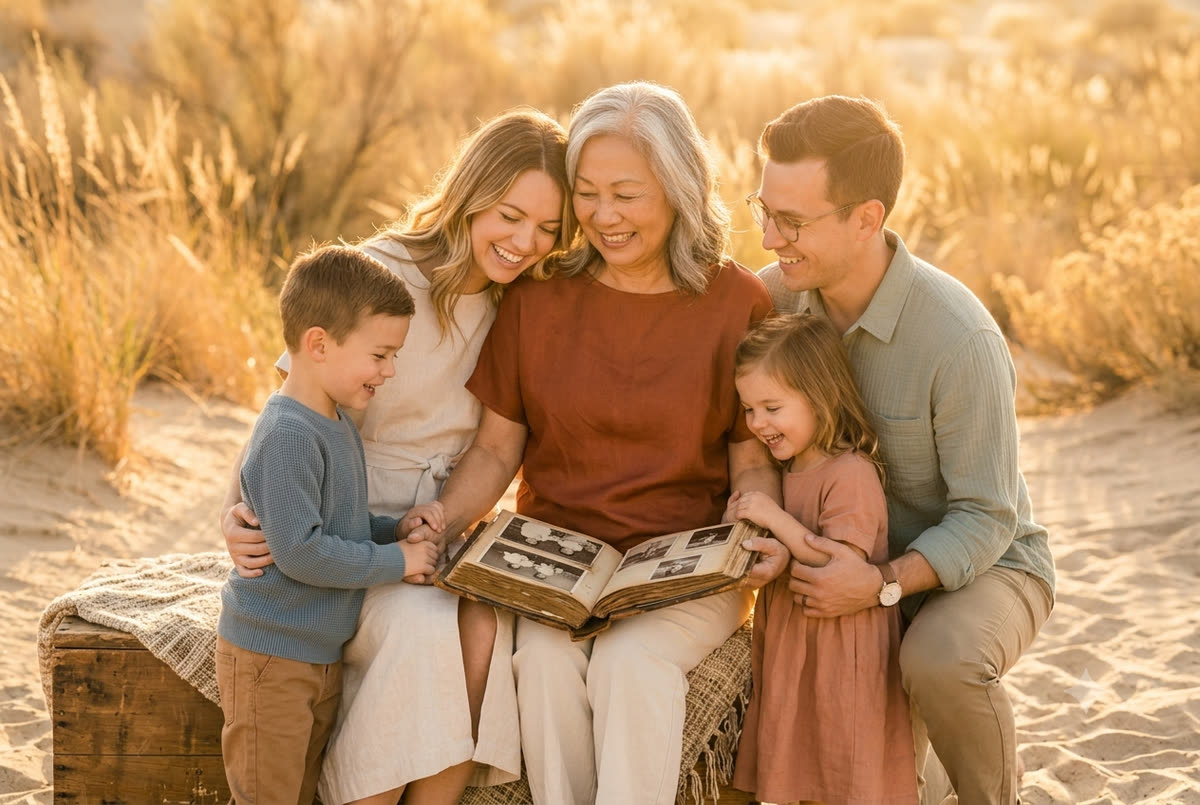
If your family spans four generations — the honoree, their children, grandchildren, and great-grandchildren — that is the photograph to build the whole session around. A four-generation portrait is genuinely rare. Most families never manage to make one, because it requires a specific set of people to all be alive, well, and in the same room at the same hour.
Here is how I like to compose it so it reads clearly instead of looking like a crowd:
- Seat the eldest. The ninety-year-old sits, comfortably, in a real chair with back support — not a folding chair. Everyone else arranges around and behind.
- Build the line of descent visibly. I often place the direct line — child, grandchild, great-grandchild — close to the honoree so the four generations read at a glance, then fill the rest of the family around them.
- Put the smallest ones where they can be themselves. A great-grandbaby on the lap, a toddler on the floor at the front. We are not going to win a battle with a two-year-old's patience, so we photograph fast and accept a little wonderful chaos.
- Make a clean version and a relaxed version. One frame where everyone is composed and looking at me, and one right after where I tell a joke and let them all react. Families almost always end up loving the second one more.
Bring names and ages written down if it is a large group. When I know who belongs to whom, I can pose the family so the relationships make sense visually, and that structure is what makes the print meaningful decades later.
Where to make these portraits in the Coachella Valley
Most of my legacy sessions happen right where the family already feels at home — a living room, a back patio, a familiar local park or garden — and for a ninetieth that is almost always the right call. Beyond that, the location depends on the honoree's mobility and the season. Let me walk through the realistic options.
At home or at the family's gathering place
For someone at ninety, comfort and dignity come first, and home is often the right answer. A living room beside a large window, a back patio, a familiar garden — these carry meaning that no rented backdrop can. Indoors I build the portrait around soft natural window light, turning the family so the window does the gentle work, and I bring my own light only when a room needs it. The advantage is enormous: the honoree never has to travel, never gets overtired, and is photographed in the setting that is actually theirs.
Many of our valley homes and country clubs — Sun City Palm Desert, Trilogy in La Quinta, the clubs in Indian Wells and Rancho Mirage — have beautiful courtyards and covered patios that photograph wonderfully in soft, indirect light. If the party is at a clubhouse or restaurant, I scout a quiet corner with good light and we pull the family aside for ten focused minutes before the meal, while everyone still looks fresh and before anyone has had a second glass of wine.
Outdoors at golden hour, if mobility allows
If the guest of honor is steady on their feet and enjoys being outside, the desert gives us something special in the last hour before sunset. The light here turns warm and forgiving, the mountains glow, and skin tones look their best. Places I love for an easy, low-walking session include the gardens at a private residence, the grounds of many of our resorts, or a shaded spot at a club. I keep these short and seated when needed — I would rather have fifteen relaxed minutes than wear anyone out.
A word on timing: the cooler half of the year is when out-of-town family is most likely to be in town, which is why so many milestone gatherings land then. But these portraits work in any season — if you are planning a summer birthday, we simply keep everything indoors in good window light or step outside only in the very early morning, and we never ask a ninety-year-old to sit out in the heat of the day.
Beyond the group shot: portrait ideas that tell the story
The four-generation frame is the headline, but the richest sessions include a handful of quieter pictures. These are the ones that surprise families with how much they come to love them.
- The honoree alone. A real, composed portrait of just them — looking like themselves, dressed how they like, at ease. At ninety, a person has a face full of story. I light it kindly and let it be what it is. This is frequently the image that ends up framed on the mantel and, eventually, printed for the memorial program years down the line. I say that plainly because families thank me for it later.
- The original couple, or the survivor. If a spouse is still living, the two of them together. If not, sometimes a portrait of the honoree holding a photograph of the one who is gone — a gentle way to keep them in the frame.
- Hands. A close image of the honoree's hands, perhaps holding a great-grandchild's. It says ninety years without a single face in it.
- Each generation separately. The honoree with just their children. Then with just the grandchildren. Then surrounded by the little ones. These sub-groupings make beautiful prints and take only a couple of extra minutes once everyone is already gathered.
- Reactions, not just poses. Someone leaning in to share a memory, a quiet laugh, the honoree watching the room. I am always half-watching for the gesture that is unmistakably this person — the particular way they wave a hand or tilt their head. That is the frame that makes a granddaughter cry when she sees it.
- The cake and the candles, made well. Yes, photograph the moment — but lit properly, with the faces visible, not a dark phone snap. A ninetieth cake deserves a real picture.
A simple timeline for the day
The single most common mistake I see is leaving the formal photos until the end, when the honoree is tired, the light is gone, and half the family has wandered off. Do it the other way around. Here is the order I recommend:
- Photograph the big group first, early in the gathering, while energy and patience are highest. Twenty minutes, done.
- Then the smaller groupings and the individual portraits — these flow naturally once the family is already assembled.
- Let the honoree go rest or rejoin the party. They have done the hard part.
- I stay for the candids — the toasts, the cake, the conversation — capturing the day as it unfolds without asking anyone to pose again.
Done this way, the demanding part is over in half an hour and the rest of the celebration belongs entirely to the family.
Practical advice and common questions
What should everyone wear? Think of one gentle palette for the whole family rather than identical outfits — pick two or three colors that sit well together and ask everyone to dress somewhere within that range. Avoid loud logos and busy patterns that date a photo instantly. For a ninetieth, I lean toward soft, warm, slightly dressy — it suits the occasion and ages well in a print.
How long does the honoree need to participate? Plan for the active portrait portion to take no more than thirty to forty minutes, with the honoree seated for most of it. I build in pauses. If someone needs to step away, we adapt; nobody gets marched through a shot list.
What if a family member can't travel? It happens, especially with extended families spread across the country. We photograph who is present and make it complete and beautiful. If you know in advance that someone is missing, tell me — there are graceful ways to include them, and we can always plan a follow-up portrait when they next visit.
Should we print, or are digital files enough? Print. Please print. A file on a phone is not a legacy — it is a file that gets lost in a software migration. A framed portrait, or an album, is the thing your family will physically hold in twenty years. I help every family choose what to print so the work doesn't simply vanish into a hard drive. I wrote more about that in my piece on why printed photographs outlast the digital ones.
Is this only for ninetieth birthdays? Not at all. The same approach suits a 90th, a 95th, a milestone anniversary, or simply the realization that the generations are all in town and the moment should not pass unrecorded. If you are thinking about marking a long marriage instead, my notes on anniversary and heritage portraits cover the same ground from a slightly different angle.
A few mistakes worth avoiding
- Waiting until "someday." Someday is the enemy of the four-generation portrait. If everyone is in town this season, that is the season.
- Relying on the guests' phones. Loving relatives take loving, crooked, half-lit snapshots. That is fine for the group text and not fine for the wall.
- Over-scheduling the honoree. A ninety-year-old does not need a two-hour shoot. They need a calm thirty minutes and a comfortable chair.
- Forgetting the honoree alone. In the rush of the big group, the simplest and most lasting portrait — just them — gets skipped. Don't let it.
- Bad light by default. Harsh overhead sun or a dim restaurant back room will undo even the most heartfelt gathering. The fix is just planning, and that is my job, not yours.
Let's make the picture your family will keep
If your family has a ninetieth coming up here in the desert — whether it is a quiet afternoon at home in Palm Desert or a full gathering at a club in Indian Wells or La Quinta — I would be honored to make these portraits with you. I will handle the light, the posing, and the timing so the day stays easy for the person it is all about, and so you walk away with the one true picture of everyone together.
When the date is on the calendar, send me a note about your celebration. Tell me who is coming, where you are gathering, and roughly when — and I will build the portrait around the person it is all about, so that years from now this is the photograph the family reaches for first.