Posing Tips for Natural Family Photos
Most people tense up the moment they hear the word "pose" before a family session. You picture stiff shoulders, frozen smiles, and a toddler who has decided this is the worst day of their life. And yet the family photos you actually treasure — the ones you end up enlarging for the wall — almost never look posed at all. They look like your family on a good afternoon. Warm, a little messy, real.
After many years of photographing families across Palm Desert, Rancho Mirage, La Quinta, and the rest of the Coachella Valley, I've learned that "natural" isn't the opposite of "posed." Natural is what you get when the posing is gentle enough that everyone forgets the camera is there. My whole approach is to give you just enough structure that you feel comfortable, and then to get out of the way so the real moment can happen. Most of my sessions happen right in a family's living room or out at a neighborhood park or garden — the places where everyone is already most at ease. That sweet spot — relaxed but intentional — is what this guide is about.
Below are the family posing ideas I actually use on a shoot, why they work, and how to make them feel effortless whether we're in your living room or out under the trees at a local park.
Why "natural" beats "perfect"
When people search for family posing ideas, they're usually picturing a chart of body positions to memorize. I want to free you from that. The families who look best in their photos are not the ones who nailed a list of poses — they're the ones who were genuinely connected to each other for a few seconds at a time.
So my first and most important tip is a mindset, not a position: come to be together, not to perform. Everything below is built to create connection, because connection is what reads as natural in a finished image. A perfectly arranged family with dead eyes will always lose to a slightly crooked one that's mid-laugh.
That said, structure helps. Most of us feel awkward when we don't know what to do with our hands, our weight, or our faces. The poses here aren't cages — they're starting points that quietly solve "I don't know what to do," so your real personality can take over.
Before you pose anything: the setup that makes it easy
Dress for connection, not just for color
Pull together a soft palette — creams, sage, dusty blues, warm rusts, sand tones — that feels at home in the desert without everyone wearing the same thing. Those tones sit beautifully whether we're working in the warm light of your home or among the greenery of a Coachella Valley park or garden. Avoid big logos and bright neons that pull the eye away from faces. If you want more detail on this, I go deep in my guide to what to wear for desert family photos.
Comfortable clothes also pose better. A kid who can't bend in stiff dress pants will not relax, and you'll see it in every frame.
Time it for the light and the temperament
In the Coachella Valley, light is everything — and the right light depends on where we're shooting. For an in-home session, I work with the soft natural light coming through your windows, which is endlessly flattering and means we're never at the mercy of the heat or the clock. For an outdoor session at a park or garden, the golden hour about an hour before sunset is glorious and forgiving. In the cooler months that window is easy and the temperature is kind; in summer we either shoot very early (think 6:30 to 7:30 a.m., before the heat climbs past comfortable), stay in the shade, or simply move the whole session indoors. I'd rather schedule around your youngest child's best hour than fight a meltdown for the sake of a calendar slot. A well-rested, recently-fed two-year-old is worth more than any pose.
Decide on an anchor
Before we start arranging people, I pick an "anchor" — usually the parent or parents — and build the family around them. This single idea solves most posing confusion. Instead of asking "where does everyone go?", we ask "where does everyone go relative to mom and dad?" The family becomes a cluster, not a row.
The core family posing ideas (and why they work)
These are the building blocks. None of them require you to be a model. They're mostly about closeness, height, and what to do with your hands.
1. The huddle
Everyone steps in until shoulders are nearly touching, heads tilting slightly toward the center. It feels almost too close — and that's exactly right. The camera adds space, so what feels snug to you reads as warm and connected in the photo. I'll often have you all look at the youngest child instead of at me, which instantly relaxes faces because you stop "performing a smile" and start actually reacting to your kid.
Why it works: Physical closeness signals warmth, and looking at each other produces real expressions.
2. Walking toward me (and away)
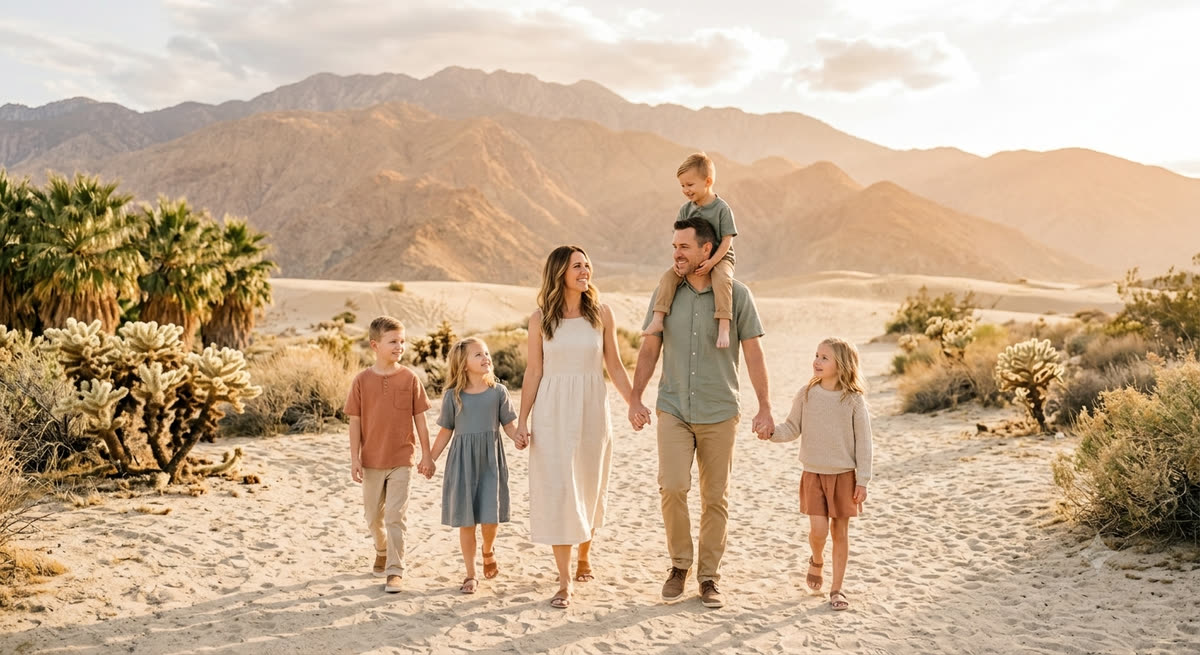
One of my favorite go-tos. Hold hands, walk slowly toward the camera, and talk to each other — I'll usually give you something to say or a silly question to ask the kids. Walking solves the stiffness problem completely because bodies in gentle motion can't lock up. The little ones inevitably break into a run or a swing-the-arms moment, and those frames are gold.
Down the hallway at home, along a shaded path at a neighborhood park, or through the gardens at the Living Desert at golden hour, the walking shot gives movement and that candid, in-between energy people love.
Why it works: Motion erases tension, and the focus on each other beats the focus on the lens.
3. The piggyback / shoulder ride
Kids on shoulders, on hips, on backs. This adds height variation (so you're not a flat line of heads), creates natural physical contact, and gives parents and kids something playful to do together. It almost always produces a genuine laugh.
Why it works: Levels and play. It breaks the "everyone standing the same height" monotony and is inherently joyful.
4. Seated and stacked
Sit down — on your living room floor, a blanket in the backyard, a park bench, or a low garden wall. Sitting naturally brings people closer and lowers everyone to the kids' world. Lean on each other. Let a child sprawl across a lap. The slight disorder of a seated family is far more endearing than a tidy standing one.
Why it works: Sitting forces closeness and informality, and it's comfortable for long enough to let real moments unfold.
5. The parent-and-child quiet moment
While the whole-family shots are the headline, the photos parents cry over are often the quiet pairings: one parent forehead-to-forehead with a child, a dad whispering to a daughter, a mom holding a sleeping baby. I always make space for these. I'll pull one pair aside, give them a small prompt ("tell her your favorite thing about her"), and let the rest of you rest for a moment.
Why it works: Intimacy at close range. These are the most timeless images you'll get.
6. The "we forgot you were there" candid
After we've done a few structured setups, I deliberately stop directing and just let you exist together. Tickle fights, a kid picking up a rock, the parents sharing a private joke. I keep shooting. Knowing how to stop posing is itself a posing skill — and it's where the most honest photos live.
Why it works: It's not a pose at all. It's the reward for all the gentle structure that came before.
What to do with your hands (where most people get stuck)
Hands are where awkwardness hides. A few reliable fixes:
- Give them a job. Hold a child's hand, rest a hand on a shoulder, slip one into a pocket, hold your partner's waist. Idle hands look nervous; busy hands look natural.
- Touch someone. In family photos, a hand connecting two people (mom's hand on a kid's back) reads as affection and quietly improves the composition.
- Soft, not stiff. Relaxed fingers, never a tight grip. I'll remind you in the moment — it's the single most common thing I gently adjust.
Posing kids without bribing or begging
You cannot pose a three-year-old, and you shouldn't try. Here's what actually works in the desert with little ones:
- Make it a game, not a sit-still. "Can you give mom the biggest squeeze?" gets a real hug; "smile at the camera" gets a grimace.
- Let them move. Running, jumping, spinning. I shoot fast and catch the peak. A moving kid is a happy kid, and a happy kid photographs beautifully.
- Don't chase the fake smile. I never say "cheese." I'd rather make them laugh for real — silly sounds, a pretend sneeze, asking them to tell me a secret.
- Build in a break. A snack and water break halfway through (especially important in our heat) resets everyone. I plan for it; it's not a failure, it's strategy.
- Lower yourself to their level. Half my session is spent crouched or sitting on the floor or the grass. Photographing kids from their height respects their world and flatters them far more than shooting down at the tops of their heads.
If you want a fuller playbook for the under-fives, I wrote a whole piece on photographing toddlers and babies in the desert.
Flattering everyone: small body-position tips that read as natural
You don't need to know modeling tricks, but a few quiet adjustments make a real difference and still look effortless:
- Weight on the back foot. Standing with weight shifted slightly back and one knee soft relaxes the whole body and avoids the "lined up for inspection" look.
- Chin slightly forward and down. It sounds odd, but easing the chin out and a touch down defines the jaw and prevents the up-the-nose angle. I'll guide this in tiny increments.
- Turn shoulders off-square. Bodies angled a few degrees away from the camera are more flattering and more relaxed than facing dead-on.
- Create a little space at the arms. A hand on a hip or in a pocket keeps arms from pressing flat against the body. Subtle, but it makes everyone look more at ease.
- Vary your heights. This is the big one for groups. Some standing, some sitting, a child on a hip, a parent crouched — a family with varied levels looks like a relationship; a flat row looks like a lineup.
The trick is that I handle all of this for you in the moment, in small nudges, so you never have to hold a "pose" in your head. You just get to be with your family.
Making the most of your setting
Where we shoot shapes how I pose people. Most families I work with choose one of two settings, and each has its own rhythm:
- In your home. This is where I do much of my work, and it's my favorite for honest, lived-in photos. We use the soft light from your windows, the couch everyone piles onto, the kitchen where real life happens. Home poses lean into closeness — stacking on the sofa, a child on a hip in a doorway, everyone tangled together on the bed or the rug.
- Local parks and gardens. A neighborhood park, a botanical garden, or a shaded resort lawn in Rancho Mirage or Indian Wells gives you greenery, room to walk, and natural places to sit and lean. These settings are wonderful for movement — walking shots, a child on shoulders, the little ones running ahead.
- Patios and backyards. Your own outdoor space splits the difference: familiar enough that kids relax, with open light and room to move.
- Backlight at golden hour (outdoors). When we're outside, I love placing the family with the low desert sun behind them, rimming everyone in warm light. It's the most flattering, forgiving light we have out of doors, and it makes even a simple huddle look luminous.
For more on the where, see my favorite Coachella Valley locations for family sessions.
Common mistakes to avoid
- Over-rehearsing. Practicing poses at home usually makes families more rigid, not less. Trust me to guide you on the day.
- Saying "cheese." It produces the exact expression you don't want. Real laughter beats it every time.
- Booking against nap time or peak heat. The light and the mood both suffer. We plan around your family's rhythm and the season.
- Matchy-matchy outfits. A shared palette with a little variety beats identical white shirts and jeans, which flatten everyone into a uniform.
- Forgetting the in-between shots. The posed frame is the anchor; the moment right after — when everyone exhales — is often the keeper.
What a session with me actually feels like
I want to set expectations, because knowing what's coming is itself relaxing. We'll start easy, usually with a walking shot or a simple huddle so everyone warms up. I'll talk the whole time, give gentle prompts, and adjust small things — a hand here, a chin there — without making you hold anything stiffly. We'll let the kids move and play, take a break when they need it, and follow the best light — the glow through your windows indoors, or the low sun outside as it drops. I keep the pace easygoing on purpose: the more relaxed the afternoon feels, the more natural the photos look. By the end, most families tell me they had more fun than they expected — and that's exactly when the best frames happen.
Natural family photos aren't a trick or a checklist. They're what's left when the awkwardness falls away and your family is simply together. My job is to create the conditions for that, gently shape it, and catch it when it arrives.
If you've been meaning to get updated family photos — marking a milestone, or simply realizing it's been too long since you were all in one frame — I'd love to hear from you. We can begin with a relaxed conversation about your family, whether your home or a favorite park feels right, and the moments you most want to hold onto. Reach out here, and let's make something you'll keep for years.