Capturing Toddlers: Patience & Play
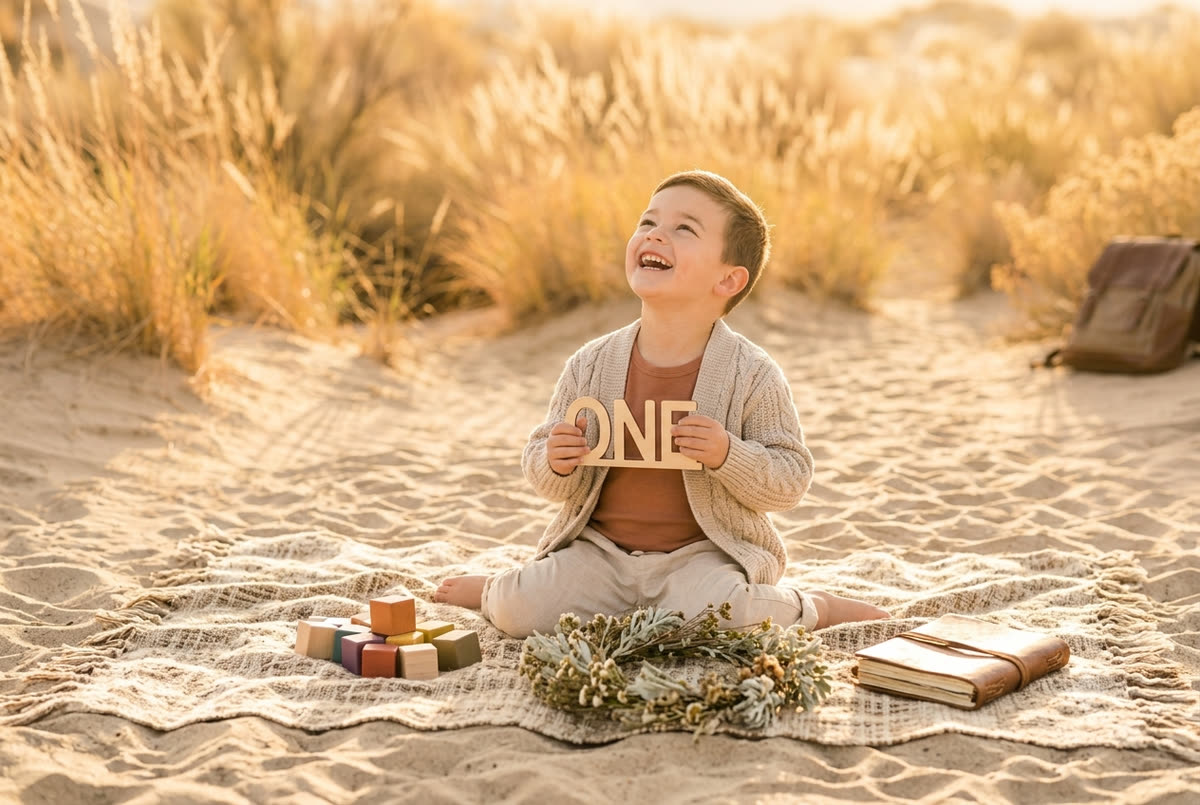
There is a moment in nearly every toddler session when a parent looks at me, a little flushed and apologetic, and says some version of, "I'm so sorry, she will not sit still." And I always smile, because that is exactly the child I came to photograph. After many years of working with families across Palm Desert and the Coachella Valley, I have learned that the toddler who is running, climbing, hiding behind your legs, and refusing to look at the camera is not a problem to be solved. That child is the whole point. The pictures I treasure most are almost never the ones where everybody held still and said cheese. They are the ones where a two-year-old looked up at her dad mid-belly-laugh and forgot I was there at all.
Toddlers — roughly the ages of one to four — are their own beautiful, chaotic, fast-moving little universe. They have opinions now. They have a definite "no." They are discovering that their bodies can run and spin and jump, and they want to do all of it at once. Photographing them well is not about controlling that energy. It is about following it, and being ready when the real moment arrives. So if you are planning a session and feeling a little nervous about whether your child will "cooperate," let me give you everything I have learned. This is the guide I wish every parent had before bringing their toddler to me, and if you are a parent simply trying to take better pictures at home, almost all of it works for you too.
Why toddler photography is genuinely different
Newborns sleep through their sessions. Big kids can take direction and hold a smile. Toddlers fall right in the middle, and that middle is its own art form. A toddler cannot be reasoned with the way a five-year-old can, but they are far more mobile and far more willful than a baby. They run toward the very thing you asked them not to touch. They give you the most luminous smile in the world and then refuse to repeat it the instant a camera appears.
This is why the old approach — sit here, look here, smile now — simply does not work, and why fighting it produces those stiff, slightly panicked portraits where a child looks like they are being held hostage. The whole craft of photographing toddlers comes down to two things working together: patience and play. Patience to let the session unfold on the child's clock instead of mine. Play to create the genuine joy and curiosity that I then quietly photograph. Everything else in this guide is really just detail underneath those two ideas.
Patience: the photographer's real skill
When parents ask what the secret to good toddler photos is, they often expect me to say something about my camera. It is not the camera. It is the willingness to wait.
Let the warm-up happen
A toddler arriving at a session is walking into a new place, often meeting a new person holding a strange black object that points at them. Of course they freeze, or cling, or test the boundaries by bolting. I never start by photographing. I start by getting down on the ground, at their eye level, and being a little boring. I let them watch me from behind a parent's leg. I might ignore them entirely for a few minutes and chat with mom and dad. Almost every toddler, once they decide I am not a threat, becomes curious — and curiosity is the doorway to everything.
I build at least the first ten or fifteen minutes of every session as pure warm-up. Parents sometimes worry we are "wasting time." We are not. That slow start is what buys us the relaxed, open faces later.
Follow, don't force
Once a toddler is moving, I move with them. If she wants to stack blocks on the living-room rug, we photograph the block stacking. If he wants to run down a garden path, I let him run and catch the gleeful look back over his shoulder. Trying to redirect a toddler back to "the spot" is a losing battle that ends in tears for everyone. Going where they go almost always lands me somewhere more honest and more beautiful than the pose I had planned.
Expect the meltdown, and don't fear it
Nearly every toddler session has a wobble — a tired moment, a frustrated cry, a flat refusal. This is normal, and it does not ruin anything. When it comes, we pause. We get a snack out. We let the parent scoop the child up for a cuddle. And here is the thing many parents are surprised by: I often keep gently photographing through the recovery, because a toddler nestled into a parent's neck, calming down, makes one of the tenderest images of the whole session. Not every picture is a giant grin. Some of the best ones are quiet.
Play: how I actually get the smiles
If patience is the foundation, play is how we build the joy. I almost never say "smile." A demanded smile from a toddler is that tight, teeth-baring grimace every parent recognizes. Real expressions come from real fun, so my whole job during a session is to be a slightly ridiculous adult who makes things happen.
A few of the games that reliably work:
- Peekaboo, endlessly. It is a classic for a reason. Hiding behind a parent and popping out gets a genuine laugh almost every time, especially with the under-twos.
- Silly sounds over silly faces. Toddlers respond more to sound than to a funny face they cannot see behind my camera. Animal noises, sneezes, a big dramatic "uh-oh," a fake hiccup. Sound makes them look toward the lens with real curiosity.
- "Don't you dare run to mommy." Reverse psychology is pure gold at this age. Tell a toddler very seriously not to do something delightful and they will do it instantly, laughing the whole way.
- Chase and tickle with the parents. Some of my favorite frames come from telling a dad to chase his daughter or sweep her up for a tickle. The connection is real, the laugh is real, and nobody is looking at the camera — which is exactly what makes it timeless.
- Give little jobs. Toddlers love purpose. "Can you find me a yellow flower?" or "Go touch that big rock and come back" turns aimless wandering into a game with direction.
The trick is variety. A game works beautifully — for about ninety seconds. Then it is stale and I need a new one. Coming to a toddler session with a deep bag of tricks, and the energy to keep refreshing them, is most of the work.
Light, place, and timing in the Coachella Valley
Photographing toddlers well in Palm Desert and the wider Coachella Valley takes a little local knowledge. Most of my young-child sessions happen in one of two places: right inside a family's own home, or at a familiar local park, garden, or shaded patio close to where they live. For a child this small, comfort is everything — and there is no setting more comforting than the rooms they already know or the neighborhood green they toddle around every week. Our desert light and climate are glorious but not always gentle, so a little planning goes a long way whichever way we go.
In-home sessions: my signature setting
When I can, I love photographing toddlers at home. A child surrounded by their own toys, their own books, the everyday light coming through the kitchen window is a child who forgets the camera within minutes. Indoors I work entirely with natural window light — positioning us near the brightest, softest windows in the house and switching the overhead bulbs off. Late morning often gives the gentlest, most even light through a window, and a home full of soft daylight makes for tender, lived-in pictures you cannot stage anywhere else. No packing the diaper bag, no car-seat meltdown, no strange new place to win over first.
Local parks, gardens, and patios
When a family would rather be outdoors, we usually stay close to home — a neighborhood park in Palm Desert, a shaded garden path, a grassy resort lawn in Rancho Mirage, a familiar courtyard, or your own backyard or patio in Indian Wells. Safe, soft ground to run on, a bit of shade, and a place your toddler already feels at ease matter far more than a dramatic backdrop. At this age, familiar nearly always beats impressive.
Outdoors, aim for golden hour
Our desert sun is intense, and the middle of the day is bright and hot enough to turn a happy toddler cranky in minutes. So for any outdoor session I schedule the golden hour — the soft, warm light in the hour or so after sunrise or before sunset. In summer that usually means an early-evening start as the light goes amber and the heat finally breaks, or a sunrise session before the day climbs past comfortable. That low, gentle light flatters little faces, and the cooler air keeps a toddler relaxed enough to actually be one.
Respect the seasons
Timing the year matters as much as timing the day. From roughly November through April, our weather is mild and golden and outdoor sessions are a pleasure. Summer, May through September, is a different conversation. When afternoon temperatures push past 110 degrees, a long outdoor session with a toddler is neither kind nor safe. In the hot months I lean even more on in-home sessions, start any outdoor ones at sunrise while it is still cool, keep them short, or stay in deep shade. Never be afraid to ask me about the heat — planning around it is part of my job, and a comfortable toddler photographs infinitely better than an overheated one.
What to expect on session day
Knowing how the day flows takes a lot of the pressure off, so here is the honest shape of a toddler session with me.
We will plan for a generous window rather than a tight one. A toddler session is unhurried by design, usually running somewhere between forty-five minutes and an hour and a half of actual time together, even though the magic often happens in concentrated bursts within that. We will not get a hundred perfect frames in a row, and we do not need to. We need a handful of true moments, and those come when we are relaxed enough to let them.
I will spend the early part hanging back and letting your child acclimate. Then we play, we follow their lead, we take breaks, and we let the session breathe. You may leave thinking, "I'm not sure she really did anything," and then see the gallery and recognize your child completely — the real laugh, the serious little face, the way she reaches for you. That is the whole goal.
How parents can help (more than you think)
Your role matters enormously, and a few simple things make all the difference.
- Time it around naps and meals. This is the single biggest factor. A well-rested, recently-fed toddler is a happy toddler. A session that collides with naptime is fighting gravity. Pick the time of day your child is usually at their sunniest.
- Bring snacks and water — but choose wisely. Snacks are a wonderful reset button. Just lean toward things that do not stain little mouths and outfits. Water, plain crackers, and dry cereal beat anything red or sticky.
- Relax your own expectations. Toddlers read their parents instantly. If you are tense and anxiously commanding "smile for the lady," your child tenses too. The most helpful thing you can do is have fun and trust the process. Laugh, play along with the games, and let me worry about the pictures.
- Don't over-bribe or over-promise. A small treat at the end is fine. A constant stream of "if you smile you get ice cream" tends to backfire into a fixated, anxious child. Let the play be its own reward.
- Dress for movement and the desert. Soft, comfortable clothing in warm, muted, earthy tones photographs beautifully against our landscape and lets a toddler move freely. Skip anything scratchy, brand-new, or fussy — and bring layers in cooler months, since desert evenings turn crisp fast.
- Let go of the perfect-family-portrait fantasy, a little. We may get the lovely everyone-looking frame, and we may not, and either way the candid, joyful, in-motion images are usually the ones you will fall in love with. Come for those.
Common mistakes to avoid
A few things I gently steer families away from:
- Scheduling an outdoor session at high noon. The light is unflattering and the heat is miserable here. For anything outside, golden hour, always — and when in doubt, we bring it indoors to soft window light instead.
- Booking when your child is due for a nap. No game I know can outrun a tired toddler.
- Saying "smile" on repeat. It produces the fake grin every time. Trust that the real smiles are coming through play.
- Apologizing for your child. Truly — you never need to. The energy, the silliness, even the tears are all part of who they are right now, and that is what we are here to remember.
- Treating it like a performance. The less it feels like a job your toddler has to do well, the better they do.
A few words on the in-between ages
Toddlerhood spans a lot of development. A just-turned-one barely walking is a very different subject than a spirited three-and-a-half-year-old, and I adjust accordingly. With the youngest, I lean on the parents heavily — much of the best work is the child in their arms, on their shoulders, being lifted and laughed with. By two and three, independence and games take over, and reverse psychology becomes my best friend. By four, real little personalities and even gentle cooperation start to appear. Wherever your child is on that arc, the approach is the same at heart: meet them where they are.
If your toddler is approaching a milestone, you might also enjoy reading about planning a first birthday photo session, the joyful chaos of a cake smash, or how I approach relaxed family sessions in the desert so everyone, not just the little one, feels at ease.
The picture you'll actually treasure
Here is what I have come to believe after all these years and all these wonderful, exhausting, hilarious little subjects. The point of toddler photography is not to make your child look like a tiny, posed adult. It is to hold onto exactly who they are in this brief, wild, magical chapter — the wonder, the stubbornness, the belly laughs, the way they still run to you when the world gets too big. Patience lets those moments arrive. Play invites them out. And the right light — soft daylight through your own front window, or a low desert sun in the last hour before dark — wraps the whole thing in something warm and honest and timeless.
So please do not worry about whether your toddler will cooperate. Bring them exactly as they are. That is the child I cannot wait to photograph.
If your little one is somewhere in this stage, tell me about them — where they are happiest, what makes them laugh, whether home or a favorite nearby park feels right. Send me a note here and we will shape a session around your actual child, on their terms, in the place they already love best.