Photographing Someone With Dementia
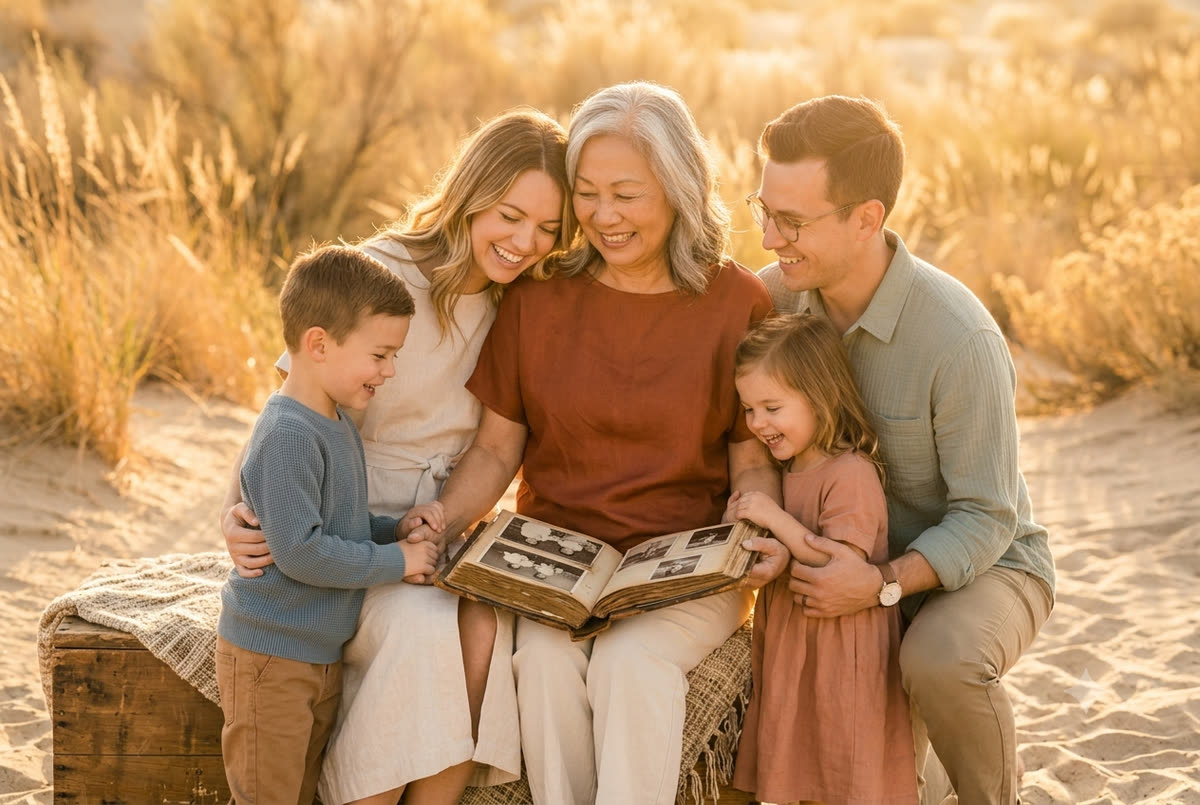
Sometimes a family will tell me, gently bracing me before a session, that their person won't remember the photographs were ever taken — that by dinner the whole morning will have slipped away. And in one sense that is true. But it is not the only kind of remembering that matters. The photographs do the remembering for them. They hold the warmth of a hand folded around a grandchild's, the particular tilt of a head when something genuinely lands, the dignity that dementia does not touch. The person does not need to carry the memory. The picture carries it for the whole family, now and long after.
If you are reading this, you are probably weighing whether to photograph a parent, spouse, or grandparent who is living with Alzheimer's or another form of dementia. Maybe you are afraid it is "too late," or that a session would only confuse or upset them, or that the person in the picture won't really be them anymore. I want to talk you through all of that honestly, because I have done this work many times and there are real, specific things that make it gentle and good rather than stressful — and a few things to avoid.
It is not too late, and "themselves" is bigger than you think
Families often arrive carrying some version of this fear: he isn't himself anymore, so what's the point? I understand what sits underneath it. But in my experience the essential person is still present, often more accessible through a camera than through conversation. Memory and language fade on different schedules than warmth, humor, and the body's old habits. A man who can no longer tell you his daughter's name will still soften his whole face when she sits beside him. A woman who has lost most of her words will still hum, still pat your arm, still raise an eyebrow exactly the way she has for ninety years.
Those are the moments I am watching for. I am not trying to manufacture a posed, "everything is fine" portrait that pretends nothing has changed. I am trying to catch the true thing that is still unmistakably this person. That is what your family will be grateful for later — not a stiff arrangement, but the real look.
So no, it is generally not too late. The honest counsel I give families is simpler than they expect: if you are wondering whether to do it, that is usually your answer to do it soon. Dementia is unpredictable. The window where someone is comfortable, mobile, and able to engage tends to narrow, sometimes faster than anyone guesses. The session I most wish families had booked is the one they kept meaning to schedule.
Pick the time of day with the disease in mind, not the calendar
Here in the desert we usually plan portrait sessions around light — the soft, low gold of the hour after sunrise or before sunset, avoiding the flat glare of midday. For someone with dementia, I flip the priority: we plan around the person first, and light second.
Many people with dementia experience what clinicians call sundowning — increased confusion, agitation, or restlessness in the late afternoon and evening. That is precisely when the desert's prettiest golden light arrives, which creates a genuine tension. For most of my dementia sessions, mid-to-late morning is the sweet spot: the person has eaten, settled, and is usually at their clearest and calmest. We trade a little of that famous evening glow for a person who is comfortable and present. It is always the right trade.
Ask the caregiver or the memory care staff a simple question: When is he most himself during the day? They will know. Whatever they say, that is when we shoot. If mornings are best, I will happily be there at 9 or 10. If there is a narrow good window after lunch and before the late-day restlessness, we use that.
Where to photograph: comfort beats scenery
Families sometimes imagine a beautiful location — the lawns at a Rancho Mirage resort, the mountains behind Palm Desert, a garden in La Quinta. Those can be wonderful. But for someone with dementia, an unfamiliar place can be disorienting, and the logistics of getting there can use up all the calm energy before we even begin.
My default is to come to where the person already is and feels safe:
- Their own home, if they still live there — their chair, their light from a familiar window, their things around them. Familiar surroundings reduce anxiety and bring out natural behavior.
- Their room or a quiet common area in a memory care or assisted living community. Most of the good residences across the valley — in Palm Desert, Indian Wells, Rancho Mirage, and Palm Springs — are very used to accommodating a photographer and will help us find a calm corner with nice window light. I always coordinate with staff in advance.
- A short, low-stakes outing only if the person genuinely enjoys being outdoors and travels well. A shaded patio, a courtyard, a familiar neighborhood garden. In the cooler months our mild mornings make a brief outdoor sit very pleasant, with soft early light and no glare; in summer we stay indoors and out of the heat entirely.
The guiding rule: I would rather make a beautiful, true portrait in a plain bedroom than a stressful one in a stunning location. Comfort photographs better than scenery, every single time.
What to expect during the session
I work slowly and quietly, and I keep things short. Here is roughly how these sessions go.
I arrive low-key. No big lighting rigs hauled into the room, no equipment that beeps and flashes and startles. I shoot with natural light wherever possible and a single quiet camera. I introduce myself simply and warmly, and I don't take it personally if there is no recognition — I am just a calm, friendly presence in the room.
I let a trusted person lead. The relationship that already exists is the most powerful tool in the room. If a daughter sits and holds her mother's hand and talks softly about an old garden, I am off to the side catching what happens between them. People with dementia often respond beautifully to a familiar face, a familiar voice, a familiar touch — and that connection is exactly what I want in the frame.
We keep it brief and flexible. A session might be twenty good minutes, not two hours. I watch for signs of fatigue or overwhelm — restlessness, repeated questions, a flat or anxious expression — and we pause or stop. I would always rather end early with everyone calm than push for "one more" and end on distress. Sometimes we break, have a snack, and come back. There is no fixed script.
I follow, I don't direct. I rarely ask the person to "look here and smile." That kind of instruction can confuse or pressure someone whose processing is slower. Instead I let real interaction unfold and I photograph it. The genuine half-smile that comes from a grandchild's joke is worth a hundred commanded ones.
Small things that make a big difference
A handful of specific tactics that consistently help:
- Bring an anchor. A beloved object — a worn quilt, a hat, a musical instrument, an old photo album, a dog — gives the hands something to do and the heart something to light up. Music is especially powerful; a favorite song can bring someone's face fully alive in a way nothing else does.
- Dress them in their own familiar clothes. Not a stiff new outfit bought for the occasion. The cardigan they always wear, the jewelry that is part of them. It is more comfortable and far more them.
- Keep the room calm. Fewer people, lower voices, no competing TV or commotion. A crowd of relatives all talking at once is overwhelming; one or two at a time is plenty.
- Let me capture the hands. When faces are hard, hands tell the whole story — a wedding ring worn thin, a caregiver's hand folded over a parent's, the texture of a long life. These end up being some of the most treasured frames.
- Don't over-coach for a "happy" face. A quiet, neutral, dignified expression is honest and beautiful. We are not faking a greeting-card mood. We are honoring a real person on a real day.
- Include yourself. If you are the caregiver, please get in the pictures too. This is your shared story, and one day you will want proof that you were right there beside them.
Mistakes to avoid
Gently, the things that tend to go wrong:
- Scheduling at the worst time of day because it suited everyone's calendar or the photographer's lighting preference, rather than the person's rhythm.
- Too many people, too much stimulation. Well-meaning families sometimes pack the room. It backfires.
- Trying to hide the disease. Forcing big smiles and props to pretend nothing has changed usually produces tense, false pictures. Tenderness reads as love; performance reads as strain.
- Waiting for a "better day." There is rarely a perfect day coming. Comfortable-and-soon beats perfect-and-someday.
- Treating it as a quick phone snapshot when it is actually a milestone. This is often a family's last unhurried chance to be photographed together. It deserves real attention.
A note on consent and dignity
This matters to me, so I will say it plainly. I always seek the person's comfort and assent in the moment, even when a family member is the legal decision-maker. If someone clearly does not want the camera near them on a given day, we honor that — we wait, we adapt, or we reschedule. Dignity is not negotiable. In practice, almost everyone settles quickly once they feel that no one is rushing or pressing them, and that the room is simply warm.
I also handle these images with care and discretion. They are private and precious, and they are yours.
This is part of a larger kind of work
Photographing someone with dementia sits within what I think of as legacy and memory work — making images while we still can, for the people who will hold them afterward. If this is on your mind, you may also find it helpful to read about photographing a loved one in hospice care and about planning a multi-generation family portrait while everyone can be in one frame together. Different moments, same underlying truth: the picture remembers so the family doesn't have to.
When you are ready
There is no wrong time to reach out, and you do not need to have anything figured out before you do. If you tell me a little about your person — where they are, what kind of day tends to be a good day, who they love to have near them — I will take care of the rest, gently and at their pace. Whether they are at home in Palm Desert or in a memory care community anywhere across the valley, I will come to them and let the session move entirely at their pace, for as long, or as short, as the day allows.
When it feels like the right time, I would be honored to help. You can reach me here, and we will find a way that feels kind to everyone.