Family Photos at Indian Canyons
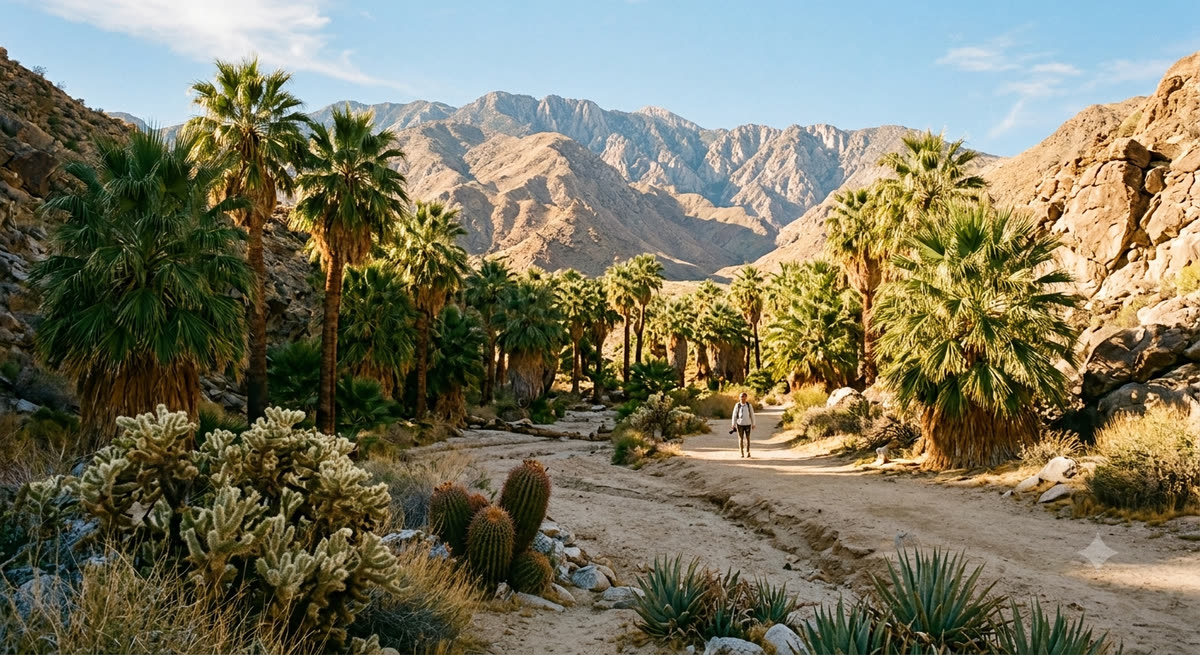
There is a moment, just after you cross from the parking area into Andreas Canyon, when the world goes quiet. The desert opens up, the palms close in overhead, and a little stream you did not expect to find is running cold over the rocks at your feet. Most of my sessions happen far closer to home — in families' own living rooms, with afternoon light spilling through the windows, or at the parks, gardens, and shaded patios tucked around Palm Desert and Rancho Mirage. Those everyday settings are where I do my steadiest work. But every so often a family wants something grander for a special gathering, and when they do, Indian Canyons is the place I love to bring them.
If you are thinking about family photos at Indian Canyons, this is everything I have learned from years of sessions here: when to come, where to stand, what to wear, how to keep little ones happy, and the small logistics that make the difference between a stressful morning and a session that feels like a genuine adventure together.
Why Indian Canyons is so special for family photos
Indian Canyons sits on the Agua Caliente Band of Cahuilla Indians reservation, just south of downtown Palm Springs at the foot of the San Jacinto Mountains. It is sacred land, lived in and cared for by the Cahuilla people for centuries, and you feel that the moment you arrive. This is not a manicured park. It is real desert wilderness — and that authenticity is exactly what makes the photographs sing.
What I love most, as a photographer, is the variety packed into one place:
- Palm Canyon holds the largest natural California fan palm oasis in the world — thousands of towering palms following the water down the canyon floor. The scale is breathtaking, and it gives us those deep green, cathedral-like backdrops you simply cannot get anywhere else in the valley.
- Andreas Canyon has the stream, the dramatic rock formations, and a shorter, shadier walk — my usual first choice for families with young children or grandparents along.
- Murray Canyon rewards a longer hike with seclusion and, in the right season, even small seasonal waterfalls.
So in a single morning we can move from a shaded oasis to a sun-warmed rock outcrop to an open desert vista, and your gallery tells a whole story rather than a single note. For families who want images that feel honest, warm, and timeless — rooted in this landscape, not a studio backdrop — there is nothing quite like it.
The best time of year for a session
Let me be direct about our desert seasons, because timing matters more here than almost anywhere.
Snowbird season (November through April) is the sweet spot. This is when the Coachella Valley is at its most comfortable — crisp mornings, warm afternoons, that famous clear light. It is also when so many of my families are in town visiting, gathering for the holidays, or escaping colder places back home. If you have parents or grandparents who winter in Palm Springs, Rancho Mirage, or Indian Wells, this is the window I gently steer everyone toward. Book a little ahead, because these months fill quickly.
Spring (March and April) can be glorious, especially in a wildflower year when the desert floor blushes with color. Mornings are still cool and the canyons feel alive.
Summer (June through September) is the one I ask you to think carefully about. Our desert heat is no small thing — afternoons regularly climb past 110 degrees, and Indian Canyons offers limited shade once you leave the oasis. I do not say never; I say early. If we photograph in summer, we meet right at sunrise, keep it short, bring plenty of water, and we are walking back to the car before the heat sets in. With babies, toddlers, or older relatives, I will usually suggest we wait for cooler months instead.
One practical note: Indian Canyons has seasonal hours and is not open every day year-round. Hours shift between the cooler and warmer seasons, and the gates open later in the morning than you might hope. I always confirm the current schedule before we lock in a date — and that ties directly into the most important piece of timing, which is the light.
Golden hour, and the gate problem
If you have read any of my other seasonal and location guides, you know I am a devotee of golden hour — that soft, low, flattering light in the hour after sunrise and the hour before sunset. In the desert it is pure magic. Skin glows, the mountains turn rose and gold, and the flat light of the middle of the day gives way to something far more forgiving.
Here is the honest wrinkle with Indian Canyons: the gates do not open early enough for true sunrise golden hour, and they close before sunset. This is the single most common surprise for families, so I want you to hear it from me first. We cannot photograph at 6 a.m. here the way we could out on open BLM desert.
What that means in practice:
- Morning sessions start as close to the opening time as possible, and we move fast to use the first good light while the canyons are still cool and the crowds are thin.
- Late-afternoon sessions work beautifully in the cooler months, when the sun sets earlier and we can catch warm, slanting light well before the gates close. In winter especially, a 3:30 or 4:00 start can be lovely.
- If your heart is set on a dramatic sunrise-or-sunset-over-the-sand look, I may suggest we pair Indian Canyons with a different desert location, or choose somewhere with more flexible access. We can always talk through it.
I track the sunset and gate times for your exact date and build the schedule around them. You do not need to do that math — that is my job.
What to expect on the day
Indian Canyons is a real natural area, and a little preparation makes everything smoother.
Getting there and the entrance fee. You drive in at the south end of South Palm Canyon Drive in Palm Springs. There is a per-person entrance fee at the gate (it is modest, but bring a card or cash, and check current rates — children's pricing differs). Plan to arrive a few minutes before our start time so we are not rushing through the entrance.
The walking. Andreas Canyon involves a short, mostly flat loop and is the most accessible for all ages. Palm Canyon has a paved overlook area near the trading post, then a moderately steep, rocky path down into the oasis itself — wonderful, but worth knowing if mobility is a concern. I scout our route ahead of time and match it to who is coming. Tell me if grandma uses a cane or if we have a stroller, and I will plan accordingly.
Footwear and comfort. Closed-toe shoes with grip, always. We are on sand, rock, and uneven ground. I keep a little bag with water, sunscreen, and a few snacks, but please bring your own water too — hydration in the desert is not optional.
Wildlife and nature. This is wild land. We give lizards, birds, and the occasional bighorn sheep their space, we stay on the trails to protect the oasis, and we leave it exactly as we found it. It is part of respecting the place and the people who steward it.
Crowds. Indian Canyons is popular, especially on weekends in season. Early mornings are quietest, which is another reason I favor them — fewer hikers wandering through your backdrop, and a calmer feeling for the kids.
What to wear
The desert palette here is warm and earthy — sand, stone, deep palm green, blue sky. I steer families toward clothing that lives in harmony with that rather than fighting it.
- Soft, warm, neutral tones photograph beautifully: cream, oatmeal, terracotta, rust, olive, dusty blue, warm gray. They make skin glow and let the landscape breathe.
- Pull from one palette. Pick two or three shades and let each person draw from that family of colors rather than marching everyone out in identical white shirts. It looks more natural and more like you.
- Texture and movement are your friends. A flowing dress, a linen shirt, a knit layer — these catch the breeze and the light. The desert wind will move fabric and hair, and that becomes part of the story.
- Avoid large logos, neon brights, and busy small patterns that vibrate on camera.
- Layers in winter. Our desert mornings can be genuinely cold before the sun crests the mountains. A cozy cardigan or jacket photographs well and keeps everyone happy between frames.
If you would like, I am always glad to look at outfit ideas before the session — it is one of the easiest ways to lift a gallery, and I do it for every family who asks.
Bringing children and grandparents
So many of my Indian Canyons sessions are multigenerational — kids, parents, and the grandparents who flew in for the season. That mix is my favorite thing to photograph, and the canyons hold space for it gracefully.
A few things I have learned:
- Keep it short for the littlest ones. Thirty to sixty minutes of real engagement is plenty for a toddler. We get the must-have grouping early, then I let kids be kids — exploring the stream at Andreas, climbing a friendly rock — and that is when the honest, joyful frames happen.
- Snacks and a "after we finish" treat work wonders. No shame in a little bribery.
- Let me do the wrangling. I am not going to bark "say cheese." I would rather catch your son mid-laugh than pose him stiffly. Parents who try too hard to control the kids usually end up tense in the frame, so my gentle ask is: trust the process and let me chase the moments.
- Mind the footing for older relatives. This goes back to choosing the right canyon. Andreas, near the stream and the flatter loop, is almost always where I bring families with grandparents.
If you are weighing a few desert spots for a big family gathering, you might also like my thoughts on extended family sessions in the Coachella Valley — the principles carry over.
Mistakes to avoid
After many sessions here, these are the ones I see most:
- Assuming you can shoot at sunrise. The gates open later than the best dawn light. Plan with the real hours, not the ideal ones.
- Booking a summer midday slot. The heat and limited shade are unforgiving. Go early or choose a cooler month.
- Wearing the wrong shoes. Sandals and slick soles do not mix with canyon rock. Closed-toe, grippy shoes for everyone.
- Forgetting water and the entrance fee. Both are small things that derail a morning if overlooked.
- Over-managing the kids. The stiff, "everybody look here" photos are rarely the ones families end up framing. The candid in-between moments are.
- Not checking the day's hours. Indian Canyons isn't open every day in every season. I confirm this for you, but it is worth knowing.
A few questions I am often asked
How long is a typical session? Most family sessions run about an hour to ninety minutes, which gives us time to move between a couple of spots without exhausting anyone. Larger groups or more locations, a bit longer.
Can we bring our dog? Indian Canyons does allow leashed dogs in many areas, which is lovely for families whose pup is part of the crew — but always confirm current rules at the gate, and keep them leashed to protect the wildlife and the land.
Is it stroller- and wheelchair-friendly? Parts of Andreas Canyon and the overlook areas are quite accessible; the descent into Palm Canyon oasis is rockier. Tell me your needs and I will plan a route that works.
What if it is windy? Embrace it. Desert wind moving hair and fabric often makes the most alive, romantic images. I will simply position us to use it rather than fight it.
Can we combine it with another location? Absolutely. Indian Canyons pairs naturally with a downtown Palm Springs stop or a stretch of open desert. I am always happy to build a little route for the morning.
Let's make something you will treasure
Indian Canyons has a way of slowing a family down — pulling everyone off their phones and into the same quiet, beautiful moment among the palms. That is when my favorite photographs happen: honest, warm, and unmistakably yours. Whether we end up out among the oasis palms or back in the comfort of your own living room, that is the feeling I am always after.
If a family morning at Indian Canyons is on your mind — whether you live here in Palm Desert or are visiting the valley for a while — tell me what you are picturing. Send me a note through my contact page, and we will map out a date built around the gate hours and the best light of the day.