Family Photographer in Desert Hot Springs
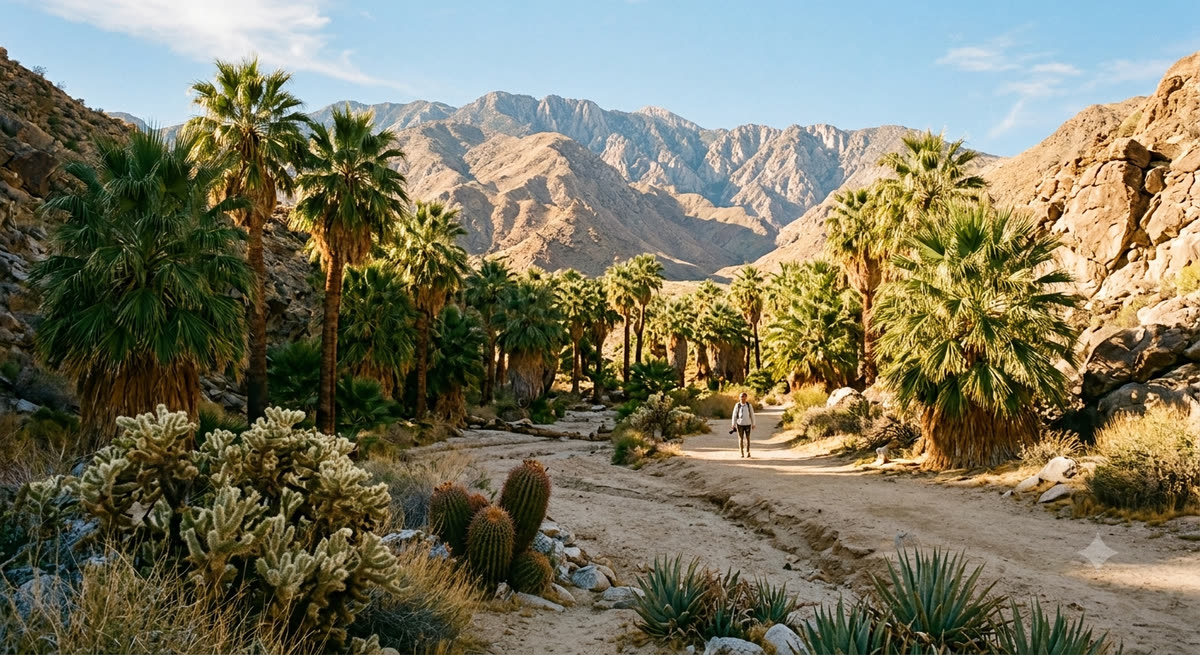
There is a particular quiet up in Desert Hot Springs that you do not find anywhere else in the valley. You climb the hill off Palm Drive, the city falls away behind you, and suddenly the whole Coachella Valley is laid out below — Mount San Jacinto rising straight up out of the floor across the way, the wind turbines turning slow on the pass, the light coming in long and gold over the open desert. I have photographed families all over this valley for a long time now, and DHS keeps surprising me. It is the one town where you can stand in your own backyard and feel like you have the desert entirely to yourself.
If you are looking for a family photographer in Desert Hot Springs, I want this to be genuinely useful — not a sales page. So here is what I actually know about photographing families here: the spots that work, the light that flatters, the seasons that matter, and how I help a session feel like an easy afternoon rather than a performance.
Why Desert Hot Springs is its own kind of beautiful
People sometimes apologize to me about DHS, as if their town is the plain cousin of Palm Springs. I disagree, and I will tell you why it photographs so well.
The elevation gives you views that the valley floor simply cannot offer. From the higher neighborhoods and from the open land along the north edge of town, you get that uninterrupted sweep across to San Jacinto and San Gorgonio — two of the tallest peaks in Southern California, framing your family in a way that feels enormous and intimate at the same time.
The light is also a little different up here. The air tends to be clear, the surroundings are open rather than crowded with palms and walls, and that means the late-afternoon sun wraps around people cleanly. When I am photographing a grandmother holding a new baby outdoors near sunset, that soft, low desert light is a gift.
And there is space. Real, uncrowded space. So much of family photography is about letting kids be kids — letting them run, wander, climb a little — and DHS gives them room to do that without a parking lot full of strangers in every frame.
Where I love to photograph families in Desert Hot Springs
Every family is different, so I never use the same checklist twice. But these are the settings I return to, and what each one is good for.
Your own home, backyard, and front step
This is where most of my sessions live, and it is the work I love most. Some of the truest family pictures I make happen at home: the window light spilling across the kitchen table in the morning, the dog underfoot, a DHS backyard with the mountains rising behind the fence. Inside, I work entirely with the soft natural light that comes through your windows — no lamps, no flash, just the rooms where your life actually happens. Home is the real texture of a family, and it ages beautifully. If your house is the heart of things, that is exactly where I want to photograph you.
Mission Springs Park and the neighborhood greens
When we do step out, the city's parks are my next stop — especially with toddlers in the mix, or grandparents who would rather not walk on uneven ground. Mission Springs Park has shade, lawn, and easy footing, which matters more than people realize when you have a two-year-old and an eighty-year-old in the same photograph. We catch it in the late-afternoon golden hour, do the running-and-laughing pictures, and keep everyone comfortable.
The mineral-spring resorts and spa courtyards
Desert Hot Springs is famous for its hot mineral water, and the small spa hotels — the mid-century courtyards, the tiled pools, the desert-modern lines — make a lovely, warm backdrop if your family is staying at one. If you have relatives flying in and gathering at a resort for a reunion, I am very happy to photograph you right where you are staying. It keeps the little ones close to naps and saves everyone the drive.
When a family wants the big desert view
Some families do ask for that wide, cinematic frame, and DHS can give it to them. The higher neighborhoods and the open land along the north edge of town look out across creosote and brittlebush to the mountains stacked behind, the San Gorgonio Pass opening wide to the west. It reads as unmistakably here, and for a large multigenerational group the scale can be wonderful — even a family of twelve looks held by the landscape. It is not how I usually work, but if it is the picture you are picturing, I am glad to plan one for the end of the day when the light goes long and gold. A short drive up the hill toward the boulders and Joshua trees of the high desert is another option for older kids and adventurous grandparents who want something a little wilder. Think of these as the scenic add-on, not the whole session.
The light, the heat, and the right time of year
This is the part most families do not think about, and it is the part that changes everything.
Indoors, I follow the windows. For an in-home session the light is the easy part: I read which rooms catch the soft, directional daylight and at what hour, and we build the session around that. Late morning and the first part of the afternoon are often loveliest inside, when the sun is high enough to fill a room without glaring through it. No lamps, no flash — just clean natural light on familiar faces.
Outdoors, golden hour is the whole game. For anything in a park, a courtyard, or out toward the desert view, I schedule the hour or so before sunset, occasionally just after sunrise. In that window the light is soft, warm, and forgiving, and the mountains glow. I keep families out of the flat, washed-out light of high noon and let the day's best hour do half the work for me.
The seasons matter more here than almost anywhere. From roughly November through April the weather is at its best, late afternoons are glorious, and outdoor sessions are a pleasure. This is prime time, and weekends around the holidays book up early because so many families are gathered with relatives visiting. If you have people flying in for Thanksgiving or the winter holidays, reach out well ahead.
Summer is not off-limits, but we plan around it. June through September, DHS afternoons are hot. When families want summer pictures, we go early — first light, before the heat builds — or we shoot the last twenty minutes before dark. With babies and older grandparents I am especially careful about timing and shade, and I always build in water and breaks. Heat is manageable; it just has to be respected.
If you want to go deeper on timing, I wrote more about it in the best time of year for desert family photos.
Photographing more than one generation
A lot of the families who call me from Desert Hot Springs are not just parents and kids. They are three and sometimes four generations, gathered because someone made the trip, or because a new grandbaby arrived, or simply because everyone is finally in the same place at the same time. These multigenerational sessions are some of the most meaningful work I do, and DHS — with its space and its easy pace — suits them especially well.
A few things I have learned about photographing extended families here:
- Build the session around the people who tire most. If great-grandma is in the photos, we choose a setting with easy footing and shade, and we make the whole-group pictures first, while everyone is fresh. Then we let the kids loose.
- Plan the groupings in advance, loosely. I like to think through the combinations beforehand — all the grandkids, each family unit, the four generations of women, the two brothers who never stand still — so we move through them naturally instead of standing around deciding.
- Leave room for the unplanned. The picture a family treasures most is almost never the lined-up one. It is the grandfather leaning down to hear what the four-year-old is whispering. My job is to be ready for that and to give it space to happen.
- Think about what these images become. A multigenerational portrait made today is the photograph a grandchild will hold thirty years from now. That is not a small thing, and I photograph it like it matters — because it does.
If you are gathering the whole clan, you might also find planning a multigenerational family session helpful as you organize everyone.
A heritage worth keeping
There is a reason I lean into the legacy side of this work. Families in the Coachella Valley are often spread across states, even countries, and the times you are all physically together are rarer than you think. Desert Hot Springs has long been a place people come to gather — to rest, to take the waters, to slow down. When you bring your family here and we make pictures, you are setting down a marker: this is who we were, this year, all of us, in this light.
I keep my files carefully and I think about prints, albums, and what survives. A photograph on a phone is here today; a printed portrait on the wall is there for the next generation. When you work with me as your Desert Hot Springs family photographer, I am thinking past this session toward the heirloom it becomes.
What it is like to work with me
I am not a herd-everyone-and-shout kind of photographer. A session with me feels more like a walk than a shoot. We talk, the kids warm up, and once everyone forgets the camera is there, the real pictures start. I am watching for the one honest gesture that is unmistakably your family — and I will wait for it.
Here is roughly how it goes:
- Before the session, we talk about your family, where you want to be, who is coming, and what you want to do with the images afterward. That last question shapes everything.
- We pick the place and the light together — most often your own home or a nearby park, sometimes the resort or, if you want it, the wider desert view — based on your family's ages, mobility, and the feeling you are after.
- On the day, I keep it relaxed. I give gentle direction so nobody feels lost, but I am mostly creating little situations and letting you be yourselves inside them.
- Afterward, I hand-edit your gallery and help you choose prints and albums, so the pictures actually live in your home rather than disappearing into a hard drive.
Common questions
How far in advance should I book?From late fall through spring (November through April), and especially around the holidays, several weeks to a couple of months is wise. Summer and early fall are more flexible. If relatives are visiting on set dates, tell me those dates early.
What should we wear?Soft, harmonious tones work beautifully both at home and against the desert — warm neutrals, dusty blues, creams, muted earth colors. Pick two or three of those and let everyone choose within them, so the group feels of a piece without looking like a uniform. Skip large logos and neon. I send every family a simple wardrobe guide once we book, and I am glad to look at options with you.
Will the heat be a problem?Not if we time it right. From late fall through spring it is lovely. In summer we shoot at the edges of the day and plan for water and shade. I will never schedule you into the worst of the heat.
Do you only photograph in Desert Hot Springs?No — I work throughout the Coachella Valley, including Palm Springs, Palm Desert, Rancho Mirage, La Quinta, and Indio. But I genuinely love DHS and the high-desert light up here, and I am happy to come to you.
Can we include the new baby / the dog / grandma?Yes, yes, and especially yes. The more of your real life in the frame, the better the pictures.
Let's plan your family's portraits
If Desert Hot Springs is home — or the place your family is gathering this season — I would love to make pictures that feel like you. Tell me who is coming, what you are celebrating, and what you picture on your wall a few years from now, and we will build the rest from there.
Start by sending me a note here, and tell me a little about your family — who is in it, where you would feel most at home being photographed, and what is bringing everyone together. From there we will shape a session around your real life, in your own rooms or somewhere close to them, and I will help you turn the result into something that stays on the wall for the next generation to find.