Dressing for Desert Heat & Bright Light
Half a closet ends up on the bed, nothing feels quite right, and the session is days away — if that's where you are, you're in good company. Wardrobe is the thing people fret over far more than posing or location, and out here in the Coachella Valley it carries a little extra weight. Most of my work happens in the easy comfort of a client's own home, in the soft natural light of a living room or by a big window, and at favorite local spots — a neighborhood park, a garden, a shaded patio — with golden-hour sessions out in the open desert as a lovely option when someone wants that wide, sculptural backdrop. Across all of those settings, our light is brighter and more direct than almost anywhere else my clients have lived or visited, and for much of the year our heat is genuinely a factor, not a footnote. The good news is that dressing well for desert photos is not complicated once you understand what the light is doing. After many years photographing families, couples, and children across Palm Desert, Palm Springs, Rancho Mirage, Indian Wells, La Quinta, and Indio, I've learned exactly what holds up in front of my camera here. Let me walk you through all of it.
Why the desert is different
When people picture a photo session, they often imagine soft, overcast, even light. Outdoors, we rarely get that. The Coachella Valley gives us strong sun, deep blue skies, pale sand, and sculptural mountains — a high-contrast, high-luminosity backdrop that is gorgeous but unforgiving of the wrong choices. (Inside your home it's a gentler story: soft window light is forgiving and easy, and most of the cautions below ease up there. Still, the same fabrics and palette serve you well in both places, so it's worth getting them right.)
Two things matter most outdoors:
- The light is intense and reflective. Bright sun bounces off sand, stucco walls, pool decks, and light ground, filling in shadows from below and wrapping everyone in warm, glowing light. That's the magic of golden hour out in the open desert or on a park lawn. But it also means heavy, dark, sweaty fabrics show every bit of strain, and anything sheer or thin can go surprisingly see-through.
- The heat is real for much of the year. From roughly May through September, afternoons routinely sit well over 100 degrees, and even our milder months can deliver warm, sun-drenched midday hours. What you wear has to let you stay comfortable enough to actually relax and be yourself, because the camera always sees tension. (One more reason an in-home session is such a comfortable choice when the forecast climbs.)
So the whole game is choosing clothing that looks beautiful in strong, warm light and keeps you cool enough to forget you're being photographed. Those two goals don't compete — they actually point to the same wardrobe.
Start with fabric, not color
Most "what to wear" advice jumps straight to color. In the desert, I want you to start one step earlier, with fabric and weight, because that's what determines whether you're comfortable and whether the clothing moves the way I want it to.
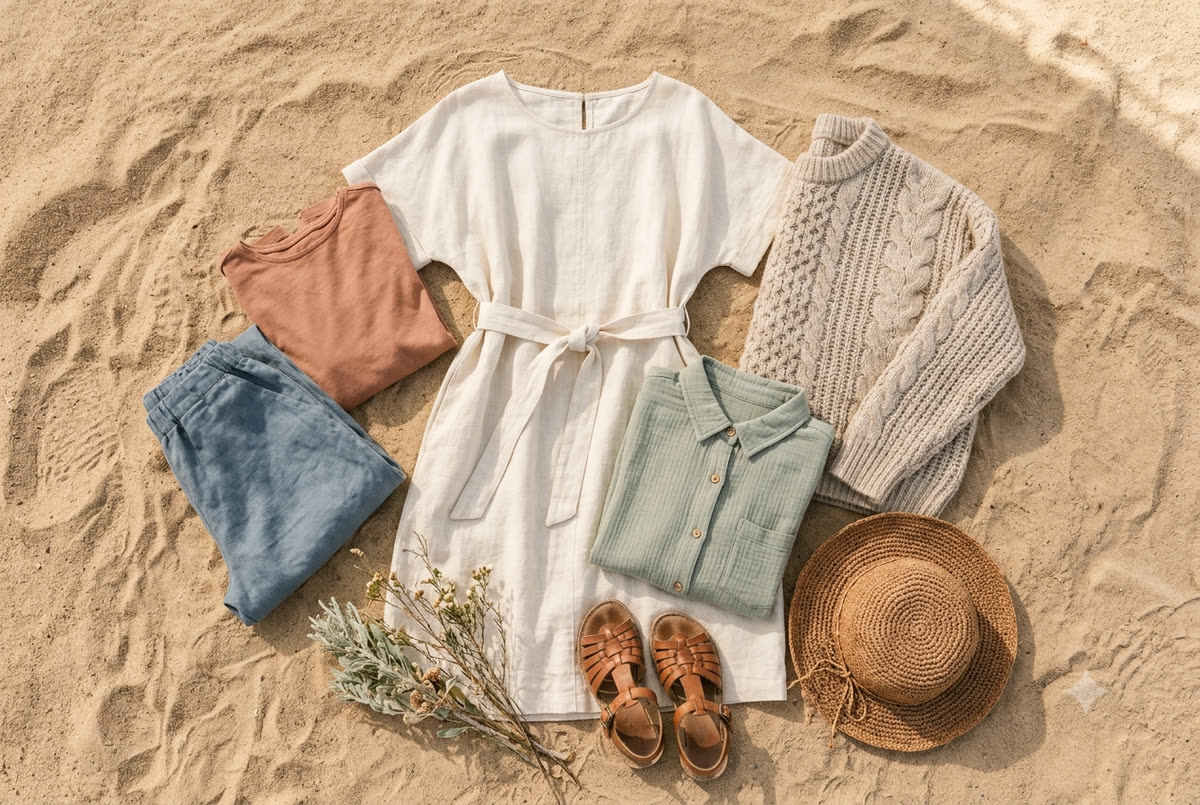
Choose light, breathable, natural fibers. Cotton, linen, linen blends, chambray, gauze, modal, and lightweight silk all breathe, drape softly, and catch a breeze. They photograph with a relaxed, lived-in elegance that suits our landscape perfectly.
Reach for flow and movement. A long cotton or linen dress, a gauzy maxi skirt, a flowing kaftan, wide-leg linen trousers — these are made for our climate. When a breeze drifts across a garden in La Quinta or a shaded patio in Indian Wells, fabric that moves gives me some of my favorite frames: hems lifting, skirts swirling, a scarf trailing. Even indoors, a fan by an open door can lend the same gentle motion. Stiff, structured clothing just sits there.
Be cautious with synthetics and heavy knits. Thick polyester, dense ponte, heavy sweaters, and anything labeled "thermal" will leave you overheated and shiny within minutes. If you love a chunky-knit look for a cooler winter sunrise, bring it as a layer you can add and remove rather than your foundation.
Watch out for cling and sheerness. Very thin jersey and lightweight whites can turn translucent in our backlight — that beautiful glow behind you is also shining through you. Either choose a slightly heavier weave, line the garment, or wear a coordinating slip underneath. I'd much rather you know this now than discover it in the gallery.
Linen wrinkles, and that's okay. People worry about linen creasing. In the desert, soft natural wrinkles read as ease and authenticity, not sloppiness. Don't let the fear of a wrinkle talk you out of the single most desert-appropriate fabric there is.
Color: working with the landscape, not against it
Our backdrop is a warm, sun-bleached palette — sand, gold, sage green, terracotta, dusty pink, pale stone, and that enormous blue sky. The colors that sing here are the ones in conversation with that palette.
My favorite desert palette:
- Warm neutrals: cream, ivory, oatmeal, soft white, camel, tan, and taupe
- Earth tones: rust, terracotta, ochre, olive, warm browns
- Muted desert pastels: dusty rose, blush, sage, soft sky blue, faded clay
- Gentle, sun-washed versions of richer colors rather than anything neon-bright
These tones reflect our golden-hour light beautifully and make skin glow rather than compete with it. A family in layered creams and warm tans against the sand at golden hour is, to my eye, the most timeless look the desert offers.
Colors to approach carefully:
- Pure stark white can blow out and lose detail in full midday sun. Soft white, ivory, and cream are safer and warmer. (At golden hour, true white behaves far better — timing matters here.)
- Neon and electric brights reflect colored light onto faces — a hot-pink top can cast a pink tinge under chins and arms. Save the boldest brights for indoor or shaded settings.
- All-black, head to toe absorbs heat (you'll cook), reads heavy against our airy backdrop, and loses the soft shadow detail that makes clothing look dimensional. A black accent is lovely; an all-black outfit fights the desert.
- Big logos, large slogans, and busy character prints date a photograph instantly and pull the eye away from faces. Quiet clothing keeps the focus where it belongs — on you.
Pulling a group together
For families and couples, you're after harmony, not a uniform. Identical outfits — everyone in the same white shirt and jeans — flatten a group and erase the individuality I most want to capture. Think of it the way you'd set a table: the pieces belong to the same family, but no two are quite the same.
Here's the approach I give every family:
- Pick a palette of three to four desert tones — say, cream, sage, camel, and a touch of rust.
- Give everyone a different combination drawn from that palette. One person leans into the cream, another the sage, a third pulls in the rust as an accent.
- Vary the textures and silhouettes. A linen dress next to a chambray shirt next to a waffle-knit henley adds the depth that makes a group photo feel rich rather than flat.
- Layer thoughtfully. A light cardigan, an open linen overshirt, a denim or suede jacket for a winter sunrise, a hat, a scarf — layers add visual interest and double as temperature control.
- Dress the most particular person first (often a tween or a partner with strong opinions), then build everyone else's palette around what they'll happily wear. A comfortable, willing subject always photographs better than a perfectly styled but miserable one.
If you'd like a deeper walk-through of building a cohesive group look, I've written more in How to Coordinate Outfits for Family Photos.
Dressing for the heat, honestly
Let's talk plainly about the temperature, because comfort is not a small thing — it's the difference between a relaxed gallery and a tense one.
The simplest fix is to come indoors. A large share of my sessions happen right in a client's home, in air-conditioned comfort, working with the soft light from your windows. The heat simply never enters the picture, and small children and grandparents stay relaxed in a space they already know. When the calendar gets warm, this is often my first suggestion.
Outdoors, we work the cool edges of the day. For sessions in a park, garden, or out in the open desert — certainly from late spring through early fall — I schedule at sunrise or in the last hour or two before sunset (our true golden hour). The light is softer and warmer then, and the temperature is survivable. Even a July session becomes pleasant at 6 a.m. or in the glow just before dusk. If you've booked a summer session and wondered how anyone manages, this is the answer — timing does the heavy lifting.
Dress for the actual temperature you'll feel. If we're meeting at sunrise in March, the desert can be genuinely cool — bring a layer. If it's an October sunset that's still warm, lean into your lightest pieces. I'll always tell you in advance what to expect for our specific date and time.
Practical heat strategies that still look beautiful:
- Choose sleeveless, short-sleeve, or loose flowing long sleeves over anything tight and long-sleeved.
- Favor a flowing skirt or dress over fitted pants — air movement is everything.
- Bring a hat. A wide-brim straw or felt hat is both a heat-saver and one of my favorite styling pieces in the desert.
- Pack water, a hand towel for blotting, and a small fan or umbrella for shade between setups, especially with little ones.
- Avoid heavy makeup in the heat; it tends to slide. A natural, lighter approach holds up far better.
A note if you're visiting from a cooler climate. Many clients pack as if our desert "winter" matches the one back home. It rarely does. Our midday can be warm and bright even in January, while a sunrise can be crisp. The safe play is light fabrics plus a removable layer, so you're ready for both ends of a single morning.
Shoes, accessories, and the small things
The little details either disappear or distract — there's not much in between.
- Shoes: In a home session you may be barefoot or in something soft on smooth floors. At a park or garden you'll meet grass, paved paths, and the occasional patch of sand or decomposed granite, so plan for it. Sandals, espadrilles, and comfortable flats work beautifully and suit the relaxed mood. If you love a heel for a more formal look, bring it for a few frames and wear flats to walk between spots. Sand and stilettos are not friends.
- Jewelry: Simple and warm-toned. Delicate gold tends to glow at golden hour. Skip anything so large it competes with faces.
- Hats and scarves: Genuinely useful and genuinely flattering here. A breeze and a light scarf can make a frame.
- Sunglasses: Lovely for a few intentional shots, but I'll want plenty of frames with eyes visible — bring them, but plan to take them off too.
- Nails and details: They show in close-up and hand-on-shoulder poses. A quick tidy goes a long way.
Outfits I love for the desert
If you want concrete starting points, here are looks that almost never miss out here:
- For her: a flowing cream or terracotta maxi dress in cotton or linen, delicate gold jewelry, simple sandals, hair down or softly back. Effortless and timeless whether you're by a window at home or against a sun-washed wall.
- For him: a linen or chambray button-down in soft white, sage, or tan, sleeves casually rolled, well-fitting chinos or relaxed trousers in a warm neutral, clean comfortable shoes.
- For children: soft natural fabrics they can actually move and play in — a little linen romper, a flowy dress, a simple tee in a desert tone. Let them be comfortable, and let them be themselves.
- For couples: one of you in a soft pattern or a touch of texture, the other in a coordinating solid from the same warm palette. Aim to complement, never to twin.
Common mistakes I gently steer people away from
- Booking a midday summer shoot in heavy dark clothing (overheating and harsh light — we fix both with timing and fabric).
- Matching the whole family in identical outfits.
- Stark, blown-out white in full sun.
- Sheer, thin pieces with nothing underneath in backlight.
- Brand-new shoes for a session on sand.
- Overthinking it to the point of stress. The best wardrobe is one you feel like yourself in.
When in doubt, ask me
Truly — sharing a few photos of your outfit options ahead of time is one of the most useful things you can do, and I welcome it for every session. I'm happy to help you build a palette, sort out layers for our specific date and time of day, and make sure everything will read beautifully in our light. For more on timing and locations, you might also enjoy The Best Times and Places for Desert Photos.
What matters most is that you arrive comfortable, relaxed, and dressed in a way that feels honestly like you. Get the fabric and the palette right — whether we're working with the window light in your living room or the glow of golden hour at a park or out in the desert — and everything else falls into place. That's when I find those quiet, genuine moments, the ones that make each of you who you are, and turn them into images you'll keep for years.
When you're ready to plan yours, let's talk through the where and the what together — I genuinely enjoy this part. Send me a note and we'll build a look that fits both you and the day.