Corporate Team Headshots in the Desert
Open almost any company's "Meet the Team" page and you can usually spot the problem in three seconds: the photos do not match. One person is cropped out of a wedding, another is a dim phone selfie, and someone in the corner has been photographed against a beige conference-room wall under fluorescent light. Each face was added whenever that person was hired, so the page reads as a patchwork rather than a team. That mismatch is exactly what corporate team headshots exist to fix — and the fix is not about vanity, it is about coherence. When a whole team looks consistent, warm, and professional, the business looks trustworthy before a single word is read.
I have been photographing people across Palm Springs and the Coachella Valley for many years, and over time more and more of that work has become headshots and personal branding for businesses. Law firms, medical practices, real estate teams, country-club staff, startups working out of the Palm Springs tech corridor — they all eventually face the same realization that firm did. So I want to walk you through everything I have learned about doing this well in our particular corner of the desert, because photographing a team here is genuinely different from photographing one in a Chicago high-rise.
Why corporate headshots matter more than people think
We make judgments about people in a fraction of a second, and online your headshot is usually the first thing a client, patient, or recruiter sees. A good corporate headshot does three quiet jobs at once. It tells someone what you look like, yes — but it also signals how you want to be perceived (approachable, authoritative, creative, meticulous), and, when it matches the rest of your team, it tells the viewer that your organization is established and pays attention to detail.
That last point is the one businesses underestimate. A single great headshot helps an individual. A consistent set of headshots — same lighting, same background treatment, same framing, same overall feeling — makes an entire company look intentional. When I photograph a team, my real product is not eleven nice pictures. It is eleven pictures that obviously belong together while still letting each person look like themselves.
What "consistent" actually means
People hear "consistent" and picture everyone posed identically like a row of mugshots. That is not it. Consistency lives in the technical and aesthetic decisions that stay fixed across the session:
- Lighting — the same direction, softness, and ratio on every face, so no one looks flatter or harsher than their colleague.
- Background — either one shared backdrop, or the same outdoor environment shot the same way, so the team reads as a unit.
- Framing and crop — heads sit at the same height, shoulders fill the frame the same way.
- Color and finish — one editing style applied across the whole set, so skin tones and contrast match.
Inside that consistent frame, individuality is the goal. The retiring partner can look warm and seasoned; the new associate can look bright and eager. Finding the expression and small turn of the head that makes each person unmistakably them — the half-second where the professional mask drops and the actual person shows up — is the part of this work I love most, even when I am doing it twenty times in a morning.
The desert advantage: why location matters here
Here is where Coachella Valley headshots get genuinely interesting, and where I get to use this landscape instead of fighting it.
Most of the time I photograph a team right where they work — I bring my lighting to their office and use their own lobby, a glass-walled meeting room, or a quiet stretch of wall, often with the bright desert light coming through the windows. It is the easiest thing in the world for a team: nobody has to drive anywhere, and the photos end up looking like the place they actually spend their days. That on-site approach, plus a clean studio backdrop when a client wants one, covers the great majority of the corporate work I do.
But we also live somewhere with extraordinary natural light and scenery, and an increasing number of desert businesses want headshots that feel like they were made here rather than in Anytown, USA. That is where it gets interesting.
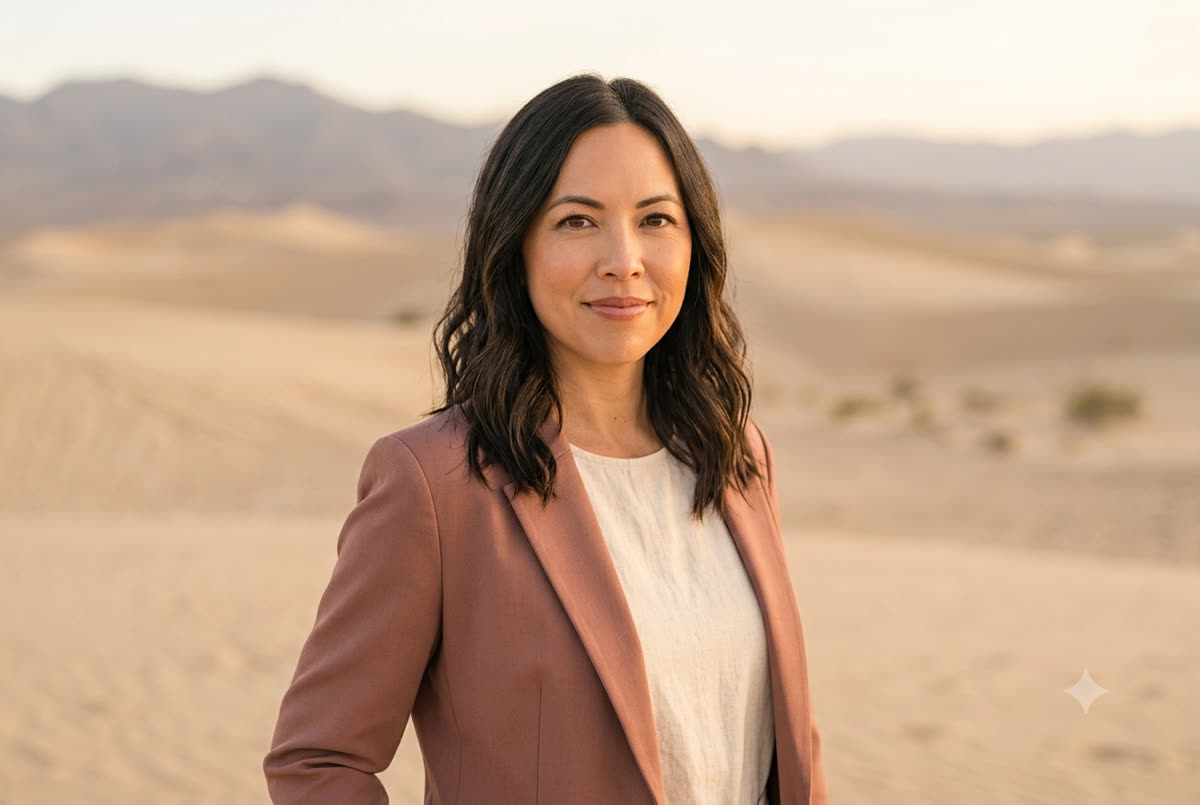
Environmental headshots use a real setting as a soft, out-of-focus backdrop. In the Coachella Valley that can mean:
- A clean, modern lobby or glass-walled office in Palm Desert or Rancho Mirage.
- A shaded courtyard, patio, or the warm adobe and desert landscaping common to our business parks and resorts.
- The mountains — the Santa Rosas behind Palm Desert and La Quinta, the San Jacintos behind Palm Springs — rendered as a gentle blue-and-tan blur behind someone's shoulder.
- The architectural lines of mid-century Palm Springs, which photograph beautifully and say "desert" instantly.
These location-based portraits give a brand personality. A real estate team that sells desert homes, a resort, a wellness practice, a design studio — they all benefit from headshots that quietly broadcast we are of this place. If you would like to go deeper on that idea, I wrote more about it in the difference between a headshot and a personal brand portrait.
That said, I always counsel honestly here: if your team is national, fully remote, or in a conservative field where a clean studio look reads as more credible, a classic backdrop is the right call. The location should serve the brand, never the other way around.
The thing nobody warns you about: heat and light
You cannot plan a desert team session the way you would plan one in a temperate climate, and this is where local experience earns its keep.
Summer (roughly June through September) is our season of 110°+ afternoons. Outdoor headshots in that heat are miserable and they show — squinting, flushed faces, wilting hair, sweat that no editing fully fixes. In summer I either move the session indoors entirely or shoot outdoors only in the first hour or two after sunrise, before the valley turns into an oven. A team of fifteen cannot stand outside at 2 p.m. in July looking fresh. It simply will not happen.
The cooler months (roughly November through April) are the opposite, and it is no accident that so much of the valley's business activity clusters here. The light is gorgeous, the temperatures are kind, and outdoor sessions are a pleasure all day. This is also when most corporate work naturally lands, which means my calendar fills earliest for those months — booking a team shoot four to six weeks ahead is wise once the season gets going.
If we are shooting outdoors, golden hour — the hour after sunrise and the hour before sunset — gives the warm, flattering, low-angle light that makes desert portraits glow. For a large team it is not always practical to fit everyone into a single golden hour, so for big groups I often build a shaded, open-sky outdoor setup that delivers consistent soft light across a longer window, or I bring studio lighting to a location and control it completely. Direct overhead sun is the one thing I steer everyone away from — it carves unflattering shadows under the eyes and nose — and knowing how to read and shape this particular light is a good part of what you are hiring.
How a team session actually runs
Clients relax once they know the shape of the day, so here is roughly how I run a corporate session.
Before the day
We talk first about the goal: how many people, where the photos will live (website, LinkedIn, press, lobby prints), the look you are after, and whether you want studio or environmental. From that I recommend a location and a time of day, and we set a per-person time slot — usually five to ten minutes each — so people can come down from their desks in a staggered schedule rather than everyone standing around for two hours. For larger teams I provide a simple sign-up grid. This single piece of logistics is what separates a smooth session from a chaotic one.
On the day
I arrive early and build the setup before anyone steps in front of the camera, so the lighting and background are locked and identical for the first person and the last. Each person gets a few relaxed minutes that never feel rushed. My job in those minutes is to get people out of their heads — most professionals are quietly nervous about being photographed, and a little direction on where to put their hands, how to angle their shoulders, and what to do with their chin does more for the final image than people expect. I show a frame or two on the back of the camera early so everyone can see they look good; that alone settles the whole room.
After the day
I cull and edit to one consistent style, retouch with a light and honest hand — skin that looks like real skin, not plastic — and deliver web-ready files plus print-ready versions. When you add staff later, I can match new headshots to the existing set so your team page never becomes a patchwork again.
What your team should wear
Wardrobe is where a little guidance prevents a lot of regret, so I send every team a short note ahead of time. The principles:
- Agree on a level of formality as a team — full suits, smart business casual, or branded polos — so no one is overdressed or underdressed beside a colleague.
- Favor solid colors over busy patterns, tight stripes, and small checks, which can shimmer and distract on camera.
- Mid-tones and jewel tones photograph beautifully and read well against both studio backdrops and desert backgrounds. Be a little careful with pure white (it can glow) and with colors that match your background and make people blend in.
- Bring a layer. A blazer or structured jacket instantly raises the professionalism of any shot, and it is easy to remove for a softer alternate.
- Keep accessories simple so the focus stays on the face.
- A small touch-up kit helps — blotting papers and a comb do real work in our dry, warm climate, especially in the warmer months.
If you want this in more detail for your team, I keep an evergreen version in what to wear for professional headshots in the Coachella Valley.
Common mistakes I help businesses avoid
- Mixing sources. Cropping individual photos from group events or letting each person submit their own selfie. It always looks like exactly what it is.
- Waiting until the website launch is days away. Good team photography takes a little lead time, especially in our busy Nov–Apr season.
- Scheduling outdoors in summer afternoons. See above — the heat will be written on every face.
- No plan for new hires. Teams grow. Decide upfront how future headshots will be matched so consistency survives turnover.
- Over-retouching. Clients meet these people in real life. A headshot that looks nothing like the person undermines the very trust it was meant to build.
- Forgetting the practical files. You want both a tight crop for LinkedIn and a wider version for the website, in the right resolution. I deliver both so you are never re-cropping at the wrong size.
Frequently asked questions
How long does a team session take?Budget roughly five to ten minutes per person, plus my setup time. A team of ten is comfortably a morning; larger teams we schedule in waves. A clear sign-up schedule keeps it efficient.
Studio backdrop or out in the desert — which is right for us?It depends on your brand and audience. Clean studio for conservative, national, or formal fields; environmental desert portraits when local character and warmth serve you. We decide together before the day, and I am happy to tell you honestly which I think fits.
Can you come to our office?Yes. I regularly bring a full lighting setup to offices across Palm Desert, Palm Springs, Rancho Mirage, Indian Wells, La Quinta, and Indio, so your team never has to leave the building. A spare room or a quiet stretch of wall is usually all I need.
What about new employees later?I keep a record of how I lit and edited your set so future headshots match seamlessly. Many of my corporate clients bring me back a couple of times a year for new hires.
What do we actually receive?Professionally retouched, color-consistent images delivered in both web-optimized and print-ready formats, cropped for the places you will use them.
A consistent team is a quiet kind of confidence
When a team page finally comes together, the staff page tends to be the part a business is proudest of — a row of people who at last look like one company, often photographed right in their own bright lobby with the desert light coming through the glass. Nothing flashy. Just consistent, warm, honest, and unmistakably them. That is the whole goal: images your team is comfortable in and your business is proud of, that still look like themselves years from now.
If your company is refreshing its website, onboarding a new group of hires, or simply tired of a mismatched staff page, send me a few details — how many people, where they work, and the kind of impression you want to make. Reach me through my contact page and I will map out the location, timing, and approach that fits your team, and tell you honestly what I would do in your shoes.