What to Wear for Branding Photos
Of everything we sort out before a branding session, wardrobe is usually the part that makes people the most nervous — and it's genuinely the easiest thing for us to solve together. Your branding photos are often the very first impression a potential client gets of you, sometimes before you've ever spoken. What you wear isn't about fashion. It's about looking unmistakably like you, at your most confident and capable, in a way that quietly tells people what it feels like to work with you.
I've been photographing people throughout Palm Desert, Rancho Mirage, La Quinta, and the wider Coachella Valley for many years, and branding sessions have a particular rhythm to them. Most of mine happen right where the work actually lives — in your home office or studio, on a sunlit patio — or in a nearby park or garden that suits your brand. They're a little more strategic than a family portrait and a lot more personal than a corporate headshot. So let me walk you through exactly how I think about clothing for these shoots — the principles, the desert-specific details, the small mistakes that are easy to avoid, and how to build outfits that will still look right to you two years from now.
Start with your brand, not your closet
Before you pull a single thing off the hanger, I want you to sit with one question: who is this for, and what do I want them to feel?
A wellness coach in Indian Wells, a real estate agent in La Quinta, an attorney in Palm Desert, and a ceramicist selling at the College of the Desert street fair are all building very different impressions. The coach wants warmth and approachability. The attorney wants authority and trust. The ceramicist wants creativity and texture. Your clothing is one of the fastest ways to communicate all of that without a single word.
So the first step is simply naming the three or four words you want people to feel when they land on your website. Grounded. Polished. Playful. Trustworthy. Calm. Bold. Once we know those words, choosing what to wear becomes almost obvious — every outfit is just a question of "does this say grounded and warm, or does it say something else?"
This is also why I never hand clients a rigid rulebook. The "right" outfit for a luxury wedding planner is the "wrong" outfit for a desert hiking guide, and both can be completely correct. The goal is alignment between who you are, who you serve, and what you put on.
Bring more than you think you need
Here's my single most practical piece of advice: plan three to five complete looks, even if your package only calls for two. Variety is what makes a branding gallery actually useful all year long.
Think of your looks along a spectrum:
- Polished / elevated — your "I'm the expert, hire me" look. A blazer, a structured dress, a crisp button-down. This is your homepage and your LinkedIn.
- Approachable / everyday — what you'd genuinely wear to coffee with a client. Softer, warmer, a little more relaxed. This is your About page and your Instagram.
- In-action / working — whatever you actually wear while doing the work. An apron, scrubs, a tool belt, a yoga set, your real laptop-and-cardigan setup.
- A pop / personality — one bolder color or a statement piece that feels like the most expressive version of you.
Each complete look should include the layers, shoes, and accessories — not just the top I'll see in a close-up. When we shoot wider environmental portraits — at your desk, across your studio, or walking a local garden path — the whole outfit matters.
A quick tip on logistics: bring everything on hangers in the order we'll shoot them, with the accessories already paired. We lose a surprising amount of good light digging through a tote bag looking for the other earring. If you want help thinking through the full session beyond clothing, my guide on how to prepare for your branding session covers the rest.
Color is your most powerful tool
If there's one thing I'd love every client to understand, it's that color does the heavy lifting in branding photography. It sets the mood before anyone reads a word.
A few principles I lean on:
- Anchor to your actual brand colors. If your website, logo, and packaging live in warm terracotta and cream, wearing those tones makes your photos feel like an extension of your brand instead of a stranger's. When your imagery and your site share a palette, everything looks intentional and expensive.
- Solid, saturated colors photograph beautifully. Deep teal, rust, olive, camel, ivory, soft denim, burgundy. They read clearly even at small sizes on a phone screen.
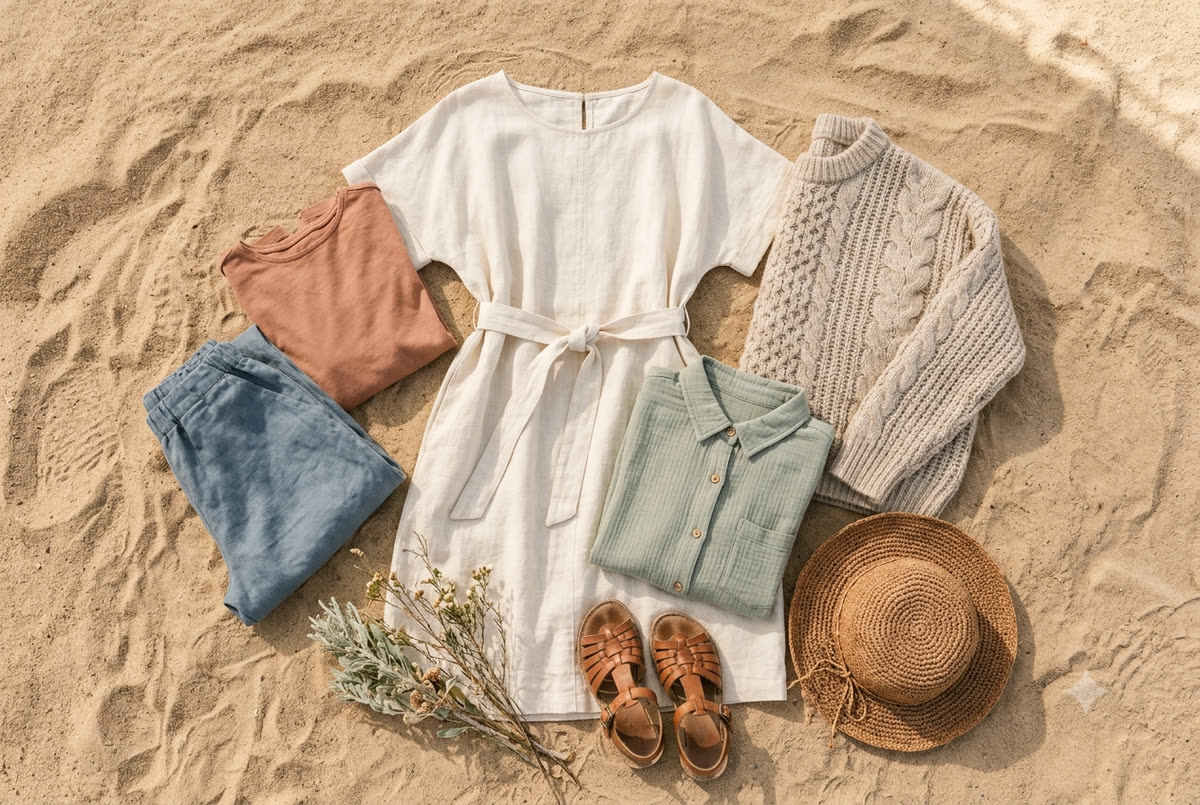
- Soft neutrals are your friend in the desert. Cream, sand, warm white, oatmeal, and taupe sit gorgeously against our landscape and never fight for attention. They also keep the focus on your face.
- Choose colors that flatter you, not just your brand. Hold a fabric up near your face in natural light. The right tone makes you look rested and bright; the wrong one can make you look tired no matter how good the photo is.
I'll talk more about specific palettes below, but the short version: pick two or three colors that work together, and build all of your looks within that family. A cohesive gallery is far more valuable to you than five outfits that look like they belong to five different people.
Dressing for the desert light and landscape
This is where shooting in the Coachella Valley really shapes my advice, and where generic "what to wear" lists fall short. Our environment is specific, and we should dress for it on purpose.
Work with the natural palette
Even close to home, our backdrops are warm: terracotta walls, mid-century pastels, the deep greens of a palm oasis, a garden in bloom, the blue-grey of the Santa Rosa mountains in the distance. Earth tones, warm neutrals, and rich jewel tones glow against this palette. A camel blazer in soft daylight by a window, an ivory dress against a white Palm Springs wall, a rust top among garden greenery — these sing.
What fights the desert? Very cool, icy tones and stark, flat black can feel disconnected from the warmth around us. They're not forbidden — a structured black dress can look powerful and editorial — but I'd use them deliberately rather than by default.
Match your light to your setting
For the most flattering, honest light, I work with whatever the space gives us. Indoors, that means soft daylight pouring through a window across your living room or studio — gentle, natural, and beautifully kind to skin. Outdoors in a park or garden, I shoot early in the morning or in the last hour or two before sunset, when that low golden sun is magic on skin and fabric. Either way, the light is soft, which means light, breathable layers are perfect — flowing fabrics, linen, and a little gentle movement all read beautifully.
Respect the season and the heat
The cooler stretch of the year, roughly fall through spring, is glorious for outdoor sessions in a park or garden — comfortable temperatures, clear skies, and long warm light, so you can wear those gorgeous layered looks without melting.
Summer is a different animal. From late May into September, a midday outdoor shoot in Palm Desert or Indio simply isn't comfortable or flattering, and it shows. In summer I keep most sessions indoors with the air conditioning and that lovely window light, or move any outdoor work to the very edges of the day, and lean toward breathable natural fabrics like linen and cotton. If your session lands in the warm months, choose fabrics that breathe and avoid anything heavy, tight, or prone to sweat marks (more on that below).
Comfort for moving around
Even a relaxed in-home shoot or a stroll through a local park means a little walking — across a room, over grass, gravel, or a stone patio. That informs a few real choices:
- Hair-friendly = simpler is safer if it's breezy outside, but honestly, a little movement in a flowing dress can be lovely. We'll use it.
- Shoes that can walk. Bring the gorgeous heels for the close-ups, but pack flats for moving between spots.
- Skip floor-length hems you can't lift if we're walking a garden path. A midi or a hem you can gather works better.
Fabrics, fit, and the small details that read on camera
The camera notices things the mirror doesn't. A few practical fabric and fit notes:
- Fit is everything. Clothing that fits well — not too tight, not swimming on you — instantly looks more expensive and more confident. If a blazer is your hero piece, consider a quick tailor visit. It's the cheapest upgrade to your photos you can make.
- Choose fabrics with a little structure or beautiful drape. Linen, ponte knit, silk, good cotton, and wool blends hold their shape and catch the light. Thin, clingy jersey can show every lump and wrinkle.
- Steam everything. Wrinkles photograph as wrinkles. Bring pieces on hangers and give them a quick steam the morning of.
- Mind sweat-prone fabrics in the heat. Silky tops and tight synthetics show perspiration fast in the desert. Natural fibers and a slightly looser cut are kinder.
- Watch tiny patterns. Very fine stripes, herringbone, and tight checks can shimmer and buzz on camera (the "moiré" effect). A bold, larger print is fine; a micro-pattern often isn't.
- Layers give us options. A blazer on, then off. A scarf added, then removed. Layers let us create multiple looks from one base and add depth to the image.
Accessories, hair, and the finishing touches
Accessories are how you turn one outfit into three and add personality without buying a new wardrobe.
- Jewelry should feel like you. If you always wear simple gold studs, wear them. If you love a bold statement necklace, bring it. Just make sure pieces sit well and don't tangle with collars or hair.
- Bring the tools of your trade. This is branding, so the props matter. A florist with a bundle of stems, a baker with a tray, a coach with a notebook, a realtor with keys — these tell your story and give your hands something natural to do.
- Hair and makeup a touch stronger than everyday. Cameras and bright desert light wash us out a little, so a slightly more defined version of your normal look reads best. Many of my clients book a professional for the morning of, and it's worth it — it shows in how polished and put-together you feel. If you'd like, I'm always happy to recommend artists I trust here in the valley.
- Glasses wearers: if you wear them daily, wear them — they're part of your brand. We'll just manage reflections as we shoot.
- Nails matter more than you'd think, because your hands are in so many branding shots. A clean, simple manicure is a nice finishing touch.
Common mistakes I gently steer clients away from
After years of these sessions, the same few snags come up. None of them are disasters, and all are easy to avoid:
- Buying everything brand new. New clothes you haven't worn can fit oddly or feel unlike you on camera. Mix in trusted pieces you already love and feel great in.
- Big logos and trendy graphics. A giant brand logo across your chest dates the photo and competes with your message. Keep it clean.
- Matchy-matchy or all-one-look. Five near-identical outfits give you a gallery you can't vary across a whole year of content. Spread across the polished-to-relaxed spectrum.
- Ignoring the bottom half. We shoot full-length out here. Plan shoes and trousers, not just the top.
- Dressing for who you were, not who you're becoming. Branding photos should reflect the business you're building. Dress at the level you want to be hired at.
- Forgetting comfort. If you're tugging at a waistband or can't breathe in a blazer, it shows in your shoulders and your smile. Confidence photographs better than any outfit.
Putting it all together: a sample plan
Here's how I might map out looks for a wellness coach photographed partly in her home studio and partly in a nearby garden in the Palm Desert area:
- Polished: a camel blazer over an ivory top, tailored trousers, simple gold jewelry, shot in soft window light — the "hire me" homepage shot.
- Approachable: a soft sage knit and jeans, hair down, for the warm About-page feel.
- In-action: her actual workout or studio wear, natural and unposed, for the "this is what we'll do together" content.
- A pop: a flowing terracotta dress catching the last golden light out in the garden — the image that stops the scroll.
Same person, same palette, four very different stories. That's the whole goal.
If you want to keep reading in this series, my notes on what to wear for family photos in the desert and what to wear for a headshot session take the same down-to-earth, practical approach to those sessions.
Let's make it easy
The best part of my job is that you don't have to figure any of this out alone. When you book with me, we plan it together before the day arrives — your brand, your setting, the season, your wardrobe — so the morning of, all you have to do is show up and be yourself.
If you're a business owner or creative anywhere in the Coachella Valley — Palm Desert, Palm Springs, Rancho Mirage, Indian Wells, La Quinta, or Indio — and you've been picturing branding photos that finally look like the real you, tell me about what you're building. Start the conversation here and we'll map out a session that fits your work, your space, and the light that suits you best.