Senior Portraits for Palm Desert High School
Every fall, parents of Palm Desert High School seniors start finding their way to my inbox with some version of the same realization: this is the last year, and it is already going fast. One day your son or daughter is learning to drive down Fred Waring; the next they are filling out college applications and counting down to that walk across the stage at the stadium. Senior portraits are the pause button in the middle of all that — the photographs you will look at twenty years from now and feel your heart catch.
I have been photographing families, children, and graduating seniors across Palm Desert and the desert cities for many years, and I can tell you that a good senior session is not about a stiff cap-and-gown headshot. It is about capturing who this young person actually is — the laugh, the posture, the quiet confidence or the wild energy — right at the threshold of everything that comes next. This is my honest, local, start-to-finish guide to senior portraits in Palm Desert, written for the families and the students who want something that feels like them.
What a senior portrait session really is
A senior session is a portrait session built entirely around one person, in the year they graduate high school. Unlike the yearbook photo — which the school arranges, usually on a tight schedule against a plain backdrop — a custom senior portrait session is yours. We choose the location, the time of day, the wardrobe, and the mood. We take our time. The whole point is to come away with images that say this is who I was at eighteen, not a generic stamp that looks like everyone else's.
For most Palm Desert High seniors, a session runs somewhere between an hour and two hours, depending on how many outfits and locations we want to work through. There is no need to hurry. The best, most natural expressions almost never come in the first five minutes — they come once a student relaxes, forgets the camera a little, and starts just being themselves. My job is to get us there gently, and I lean on conversation more than instruction to do it. I promise you do not need to know how to pose. That is what I am for.
Most of my sessions begin somewhere comfortable and familiar — often right inside a family's home, or on a shaded patio, or at a nearby park or garden the student already knows. Starting on home ground does more for a nervous teenager than any scenic backdrop can. We can always add a location with a bigger view once they have warmed up, but the home, the park, and the garden are where my work really lives.
When to book — the desert's calendar matters
Timing is the single most important practical decision, and here in the Coachella Valley it is driven by two things: the school year and the weather.
Book for fall, ideally September through November. This is the sweet spot. The brutal summer heat has finally broken, the desert is comfortable again, and we still have plenty of margin before college application deadlines and yearbook submission dates. Many schools, Palm Desert High included, want senior portraits submitted relatively early in the year, so a late-summer or early-fall session keeps you safely ahead.
Spring works beautifully too, roughly February through April, when the valley is in its gentlest stretch — wildflowers in the higher desert, mild temperatures, and gardens at their greenest. If your student missed the fall window or simply wants spring imagery for graduation announcements, this is a lovely time.
Be cautious about summer. From June into September, daytime temperatures regularly climb past 110 degrees. We can still shoot — I have done plenty of summer sessions — but it means an indoor session with open windows, or for outdoor looks starting at sunrise or working in the last sliver of light before sundown. It also means being realistic about comfort and wardrobe; no one looks their best overheated.
A note on lead time: I take a limited number of seniors each season so that every student gets my full attention, and the fall calendar fills early. If you are reading this in late summer, reach out now. If you are planning ahead, even better. Booking four to six weeks out gives us room to plan wardrobe and locations without any rush.
Matching the light to the setting
If you take only one thing from this guide, let it be this: the light is everything, and the right light depends on where we are shooting.
For an in-home session, I work with natural window light. A north-facing window in the morning, sheer curtains softening a bright afternoon, the glow that pools on a kitchen floor — soft, directional daylight indoors is some of the most flattering light there is, and it never asks anyone to squint or sweat. Much of my favorite senior work is made this way, in a living room or a doorway, with the family's own home as the backdrop.
For outdoor looks — a park, a garden, a patio, or a scenic spot with a view — I plan around golden hour, the roughly ninety minutes after sunrise or before sunset, when the sun is low and the light turns warm and directional. In the Coachella Valley that light is genuinely special: it glows against the San Jacinto and Santa Rosa mountains and wraps a person in a flattering warmth you simply cannot get from overhead midday sun.
What this means for you: our outdoor start time will not be arbitrary. In summer that might mean meeting at 6:00 a.m. or 6:30 p.m. In winter, with the early sunset, late afternoon works perfectly. I will always tell you exactly when to arrive based on the date, and I plan our locations around how the light moves across them in that window. It is one of the advantages of working with a photographer who actually lives and shoots here — I know which spots glow at which hour, and how to find good light inside a home too.
Where to shoot: from home ground to the wider valley
Location is where a senior session gets personal, and the Coachella Valley offers an incredible range. I almost always start close to home, then we decide together whether to venture out for a bigger view. Here are the kinds of settings I love, and what each one brings to the images.
In the home, and on the patio
This is my signature setting, and the one I steer most families toward first. A senior photographed in their own home — at the kitchen island, on a sunlit bed reading, leaning in a doorway, out on a shaded back patio — gives you portraits no other setting can. The space holds their history. Window light is soft and forgiving, the student is instantly at ease, and the images feel like them rather than a backdrop they borrowed for an hour. Years from now, these are often the frames families reach for first.
Local parks and gardens
A short walk from the front door, the valley's parks, botanical gardens, and green community spaces give us trees, lawns, blooming beds, and dappled shade — all gentle, all flattering, and all close enough that a student never feels like they have been hauled out to a wilderness. Civic Center Park in Palm Desert, the gardens around the resort corridor, and the tree-lined parks of La Quinta and Indian Wells are reliable favorites. This is where most of my outdoor senior work happens.
The wider desert landscape, when a student wants it
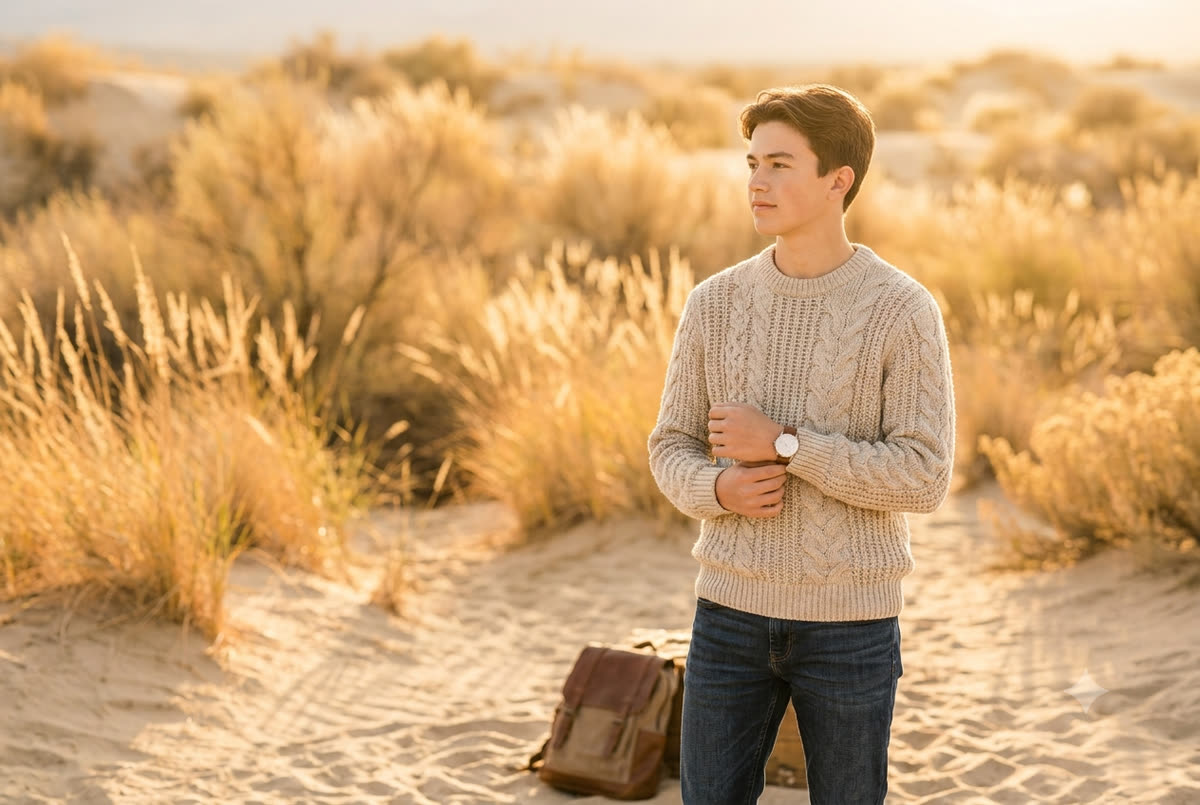
Some seniors do want that raw, cinematic desert look — the open sand, the scrub, the distant mountains, the enormous sky. It can make a striking frame or two, and if your student has their heart set on it, I am happy to fold a scenic stop into the plan. I treat it as the dramatic accent, though, not the foundation of the session. We get the relaxed, true-to-them images first, on familiar ground, and add the big view as a bonus.
Palm Springs and mid-century architecture
If your senior has a bold, modern sensibility, the clean lines and saturated colors of Palm Springs architecture are a gift — bright walls, breeze-block patterns, vintage doors, and pops of color that make a portrait feel editorial. A short drive up the valley opens up a completely different look from the open desert.
Palm groves and tropical greenery
The desert surprises people with its lush pockets. Tall date palms and shaded oasis-style groves around Indio, La Quinta, and the surrounding cities give us deep green, layered backgrounds — a beautiful contrast to the arid look, and wonderful for soft, romantic light filtering through the fronds.
Downtown and urban texture
For a student who is more city than sand, the streets and storefronts of Palm Desert's El Paseo district, or the walkable stretches of the desert cities, offer brick, murals, glass, and texture. Great for a relaxed, contemporary feel and for incorporating a little personality and style.
La Quinta, Indian Wells, and Rancho Mirage resort landscapes
The manicured grounds, water features, and mountain backdrops around the resort corridor — La Quinta, Indian Wells, Rancho Mirage — give a polished, elegant look that many families love for more formal portraits.
Somewhere meaningful to your student
Some of my favorite sessions happen at a place that matters to the senior — a favorite trail, the field where they played their sport, a backyard, a spot they have driven past their whole life. If there is a location with a story, tell me. Those personal touches almost always become the photos the family treasures most.
We can absolutely combine two locations in one session if they are reasonably close and we manage the light well. I will help you build a plan that flows.
What to wear: a real wardrobe guide
Wardrobe is where many families feel the most unsure, so let me be specific and practical.
Bring two to three outfits. A typical range is one polished or slightly dressy look, one casual everyday look that is truly "them," and one that shows personality — a sports jersey, a favorite band tee, an instrument, a piece tied to a hobby. Variety gives you images for different uses: the formal one for grandma's frame, the relaxed one for graduation announcements, the fun one for the student's own phone wallpaper.
A few things I have learned over many desert sessions:
- Solid colors and simple patterns photograph best. Busy logos and tight stripes can distract from the face. Earthy tones — warm neutrals, soft greens, denim, rust, cream — sit beautifully against the desert palette. Deep jewel tones look stunning at golden hour.
- Dress for the temperature, honestly. If we are shooting a warm September evening, lightweight fabrics keep your student comfortable and relaxed, which always shows in the photos. For a cool winter morning, layers are your friend — and a jacket or sweater can become a great styling element.
- Mind the footwear. We may be walking on sand, gravel, or uneven ground. Bring the cute shoes for the photos, but pack comfortable ones for getting between spots.
- Keep it timeless. Trends date a photograph fast. Ten years from now, a clean, classic look will still feel right; a hyper-trendy outfit may not.
- Details matter. Iron or steam clothes beforehand, check for stray tags and bra straps, and bring a comb. Little things that take thirty seconds to fix in person are nearly impossible to fully erase later.
If wardrobe feels overwhelming, do not worry — I help every senior plan their outfits before the session so nothing is left to chance. For a deeper dive, I put together a full breakdown in what to wear for your desert portrait session.
Props, pets, and personality
A senior portrait should reflect a whole person, not just a face, and props are one of the easiest ways to tell that fuller story. Over the years I have photographed seniors with their cleats and trophies, their cellos and guitars, their cameras, their cars, their skateboards, their letterman jackets, and — a personal favorite — their dogs.
If your student has a passion, let us build it in. A guitar in hand changes how a person stands. A beloved pet brings out a smile no instruction ever could. These are the touches that make a portrait unmistakably theirs. Just give me a heads-up in advance so we can plan the right location and timing (golden-hour light plus an excited Labrador requires a little choreography, but it is always worth it).
How to prepare your senior — and yourself
The students who get the best photos are not the most photogenic ones. They are the most relaxed ones. Here is how we get there.
The week before: Plenty of sleep, lots of water — the desert is dry and hydration genuinely shows in skin and energy. If your student wants a haircut, schedule it about two weeks out, not the day before, so it has time to settle. Hold off on any new skincare experiments.
Hair and makeup: Whatever makes your student feel confident is the right call. Many seniors do their own, and that is perfectly fine; others book a professional, especially the girls, which can be a lovely treat. The guiding principle is to look like the best version of yourself, not a different person. Natural, slightly enhanced makeup photographs better than a heavy application.
The morning of: Eat something. Bring water. Build in margin so you are not rushing — arriving frazzled shows on a face, and our golden-hour window does not wait. I would rather you arrive ten minutes early and calm than right on time and stressed.
For parents: You are welcome to come along, and many do. Your job is the easy one — be encouraging, hold the water bottles, and let me handle the directing. Sometimes a parent's presence helps a shy teen relax; sometimes a student loosens up more when mom and dad hang back a little. We will read the room. And yes, if you want a few photos of you with your graduate, just say so — these years do not come back, and a portrait of you together is something you will be grateful for.
What to expect during the session, step by step
I like families to know exactly how this goes, because knowing removes the nerves.
- We start where it is comfortable — usually the home or a nearby park at our planned time. We spend the first few minutes just talking, with no immediate posing.
- We ease in. I will guide your student into natural positions, give small directions, and crack a few jokes. Within ten minutes or so, the stiffness melts and we start getting the real expressions.
- We work the light and the outfits. If we are doing multiple looks, we move efficiently — following the window light indoors, or the best of golden hour if we have stepped outside.
- We capture the variety — relaxed frames in familiar surroundings, classic portraits, candid laughs, the prop or pet moments, a scenic shot or two if we have added one, and the polished cap-and-gown frames if you want them.
- We finish without rushing. I always tell seniors: the last shot is just as important as the first. Some of my favorite images come at the very end, once everyone is loose and having fun.
After the session, I carefully cull and hand-edit your images — color, light, and gentle, honest retouching that keeps your student looking like themselves. I will never over-process a face into something plastic. You can expect a beautifully finished gallery, and I will walk you through prints, albums, and announcement cards if you would like them.
Cap and gown, yearbook, and the graduation timeline
Two practical things specific to graduating seniors.
Yearbook deadlines come early. Most high schools, including those across the Desert Sands and Palm Springs school districts, require senior portrait submissions well before graduation — often in the fall. If your photo is destined for the yearbook, confirm the school's exact specs (size, background, formatting) and deadline early, and let me know so I deliver a compliant image on time. Do not assume you have until spring; many students get caught out this way.
Cap and gown sessions can be separate. Gowns often are not distributed until later in the year, so many families do a main creative session in the fall and then add a short cap-and-gown set in spring closer to graduation. We can plan either approach — all in one, or split across two sessions — whatever fits your timeline.
Common mistakes I gently steer families away from
- Waiting too long. The single most common regret. Fall books up, deadlines sneak in, and summer heat is no one's friend. Earlier is always easier.
- Shooting at the wrong time of day. A noon session in the desert fights you the whole way. Trust the golden hour.
- Over-coordinating outfits to the point of stiffness. Let your student wear what feels like them.
- Forgetting it is about the person, not the backdrop. A gorgeous location is wonderful, but a genuine expression is everything. We prioritize the human.
- Skipping the print. Galleries live on phones and phones get lost. Print at least a few. These are heirloom images, and they deserve to exist on a wall.
Why work with a photographer who knows this valley
A striking backdrop is the easy part. What I bring after many years of photographing in the Coachella Valley is knowing how to make a senior comfortable in their own home, where the soft light falls indoors, which nearby parks glow at which hour, how to keep a session pleasant in our climate, and how to draw a real, unforced expression out of a nervous eighteen-year-old. The frame where a guarded teenager finally lets their guard down — where you suddenly see the whole person — that is the part of this work I love most.
Senior year goes by in a blink. These portraits are how you hold onto it. If you would like to read more in this series, you might also enjoy planning the perfect desert golden hour session and a family's guide to fall portrait season in the Coachella Valley.
Let's capture this chapter
If you have a Palm Desert High senior — or a student at any of our valley high schools — I would love to create portraits that you and they will treasure long after the tassel turns. Tell me a little about your student: where they feel most themselves, what they are into, when graduation lands, and the kind of images that would mean the most to your family.
You can reach me anytime through my contact page. I look forward to hearing your senior's story and helping you hold onto this beautiful, fleeting year.