Documentary vs. Lifestyle Family Photos
Every so often a parent reaches me and says, "I don't want the stiff, everybody-look-here pictures. I want our real life — the way my kids actually are." I love that message, because it tells me they've already started thinking about how they want to be photographed, not just whether to do it. And almost always, the conversation that follows comes down to two words that get used interchangeably but really aren't the same thing: documentary and lifestyle.
After many years photographing families across Palm Desert, Rancho Mirage, Indian Wells, and the rest of the Coachella Valley, I've come to think of these two approaches as cousins. They share a family resemblance — both are warm, both feel honest, both move away from the rigid posed portrait. But they ask different things of me as the photographer and different things of you as the family. Understanding the difference is the easiest way to make sure the pictures you end up with are the ones you were imagining.
So let me walk you through it, plainly, the way I would if we were sitting at your kitchen table.
The short version
Documentary family photography is observational. I become a quiet witness. I don't direct, I don't ask anyone to look at me, and I let the day unfold exactly as it would if I weren't there. Think of it as a true story told in photographs — the morning chaos, the unprompted belly laugh, the toddler who refuses pants on principle.
Lifestyle family photography is gently guided. I set up real situations — a walk, baking together, snuggling on the bed — and then let genuine moments happen inside that frame. I might say "head toward that doorway" or "tickle him," but I'm not posing anyone. It's the feeling of candid with a light hand on the wheel.
Both produce natural, un-stiff images. The difference is how much I shape what's in front of the lens.
Documentary family photography, explained
The heart of documentary work is non-interference. My job is to anticipate, position myself well, and disappear. The reward is photographs with nothing performed in them — no "say cheese" faces, no arranged hands. Just your family being your family.
What a documentary session tends to capture:
- The unscripted rhythm of an ordinary day — breakfast, a board game, the dog underfoot.
- Real expressions, including the messy and the in-between. A frustrated cry can be as tender as a giggle when you look back years later.
- Connection that you can't fake — the way your daughter leans into you without being told to.
- The details that vanish: the height marks on the doorframe, the specific way your son holds his stuffed animal this year.
Documentary photography asks the most of you in one respect: you have to let go. The families who love it most are the ones who can genuinely ignore me and trust that the "boring" moments are exactly the point. The reward is honesty you simply cannot stage.
It does have trade-offs. You won't necessarily get a polished, everyone-looking, frame-it-for-Grandma portrait — although those often happen organically too. And it works best when there's life to document, which is why it pairs so beautifully with the kinds of in-home sessions I write about in why in-home family photos feel so different.
Lifestyle family photography, explained
Lifestyle is where most families land, and for good reason. It keeps the natural, candid feeling of documentary but gives me enough room to gently shape light, location, and activity so the images are consistently flattering and beautiful.
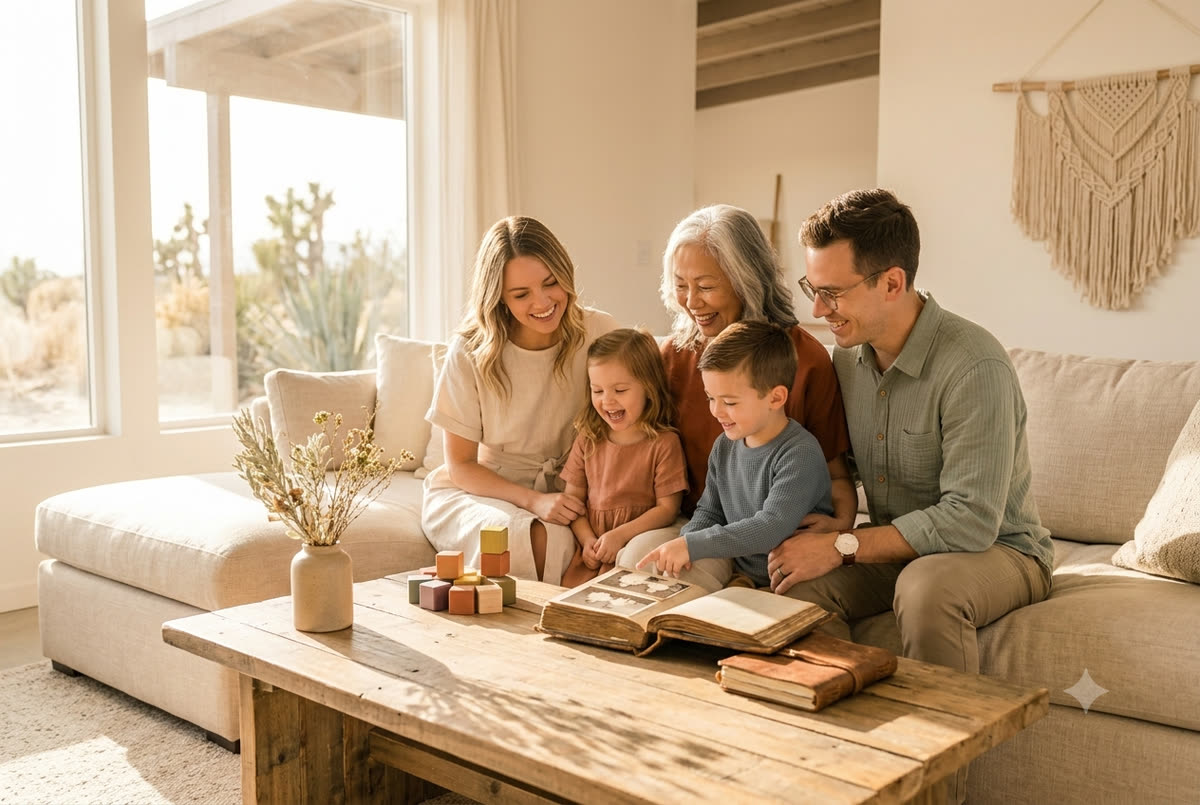
In a lifestyle session, I create prompts rather than poses. Instead of "stand here and tilt your chin," it's "all four of you pile onto the bed and read this book." Instead of arranging a smile, it's "Dad, whisper something silly to her." The activity is real, the laughter is real — I've just set the stage so the desert light is hitting you the right way and the background isn't a pile of laundry.
What lifestyle does especially well:
- Reliable, beautiful light. Here in the valley, that matters enormously. I can position your family so we're using soft morning light through a window, or that forgiving glow about an hour before sunset, rather than leaving it to chance.
- A mix of moments and "keepers." You get the candid in-between shots and a handful of images where everyone happens to be looking and connected.
- Comfort for kids. Children are wonderful at lifestyle sessions because they have something to do. A task — picking oranges, splashing, building a fort — beats standing still every single time.
- Flexibility of setting. Most of my lifestyle sessions happen right where life already does — inside your home, on the patio, in the backyard — or at a nearby park or garden a few minutes from your door. Those everyday places are my bread and butter, and they hold more of your family's real story than any far-flung backdrop.
If documentary is a pure observed story, lifestyle is a story we tell together — you live it, I shape it just enough to make it sing.
A side-by-side, the way it actually plays out
Imagine the same Saturday morning pancake breakfast, two ways.
Documentary: I arrive, you start cooking, I fade into the corner. I catch your son sneaking chocolate chips, the flour handprint on your jeans, the unposed moment your husband kisses the top of your head at the stove. Nobody looks at me the entire time. The photos feel like memories you can almost hear.
Lifestyle: I arrive, we decide pancakes are the activity, and I suggest we do it near the big kitchen window for the light. I might ask your daughter to stand on a stool and "help" stir, then let the real giggling take over. You'll get the candid mess and a gorgeous frame of the whole family around the island, naturally turned toward each other.
Neither is better. They're different instruments for different songs.
Which one is right for your family?
Here's how I help families choose.
Choose documentary if:
- You want a true, unedited record of a specific season of life — a new baby's first weeks, the last summer before a child leaves for college.
- You're drawn to honesty over polish and the in-between moments make your heart ache in the best way.
- Your family is comfortable genuinely ignoring the camera. (Some kids are naturals; others perform — and that's okay, we'll talk it through.)
Choose lifestyle if:
- You want natural, candid images but also a few you'll confidently print, frame, and send out at the holidays.
- You'd like guidance — many parents feel more relaxed knowing I'll gently steer things.
- Light, setting, and consistency matter to you, which in our bright desert climate is no small thing.
And honestly? Most of my favorite sessions blend the two. I'll often spend the first stretch in pure documentary mode while everyone settles and forgets I'm there, then add light lifestyle prompts once the nerves have melted. You don't have to pick a lane on the form; we'll find the right mix in conversation.
Doing this well in the Coachella Valley
Our corner of California shapes how I approach both styles, and it's worth knowing before you book.
Home and the neighborhood park come first. The large majority of my work happens inside your home or at a familiar local spot — a community park, a shaded botanical garden, a courtyard or patio you already love. These settings are comfortable for kids, easy on the schedule, and full of the small details that make a session yours. When we do head outside, I gravitate to those close, green, walkable places rather than anything remote.
Light follows the setting. Indoors, I'm constantly reading window light, which is why a home with good natural light is such a gift — soft, flattering, and entirely free of the squint that midday glare brings. When a session moves to a park or garden, I plan around the golden hour instead — roughly the first hour after sunrise and the last hour before sunset — when the light goes soft and warm and the mountains glow at the edge of town.
Working with the desert calendar. The valley's heat is the practical thing to plan around. In the cooler months, mornings and late afternoons outdoors are a pleasure, and that stretch books up early. Through the deep summer, I move most sessions indoors or to the very edges of the day; an in-home lifestyle morning with the AC humming and coffee on is one of my favorite ways to work in July and August.
Settings that mean something. Whether it's the architectural light of a mid-century Palm Springs home, a backyard with the Santa Rosa Mountains behind it, a rose garden in Rancho Mirage, or a citrus-dotted yard in La Quinta or Indio, the valley gives us settings you won't find anywhere else. For lifestyle work especially, I love building a session around a place that already belongs to your family's everyday life.
Common mistakes to avoid
A few things I gently steer families away from:
- Over-cleaning and over-coordinating. For both styles, the goal is your life, not a staged version of it. Matching outfits in five identical colors can flatten the very personality we're trying to capture. Coordinate loosely; let everyone look like themselves.
- Scheduling against your kids. Don't book a session that collides with nap or the late-afternoon meltdown hour. Well-rested children photograph like little angels; tired ones do not, and that's not a documentary moment anyone enjoys.
- Expecting documentary to deliver posed-portrait results. If your true wish is a wall portrait of everyone looking and smiling, say so — that's a lifestyle or hybrid conversation, and I'm glad to have it.
- Confusing candid with unplanned. Even pure documentary takes planning — timing, location, the right slice of the day. Natural-looking and effortless are not the same thing on my end.
A few questions I'm often asked
Will my kids ruin a documentary session by acting up? No such thing. Documentary welcomes the real. The tantrum, the silliness, the refusal to cooperate — those frames are often the ones families treasure most a decade later.
Can we do part documentary, part lifestyle? Absolutely, and many families do. We'll plan an arc that starts observational and adds gentle prompts.
Is one more expensive? They're priced the same in my work — both are simply time spent and care taken. What differs is the experience, not the investment.
What about newborns and milestones? Documentary and lifestyle both shine for new babies and big life moments. If that's where you are, you might also enjoy planning a newborn session at home.
My honest take
If you remember one thing, let it be this: both documentary and lifestyle exist to give you photographs that feel like you — warm, honest, unhurried, and true. The posed-and-stiff era is over. The only real question is how much you'd like me to shape the moment versus simply witness it, and there's no wrong answer.
What keeps me at this work is the small, true thing in a frame that makes a family unmistakably itself — the lean of a child into a parent, the look that passes between two people who forgot the camera was there. Some of those I catch from the corner of a quiet room; others I coax out by setting a simple stage. Either way, the goal is the same.
Still deciding which approach fits? Tell me a little about your family and the season you're in, and I'll help you sort out whether documentary, lifestyle, or a blend of the two will give you the photographs you're picturing. You can reach me through my contact page — I'd love to hear your story and make these images with you here in the Coachella Valley.